 © Carolize Jansen | FreshPlaza.comMingling at Fruit Attraction Madrid last September, sipping Sangria and basking in the convivial atmosphere along with the gathered international fruit export community, new FPEF CEO Piet de Jager (right) thought to himself: what a job! "Then in November the wind started blowing at Cape Town harbour, and it didn't stop blowing for months, and I thought, man, what a job… It's been a baptism by fire since I took over as chief executive, a real rollercoaster ride," he says.
By summer's end, stonefruit and grape growers and exporters had incurred millions in unforeseen costs while containers delayed beyond salvation on arrival were simply dumped – and charged to the producer. "The eventual losses to the deciduous industry will be in the billions of Rands lost."
Now, war in the Middle East as the citrus season heats up. Lemons from northern South Africa had been late (while the market was clamouring for it), with the result that lemons from north and south are coming in concurrently, posing, he says, "a massive problem".
Are they relieved at the news of the ceasefire and the (temporary) re-opening of the Strait of Hormuz? "It seems that it's only open for oil tankers for the moment. Those with vessels in the Persian Gulf might get it out, and that's good, because one of the consequences is that a shortage of empty containers has developed, as it did during COVID. For that reason, we don't expect too many exporters to go in with cargo. You don't know whether you'll be able to exit again."
A doubt-filled start to the citrus season: the Middle East has always been the go-to destination for fruit with a citrus black spot risk profile, or fruit of the 'shoulder sizes', those sizes not wanted by European and UK retailers. How much the Middle East will be able to absorb this season is a vexing question to which the citrus industry is modelling various scenarios.
Citrus demand in the region is highly dependent on the hospitality sector, and traveller numbers will doubtless be down. Oman has placed a cap on domestic food prices, and fuel prices have shot up. "Just because the market is accessible again, one shouldn't err in thinking it will be business as usual."
And getting the fruit there: it can perhaps be offloaded at an alternative port, he notes, but will there be a refrigerated truck available to take it to the destination, and at what cost?
 © Carolize Jansen | FreshPlaza.com
What does FPEF do?
The Fresh Produce Exporters' Forum, FPEF, is a voluntary organisation representing the exporting agents of 90% of the country's fresh exports; overwhelmingly fruit, perhaps one percent vegetables. Levies are calculated on a sliding scale, with 20% of members, approximately, accounting for 80% of volumes exported.
The beautifully designed FPEF directory of their members is well-known to those on the fruit expo circuit and distributed to diplomatic missions abroad.
Besides global representation of South Africa's fresh exporters, the organisation aids their members in requesting dispensation from the Department of Agriculture, and along with Fruit South Africa, it brings its expertise to bear in a consultative capacity in market access negotiations.
One of the first events of his tenure was the release of a guide called Harvest to Home, completely revamped by FPEF transformation manager Johannes Brand and used by the industry during induction courses and training to give employees a fuller picture of the industry in which they work.
FPEF is committed to a more diverse profile of employees in the downstream sections of the value chain, and to that end, they fund the salaries of around fifteen graduates of colour at participating members' workplaces. Between 60 and 70% of these graduates go on to permanent employment in this sector.
 © Obatala Solutions
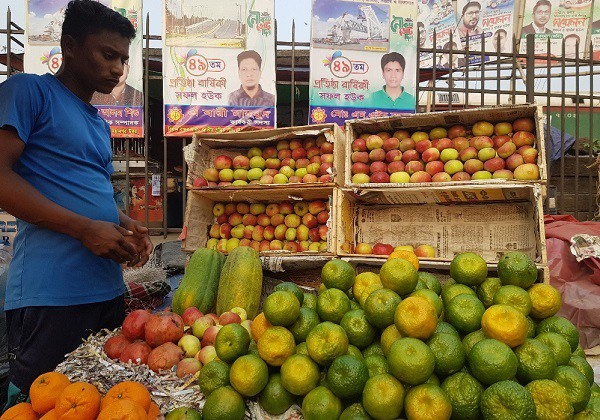
Fruit stall in Dhaka, Bangladesh
Fresh trade is risky business
International trade is risky: FPEF has a list of over 300 entities red-flagged for fraudulent behaviour; certain countries like Bangladesh, Dubai, and Saudi Arabia feature repeatedly. Some South African fruit exporters have lost millions to fraudsters. FPEF would also be the port of call for those who believe they've been defrauded by a South African exporter or who wish to verify the good standing of one.
Before being allowed to join FPEF, an exporter needs to be nominated by two existing members, and all directors, plus the company, must be subjected to extensive credit checks.
All exporters (unless they only export their own product and no one else's) are required by law to be registered with the Agricultural Products' Agents Council, APAC, and once a year, FPEF and APAC reconcile their member lists to track down those – and there are some – who export third-party product sans APAC registration. APAC manages a fidelity fund to compensate farmers' losses caused by dishonest agents.
An independent panel of mediators (FPEF pays for the first mediation session) exists for disagreements between parties.
 © Carolize Jansen | FreshPlaza.com
China's tariffs to reduce over years
Obtaining formal admission to a market is, however, only the start of a long road, De Jager observes. "With many of the new target markets into which we're putting a lot of effort, South Africa has no trade agreement, countries like India, China, Vietnam and Indonesia."
China's announcement that from 1 May 2026, it would be scrapping trade tariffs is welcome, but De Jager cautions that it doesn't mean overnight there will be a zero percent tariff on the country's fruit exports. "We welcome the agreement, but one needs to carefully scrutinize the extensive tariff lines. Certain lines will have no tariffs from the start of next month, but very few. The tariff on South Africa's citrus, for example, will only be phased out over a decade, other trade lines over five years, some over two years."
The other side of the coin, he points out, is reciprocity: what will South Africa agree to in exchange? This decision will likely encompass all economic sectors, not only fresh exports, and is being considered by the Department of Trade and Industry.
The tariff upon entering the US market is, fortunately, not 30% anymore, but a blanket 10% on all imports, levelling the playing field for South Africa with regard to countries like Chile. Certain fruits, like oranges and mangoes, were fully exempted from any tariffs, and industry is engaging the US to expand that list. The African Growth and Opportunity Act (AGOA) has been renewed for another year, with South Africa included.
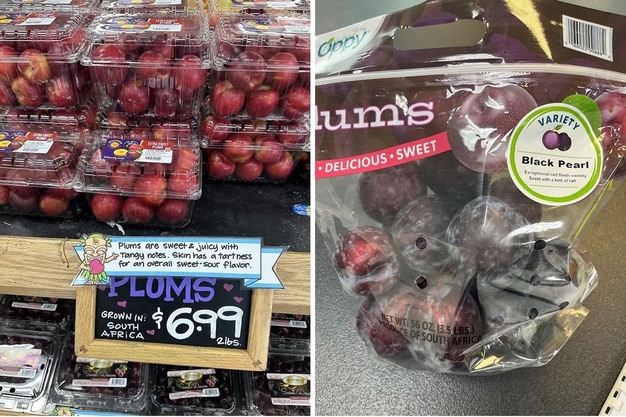 © RubiscoSouth African plums sold in the USA (February 2024)
For more information: Piet de Jager
Fresh Produce Exporters' Forum
Tel: +27 75 411 1378
Email: [email protected]
https://www.fpef.co.za/