Despite volatile exchange rates, rising production costs, climate variability, and a growing web of certification requirements, Costa Rica's banana industry can draw on robust institutional frameworks, seasoned producers, and a hard-earned reputation for sustainability. For Grupo San Alberto, challenges are also opportunities — to invest in efficiency, build resilience, and keep pushing product quality forward.
 © FreshPlaza
Nearly half a century ago, five former Chiquita employees had the vision to transform a stretch of cacao land in the Siquirres region into a banana farm. What they founded then is today Grupo Bananero San Alberto, a family business with close to a thousand hectares under cultivation.
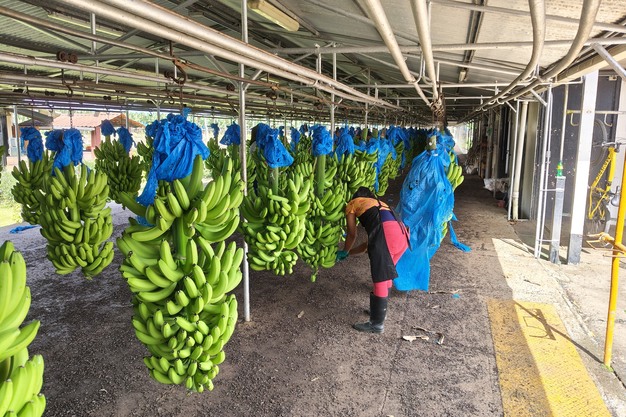
The group produces around 56,000 boxes of premium fruit per week — roughly 2.9 million a year. Adding second-grade fruit, the total annual output comes to around 3.5 million boxes. "Every single one is exported; nothing stays in the domestic market," says Alberto Pastor, a third-generation family member and chairman of the board.
 © FreshPlaza
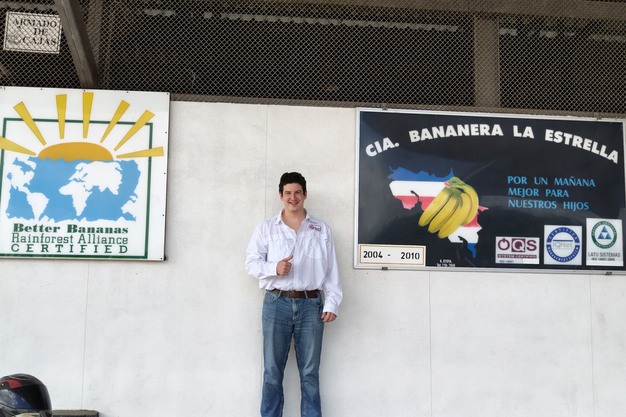
Alberto Pastor, a member of the third family generation and chairman of the board.
The two main destinations are the United States and the United Kingdom. In the US, Walmart is by far the largest individual customer, accounting for roughly half of total volume; in the UK, Morrisons serves as the key retail partner. For distribution across the rest of Europe, the group works through intermediaries. The product is exclusively the Cavendish banana.
The certification squeeze
Running a banana operation in Costa Rica today means navigating an ever-thickening tangle of compliance requirements. "One of the biggest hurdles we've faced lately is that distributors keep demanding more and more certifications. They want their bananas certified in a thousand different ways to prove to consumers that it's all fair trade, that they're green bananas, that we're doing right by the environment. All of that is fine — we share those goals. But at the same time, nobody wants to pass that cost on to the customer. And that's what keeps margins razor-thin."
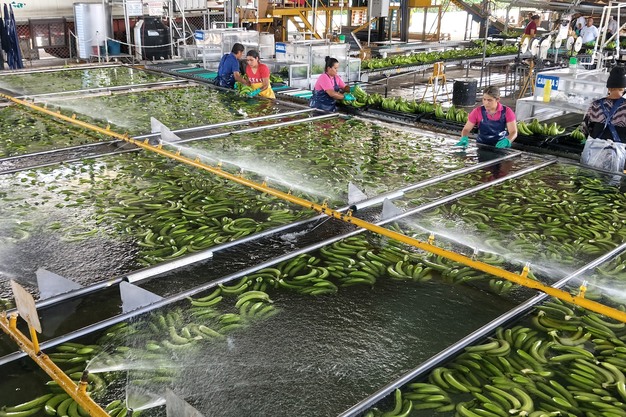 © FreshPlaza
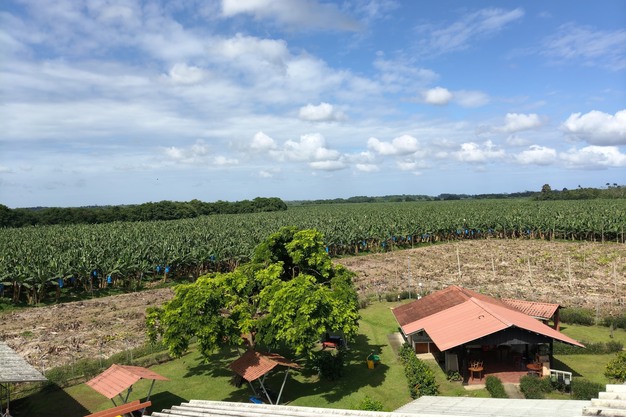
The domestic economic environment only adds to the pressure. The exchange rate has been unfavorable for exporters, with the Costa Rican government perceived as more inclined to favor imports. Fertilizer costs, shipping expenses, and steep fees at the new port have all pushed the cost base higher. Geopolitical factors — oil prices, the war in Ukraine — have piled on further strain. And looming over all of it is regional competition: Guatemala, Nicaragua, and, above all, Ecuador are expanding their banana acreage while operating at lower production costs. "Ecuador sets the price of fruit in this part of the world," Pastor acknowledges. Costa Rica has no choice but to compete on quality and efficiency, not volume.
On the labor side, "people just don't want to work on banana farms anymore," Pastor notes. The group has made a deliberate choice not to cut wages, as some competitors have done. "We put the worker first." He points to the visible drop in staff morale at some multinationals that have gone down the road of aggressive cost-cutting. Grupo San Alberto employs around a thousand people in total — roughly 250 per farm and 15 at the head office — and Pastor makes no secret of his pride in keeping that management structure lean.
 © FreshPlaza
Disease control with an iron fist
On Black Sigatoka — the leaf fungus that attacks banana plants and dents yields — Pastor describes a methodical, no-nonsense approach. "The key with Sigatoka is consistent upkeep." The group removes three or four banana hands to speed up ripening and allow for an earlier harvest. Leaf removal and hand trimming are carried out systematically by hand, supplemented by aerial spraying.
The contrast with larger competitors is telling: by cutting staff, some companies end up spending more on aerial applications at higher chemical doses. "When you're working with constraints, you get more creative," Pastor observes.
On Tropical Race 4 — the soil fungus threatening Cavendish bananas worldwide — the group is on high alert. "We've invested heavily in biosecurity. We still have a way to go, but it's very much part of our efforts."
 © FreshPlaza
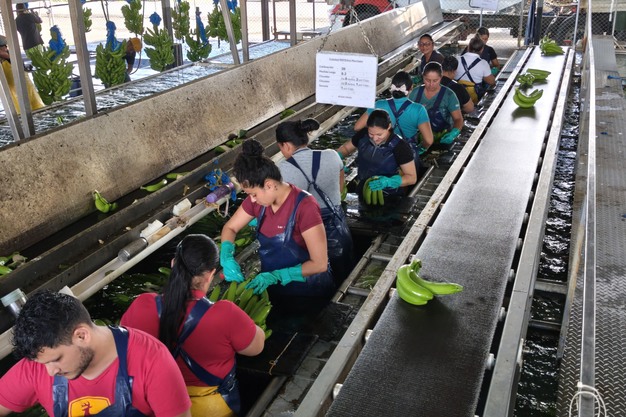
On soil health, Pastor is unequivocal: Grupo San Alberto stopped using herbicides more than 30 years ago. "Everything is cut and left in place. That's a sacred rule for us." The principle is simple: "The soil is king."
Three bets on the future
Pastor outlines three strategic lines of growth. The first is physical expansion: acquiring or developing additional land close to existing operations. The second is banana by-products. In collaboration with the food technology center at the University of Costa Rica, the group is exploring banana flour and, potentially, a banana-based drink. "These are prototypes, obviously," he is quick to add, "but it's a direction we want to pursue."
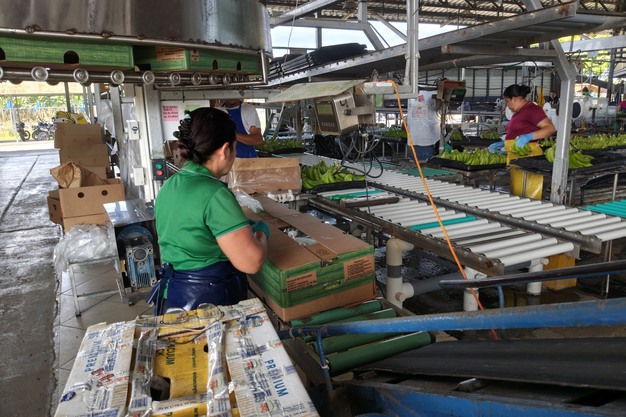
The third, and perhaps most significant, is technology, particularly in the packing plant. Pastor sees enormous potential in camera recognition systems capable of detecting quality defects that are invisible to the naked eye when the banana is still green. Latex scarring and abrasion damage, for instance, only show up in the later stages of ripening, often by the time the fruit has already reached the market. Working with Corbana, the national banana corporation, the group is testing systems that allow fruit to be graded with greater precision, ensuring that only the best makes it into the export boxes.
 © FreshPlaza
"If we don't go down this road, whoever is cheaper than us will win the war," Pastor warns. "If you can't win on size, you have to win on smarts."
More than a business
Grupo San Alberto is more than a commercial enterprise. It is a community, according to Pastor. "With between 900 and 1,000 direct employees, and many more families who depend on them indirectly, every banana sold carries real social weight. Any buyer or distributor has to understand that they are not simply purchasing a piece of fruit; they are contributing to the livelihoods of an entire community. Banana farming is one of the most labor-intensive forms of agriculture in Costa Rica, with one of the highest worker-to-hectare ratios in the sector. That is not a weakness. It is a story worth telling."
A family business
Grupo San Alberto was founded in 1979 on converted cacao land, following the introduction by the Costa Rican government of credit schemes to encourage banana cultivation. Today, the Pastor, Lacombe, and Herrera families remain at the helm. In 2025, a fourth farm — called Fama, in Siquirres — was added to the portfolio, bringing total production area to close to a thousand hectares. Each farm manages its own packing line and administrative structure, but Grupo San Alberto functions as the unifying backbone. "We can negotiate as a bloc," Pastor explains. "We have economies of scale when it comes to buying inputs."
The group holds a range of certifications, including Rainforest Alliance, GlobalG.A.P., SMETA, and Walmart Chain of Custody.
For more information:
Alberto Pastor Peralta (president)
Grupo Bananero San Alberto
San Alberto Nuevo, Siquirres
Limón (Costa Rica)
Tel.: +506 2103 8350
[email protected]
www.gruposanalberto.com