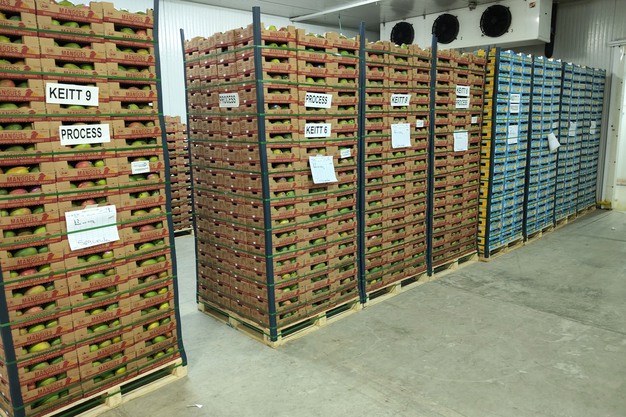
Costa Rica's mango export season, which runs from February to May, tries to fill some gaps between the Peruvian and Mexican seasons. Manga Rica, a grower-exporter, splits sales roughly 50/50 between the U.S. and Europe. "This season, supply disruptions in Peru, Brazil, Ecuador, and Nicaragua intensified buyer pressure," general manager Andrés Medina says. "Easter demand further boosts urgency. Our main varieties are Keitt, destined principally to Europe, and Tommy Atkins, shipped dominantly to the U.S."
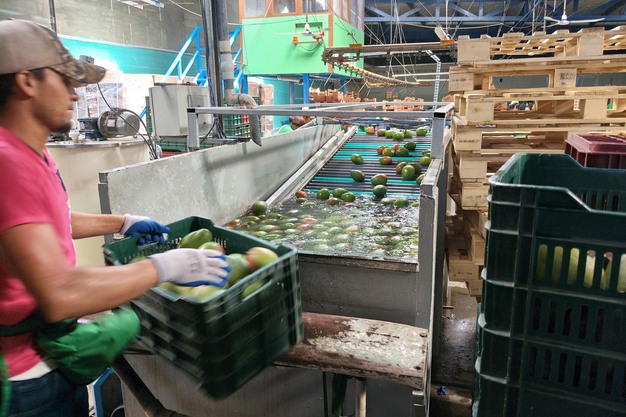
There is one sentence that Medina likes to use when he describes his company's position in the global mango trade: "If you eat a mango in the United States coming from Costa Rica, it is coming from us." Manga Rica is the only mango exporter in Costa Rica accredited to send fruit to the U.S. market via the mandatory hot water treatment process, by which mangoes are submerged in hot water for 75–90 minutes to eliminate quarantine pests, mainly the fruit fly. An on-site USDA inspector ensures compliance. "And we're responsible for roughly 90% of all Costa Rican mango exports," Medina states.
 © FreshPlaza
Filling the gap between Peru and Mexico
Manga Rica farms 517 hectares in the Guanacaste region, the only area in Costa Rica, Medina says, with the right conditions to grow mangoes commercially. The climate is decisive: hot days, cool nights, and crucially, low humidity. "The enemy of the mango is the humidity," he explains. "If you have humidity, the mangoes get fungi problems." That dry-heat combination naturally triggers flowering and keeps fruit healthy through to harvest.
The export season runs from February to May. Costa Rica positions itself in the window between the Peruvian and Mexican seasons. "We try to take advantage of that window, because prices get up a little bit," Medina says. "We don't compete with the big volume from Peru or Mexico; we try to move depending on whether the Peruvian or Mexican season is delayed."
Competing on volume is a mission impossible, as the Faostat figures make clear. In 2024, Mexico — the world's fifth largest producer — harvested 2,650,034 tonnes of mangoes. Peru, ranked 23rd globally, also leaves Costa Rica far behind with a production of 335,656 tonnes versus just 29,487 tonnes. In 2024, Mexico was the largest exporter with 442,291 tonnes, while Peru ranked sixth with 177,866 tonnes.
 © FreshPlaza
Manga Rica's annual production averages around 7,000 tonnes, though it varies year to year. The variety breakdown is approximately 40% Keitt, 35% Tommy Atkins, and around 15% Ataulfo, with small quantities of other local varieties. The split is market-driven: Keitt goes primarily to Europe, where fiber-free mangoes dominate consumer preference. "It is very difficult to sell Tommies in England, in France, in Holland," Medina notes. Tommy Atkins, meanwhile, has a traditional following in the United States, though American consumers are increasingly warming to Keitt as well.
Easter pressure and a favourable market
Mid-March, Manga Rica found itself in an unusually strong market position. Peru had been disrupted by heavy rainfall in the north, Brazil had experienced crop problems, and supply from Ecuador and Nicaragua was also constrained. With multiple key origins running short simultaneously, buyers were scrambling. "This week, people have been pushing hard to get mangoes for Easter," Medina says.
The company's market split between the U.S. and Europe hovers around 50/50, though it fluctuates depending on pricing and supply conditions. Customers include major retailers such as Tesco, Marks & Spencer, Aldi, Lidl, and Jumbo. Canada is a logical next step; no hot water treatment is required, but for now, existing clients in the U.S. and Europe absorb all available volume. China remains inaccessible: "For China, we need protocols between China and Costa Rica. They are not done yet." Japan is another market Medina is actively lobbying for: "I'm trying to push the government, because sometimes what happens in the United States with tariffs, it was terrible for us. We need to look for other options."
 © FreshPlaza
No room to grow, so growing smarter
One of the most significant structural constraints facing Manga Rica is the inability to acquire more land. Guanacaste has become one of Costa Rica's premier tourism destinations, and land prices have risen sharply as hotels and resort infrastructure gobble up available plots. "The cost of the land is too expensive. This is a tourism area. People invest in hotels and different infrastructure, only for tourism." Expanding the farm footprint is, in practical terms, off the table.
Instead, Medina is squeezing more out of the 517 hectares he already has. Historically, trees were planted at 10-by-7 metre spacing, standard practice 30 to 35 years ago. He is now cutting older, oversized trees and replanting at tighter densities, increasing the number of trees per hectare. "This is the way we are increasing every year," he says. A parallel initiative involves an innovative crop management, which has cut the time from planting to first production from five years to three, a meaningful gain in capital efficiency.
Mechanised pruning has also become a priority. Reducing tree height not only improves fruit quality and colour, but it also makes harvesting cheaper and more efficient. "If you reduce the size, you are able to get more branches. If you have more branches, you get more flowers." From 7,000 tonnes today, Medina's target is 10,000 tonnes within six years, achieved on the same land through improved methods and higher planting density.
New varieties: Possibilities and limits
Manga Rica is currently trialling 10 hectares of Kent under a system developed with Brazilian consultants, using hormones and specific agronomic management to induce flowering in an environment that is not naturally ideal for the variety. "Kent is very well known in Europe; it's the most popular. We are trying to manage it in an alternative way to produce Kent here."
Palmer is a variety that Medina is more ambivalent about. The farm has productive Palmer trees, but market reception has been inconsistent. The size is sometimes not big enough for U.S. buyers. Ataulfo presents a different challenge: introduced from Mexico on 18 hectares, it produces excellent fruit in terms of taste, but yields are below Mexican standards, and more than half the output falls into small sizes for which the U.S. market has limited appetite. "Mexico ships massive volumes. We can't compete with their costs." Much of the Ataulfo production is sold domestically.
Labour shortages
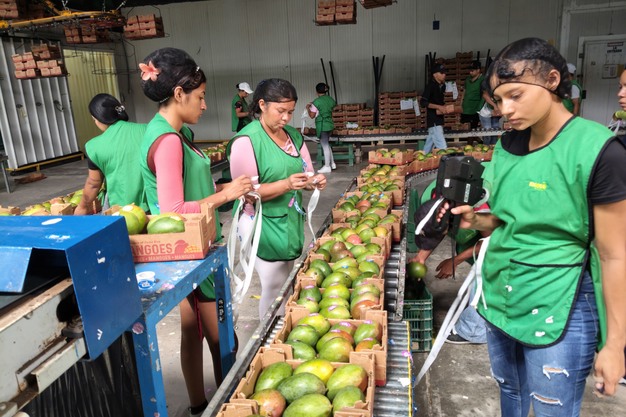
Manga Rica employs around 70 permanent staff year-round and scales up to more than 600 workers during the season. Recruiting that seasonal labour force is becoming increasingly difficult, squeezed from two directions at once. On one side, the construction boom driven by tourism in Guanacaste offers competing employment, often at better wages than field work. On the other hand, the emigration of Nicaraguan workers to the United States has dramatically shrunk the pool that Costa Rican agriculture has traditionally relied on.
To hold onto workers, the company has had to raise wages and, in some cases, provide housing and food during the early weeks of the season. Approximately 40% of seasonal workers are Costa Rican, but recruiting locals for field labour gets harder every year. Medina is also trying to capture workers transitioning out of the coffee harvest, which concludes around the time the mango season begins.
 © Manga Rica
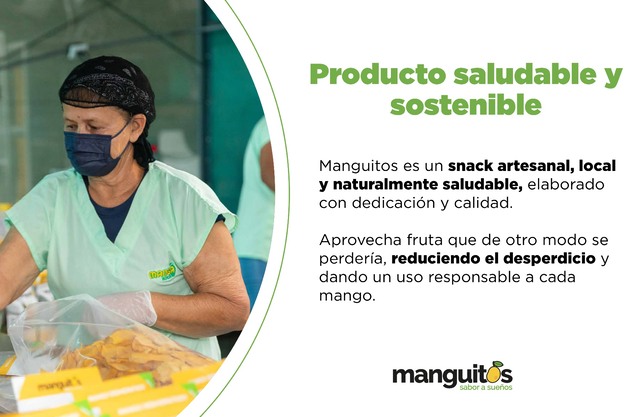
Manga Rica also runs a meaningful social initiative called Manguitos. In the Guanacaste region, where one in three people lives in poverty, many women depend solely on seasonal harvest work. Manguitos gives them stable, year-round employment by producing artisanal dried mango snacks, made from fruit that would otherwise go to waste. The project targets single mothers in particular, offering them a reliable income and a real path out of poverty.
Strong colón
Fruit destined for Europe and the U.S. East Coast ships from Puerto Limón; a small volume for the U.S. West Coast goes via Puerto Caldera, about two hours away. The transit time to Miami is only four to five days, a significant competitive advantage in terms of fruit quality on arrival. That speed is part of what makes the Costa Rican window attractive to buyers who want fresh, consistent product.
Cost pressures, however, are real. Rising fuel prices feed through into farm operating costs — tractors, diesel, internal transport — and into shipping rates. There is also a more structural challenge: the strengthening of the Costa Rican colón against the U.S. dollar erodes export revenues in local currency terms. "That affects us a lot, it's a very big impact," Medina says.
One farm, one standard
One of Manga Rica's most compelling selling points, in Medina's view, is the uniformity of its product. Because the entire operation is a single contiguous farm — the furthest point being 40 minutes away by tractor — management conditions, ripening schedules, and harvest timing are tightly controlled. The contrast with competitor origins is stark. "In a container of other areas of origin, you might get 10 different growers, different maturity stages: a mix. In our case, the consistency is what the market pays for. If you put 22 pallets in a container, everything ripens at the same time."
About Manga Rica
Manga Rica is a 100% Costa Rican mango company with various shareholders, among which is also the Montecristo group, a diversified conglomerate with a presence in multiple sectors, represented by businessman Francis Durman. The company holds GlobalGAP, SMETA, Rainforest Alliance, and LEAF certifications. The latter two bear witness to a robust sustainability programme, with solar energy playing a central role in the company's production processes.
 For more information:
Andrés Medina (general manager)
Manga Rica
Barrio La Cruz, Liberia
Guanacaste (Costa Rica)
Tel.: +506 2666 4744
[email protected]
www.mangarica.com