Costa Rica is a well-known player on the world market for pineapples and bananas, ranking first and third, respectively, among global exporters. But its export basket extends well beyond those two crops, encompassing root and tuber vegetables, melons, watermelons, mangoes, and a range of other tropical fruits. Over the next three weeks, we will be introducing around fifteen companies from the sector.
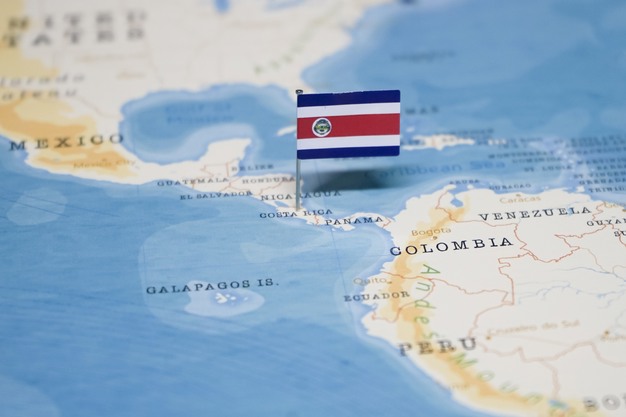
Costa Rica sits on the Central American isthmus between the Caribbean Sea and the Pacific Ocean, giving it a distinctly maritime character with roughly 1,290 kilometres of coastline. It borders Nicaragua to the north and Panama to the southeast. Around 60% of its territory is forested. The terrain is highly varied: several mountain ranges run through the country, and the highest point is Cerro Chirripó at 3,820 metres. There are also around 200 volcanoes, five of which remain active.
The climate is predominantly tropical, with relatively stable temperatures year-round, though two distinct seasons shape the calendar: a dry season from early December to late April, and a rainy season from early May to late November. Significant differences in altitude, combined with the close proximity of mountains, valleys, and lowlands, create striking regional climate variations within a relatively small area.
 © ID 140228159 © Hyotographics | Dreamstime.com
People and economy
In 2022, Costa Rica had just over 5 million inhabitants, with Spanish as the official language. Life expectancy stands at 81 years (2023), according to World Bank data. Economically, GDP per capita amounts to $18,587 (2024). Digital connectivity is high, with 85% of the population online.
Costa Rica is a presidential republic. Its first female president was elected in 2010, and the current head of state is Rodrigo Chaves. One particularly striking feature is the gender balance in parliament, where 49% of seats are held by women. Politically and economically, the country ranks among the most stable in Latin America. In the Economist Intelligence Unit's Democracy Index, Costa Rica places 18th out of 167 countries, ahead of no fewer than 20 EU member states. Despite this stable democratic track record, the country has in recent years been grappling with a problem that plagues much of the region: drug-related insecurity.
The economy is primarily driven by the services sector. Since the early 2000s, tourism has generated more foreign exchange than the main traditional agricultural export products — bananas, sugar, cocoa, pineapples, and coffee — though exports of medical equipment and IT services have grown even larger. The economy expands at around 4.3% per year, and unemployment stood at 6.9% in 2024. Agriculture, forestry, and fishing account for 3.6% of GDP (2024).
 © ID 37242006 © 9comeback | Dreamstime.com
Pineapple
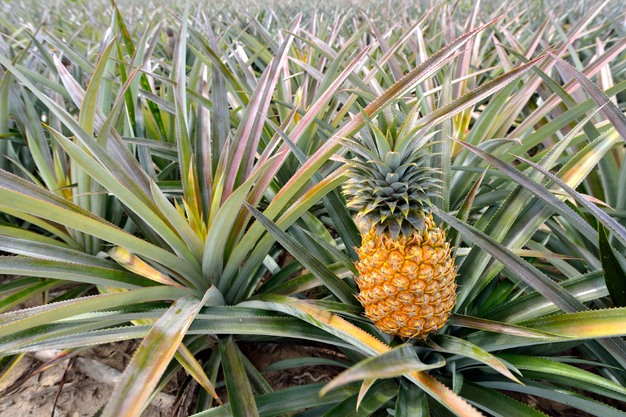
According to Faostat, the statistical service of the UN Food and Agriculture Organization, Costa Rica is the undisputed world leader in pineapple exports, with a value of €1.14 billion in 2024. Although it accounts for only 10% of global production — a ranking it also tops — it controls 49% of international trade in this fruit. The Philippines follows at a considerable distance (€361 million; 15%), with around sixty other countries each accounting for less than 2%. Just over 53% of Costa Rica's pineapple exports went to North America in 2024, while 36% were destined for the EU, according to TradeMap figures. A remarkable 86% of all pineapples imported by the EU originate in Costa Rica.
Banana
In the global banana export market, no country comes close to Ecuador, which commands a 24% share of world trade with exports worth €2.82 billion. Behind Ecuador, Costa Rica is second only to the Philippines, with both countries — along with Colombia and Guatemala — each accounting for around 9% of global banana exports. This underlines Costa Rica's strong export orientation, given that it ranks only 14th in terms of production. Around 47% of its exported bananas were shipped to Europe and 30% to North America, with the remainder fairly evenly distributed across Asia, the Middle East, Africa, and the region itself.
Costa Rica supplies just under 18% of all bananas imported by the EU, behind Ecuador (34%) and Colombia (24%). Other origins — including Ivory Coast, Guatemala, the Dominican Republic, Cameroon, Peru, and Panama — all remain below the 5% threshold. According to a report by international trade and data platform Tridge, 87% of Costa Rica's banana supply chain was in the hands of Dole Food Company, Del Monte Fresh Produce, and Chiquita Brands in 2021.
Root and tuber vegetables
At the most recent Fruit Logistica in Berlin, Procomer — Costa Rica's foreign trade promotion agency — coordinated the participation of fifteen export companies. They showcased a diverse range of fresh produce, including MD2 pineapple, coconut, papaya, squash, and chayote, alongside root and tuber crops such as sweet potato, ginger, cassava, yam, malanga, and taro.
According to Eurostat figures, Costa Rica's fruit and vegetable exports to the EU in 2025 were dominated by pineapple (€691m) and banana (€640m). Further down the list came cassava (€58m), watermelon (€42m) and melon (€22m), followed by taro (€5m), yam (€3.5m), mango (€1.6m), plantain (€1.5m), tayer (€1.1m), coconut (€1m), carrots and turnips (€0.7m), squash (€0.5m), sweet potato (€0.2m), other tubers (€2.8m), nuts and tropical fruits (€0.1m) and other tropical fruit (€0.3m). Overall, Costa Rica's fresh produce exports to the EU have grown by 28% over the past five years.
Logistics and shipping connections
Maritime transport to the U.S. East Coast and Europe is handled through the port of Limón. Transit times are highly competitive: just four days to Miami, around ten days to the northeastern United States, and between 13 and 15 days to the UK, Antwerp, and Rotterdam, all served by direct connections. For the U.S. West Coast, cargo is moved via feeder service to the port of Balboa in Panama, where it connects with the main service to California — a total journey of approximately two weeks.
Export and import figures for fresh produce are sourced from Faostat, TradeMap, and Eurostat.