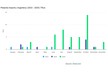
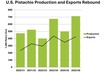
This Thursday is International Pistachio Day. According to the latest data from the Ministry of Agriculture, Fisheries and Food (still provisional for 2025-2026), Spain's pistachio production has grown significantly in recent years, going from 8,210 tons in 2018-2019 to 42,374 tons this season. This year, production jumped 73.6% from the previous year and is 140.7% higher than the average.
Castile-La Mancha ranks first among autonomous communities with nearly 20,000 tons, followed by Andalusia, which expects a 131% increase in production compared to last season, and Aragon, according to the same official report.
The production growth is mainly attributed to new plantations coming into production and the gradual ripening of existing ones. Salvador García, the Managing Director of Víridi Horizons, states that this trend is clearly upward. While Spain remains a minor participant in the global market, pistachio cultivation presents opportunities beyond just domestic consumption.
In this context, the company has established a laboratory focused on promoting pistachios as an industrial ingredient. Currently, only about 10% of national production is used for processing into ingredients, leaving room for growth in the European pistachio paste market, estimated at approximately 30,000 tons annually.
The company states that developing a national paste with full traceability and no additives would enable it to compete in quality with imported products, especially those from Italy, and enter higher-value markets.
As production has increased, pistachios have also become more popular with consumers and are now commonly found on supermarket shelves and in restaurants.
Beyond its commercial aspect, the crop is increasingly seen as a means to combat depopulation. David Soler, leader of Pistachyde in Tembleque (Toledo), emphasizes that pistachios help maintain population levels in rural regions. The company oversees the entire value chain locally, from cultivation to marketing.
Soler emphasizes the importance of the immigrant population in the primary sector, especially in this crop, viewing it as an essential group for rural areas. The company's model relies on direct participation at all stages and a business culture focused on people.
Moreover, the activity associated with the pistachio nut benefits the local economy through initiatives like Terra Galega, a catering business in the area where this nut is also prominent.
Source: efeagro.com