In 1989, Jan van Bergeijk moved from the Netherlands to the Spanish soft fruit region of Huelva. He saw opportunities for early raspberry cultivation there. And so, the Dutch businessman introduced commercial raspberry farming to Spain. “When we produced our volumes, the market was not ready for them, and we did not know where to send the raspberries,” Jan laughs, reflecting on the past 30 years.
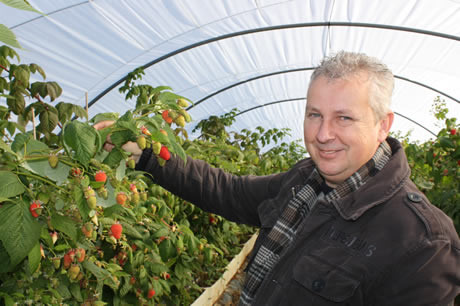
Since then, raspberry farming in Spain has grown, and now surpasses 2,000 hectares. There have certainly been years of growth, but this acreage has remained the same in recent years,” he says. “After all, production costs climb every year, which means it becomes increasingly difficult to end up in the black each year. I expect this will lead to growers falling away in Spain, and at some point, in Morocco too.”
Price recovery
In December, there were delays in the current season due to rain. “Production was high then, and prices were disappointing. In January, production fell, and prices climbed to normal levels again. In recent years, the demand at that time of the year was still low. However, this January, we saw a recovery in demand. Production lagged far behind consumption,” explains the grower.
“We do not have much competition from other countries at the moment. There was, however, a lot of Moroccan raspberries on the market in December,” says Jan, whose company forms part of the Plusberries group. This group is made up of six family businesses. They specialize in growing berries and early stone fruit.
They farm with these in the Spanish Huelva and Badajoz regions. They each specialize in a different product - strawberries, raspberries, blackberries, blueberries, nectarines, and peaches. Within the group, El Remolino Plusberries, Jan's company is responsible for the commercial production of raspberries.
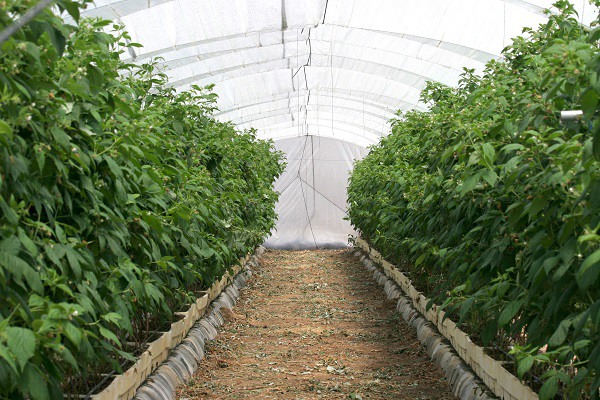
Greenhouse crops have higher cost prices
He is also not concerned with competition from Dutch and Belgian greenhouse crops. “Cultivating this product in a greenhouse costs more. That is a completely different segment to the one in which we find ourselves. It is certainly a trend to buy locally-grown products, but those grown in greenhouses will always fetch a premium price. I, therefore, doubt greenhouse production in the winter in Northern Europe is feasible. Cost price is becoming a sticking point for everyone. That is why, over the years, it has become less attractive to grow raspberries year-round.”
There are organic raspberries on the market, but according to Jan, that too is not a segment you can simply switch to on a large scale. “You are enormously volume-bound. If you produce too much, you will get a conventional price, and that does not cover this product’s cost price.”
Plusberries, just like many of its fellow companies, is busy introducing sustainable packaging. The environmental burden is not the point, though, according to Jan. “The end-user must correctly recycle the packaging; then the environmental problem is as good as solved. The issue is currently being laid at farmers’ feet. All our packaging is, however, recyclable.”

The Northwestern European market remains Plusberries’ most important sales region, with France, Germany, the United Kingdom, and Scandinavia as the primary markets there. “But, we do see that supermarket programs determine most of the trade. Day trading is becoming less and less important,” says Jan. “We incidentally do overseas exports too, but we are very cautious with this. Raspberries are not an easy product for far-off destinations. You also need a specific price, while there is ever more competition from local cultivation. We focus mainly on Europe.”
Going back to the Netherlands is also out of the question for Jan. “I have lived in Spain for 30 years now. When I left the Netherlands, Spain was still far, but the distance has become, figuratively, much shorter. I now visit the Netherlands often enough. But if I were faced with the same choice again, I would go overseas again in a flash,” concludes Jan.
More information
Frutas Remolino
Jan van Bergeijk
T +34 609 01 66 54
[email protected]
www.plusberries.com