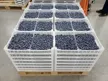
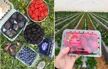
Good blueberry season in northern Spain
The current blueberry season is going well in Asturias. "The early varieties started with the Duke in June; currently, we are working with the Aurora, and the Central Blue will be harvested until late October / early November. This season is going well, with good weather and normal prices for the time of the year," says Juan Carlos García, director of Arándanos El Cierrón.
"This is good news for blueberries. We have had two years with poor harvests due to the impact of rainfall and lack of sunlight. Last season, the quality was lower, and there was also still fruit from northern Africa and southern Spain on the market when the season started. Then Poland arrived earlier. Normally, the Morocco and Huelva seasons end in June, when northern Spain starts, followed by Poland in mid-July. This overlap between campaigns took a toll on our market positioning," said the director.
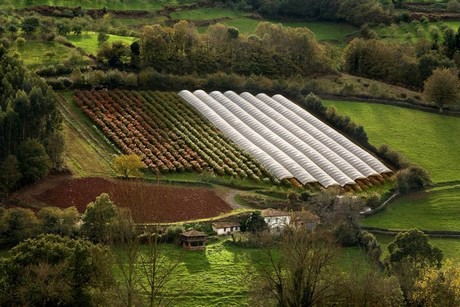
Small fruits: a market niche for Spain
While the firm is a blueberry specialist, it also grows other types of berries, including kiwi berry. "This is a crop that is grown in northern Spain and which has potential, since its harvest takes place earlier than in Central Europe. The north is the natural growing place for the product. The most demanded varieties are the early Ananasnaja and Geneva and the mid and late season Bingo and Scarlett," says Juan Carlos.
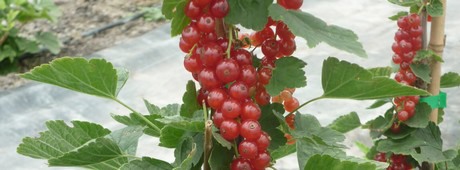
"Red currants are another emerging market niche. Our location is an ideal place to cultivate the crop. We start the season earlier than the Netherlands, around the end of May / beginning of June. The price of the Dutch red currants is higher, since we work with lighter structures and do not need heated greenhouses that entail high costs, as is the case in the Netherlands. The market gap is ideal. We are currently exporting to Italy, the UK, Portugal and Germany."
"If Brexit hinders trade, new channels will emerge"
"The demand for blueberries continues to grow on the national and international market. We are currently exporting to the UK, Scandinavia and the Netherlands. I have no doubt that new channels will open if Brexit hinders trade. Supermarket chains are, however, the greatest threat to this type of fruit, with import prices pushing down the prices of the rest of the harvest," said Juan Carlos García.
Juan Carlos García and his son Adrián manage the company with their 30 years of experience in the cultivation of blueberries and soft fruit. In addition, Juan Carlos is a technician at the Regional Department for Agricultural Research and Development (SERIDA, a leader in the cultivation of soft fruit and a global pioneer in blueberry grafting).
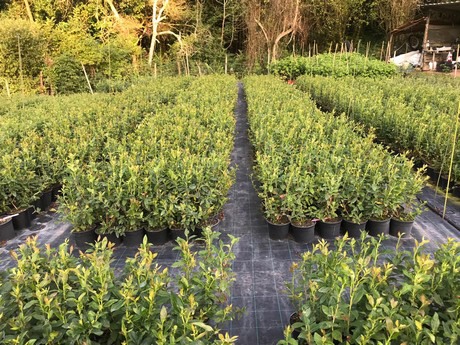
Ideal climate for blueberry cultivation
“The region of Asturias is the ideal place to grow blueberries; not only do we have the ideal climate, but we also have R&D and extensive experience in growing. The area used to be focused on dairy production and mining and only later discovered the potential of small fruit. Years of work and research have paid off," said Juan Carlos.
"From 2005, blueberry cultivation started to spread across the region. Much has happened since then. Blueberry consumption is no longer rare, but common. And the crop is now even more profitable and efficient thanks to the implementation of innovative techniques, such as the use of adapted substrate," he says.
"We develop plants in different sizes. The first stages of reproduction are carried out in the laboratory, with in vitro technology, which is more efficient than traditional techniques with cuttings. In the spring, they are planted in pots, where they remain for one or two years before being planted in the fields."
"We focus on two different sectors with our nursery plants. The small 1 and 2 liter pots are intended for professional growers, and the larger sizes, in 2 to 4 liter pots, are intended for supermarkets, garden centers and hobbyists. This sector is flourishing and offers the possibility of growing fruit quickly."
"The future of blueberries lies in increasing the crop's profitability "
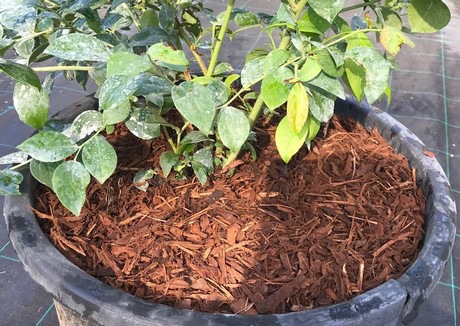
Blueberry growing is growing on par with the demand for nursery plants. For the latter, Costiña Orgánica produces an innovative substrate mixture. "To make the most out of this crop, the substrate is essential. A mixture of pine bark, peat and coconut ensures optimum oxygen circulation, which is vital for blueberries. These substrates retain sufficient water, but never too much," explains Óscar Guido, director of the company. He adds that "peat retains water and nutrients, coconut improves the oxygen supply to the roots and the tree bark protects the structure. Since peat is not a sustainable product, its presence is of secondary importance. It is possible for it to be replaced with soil and pine bark."
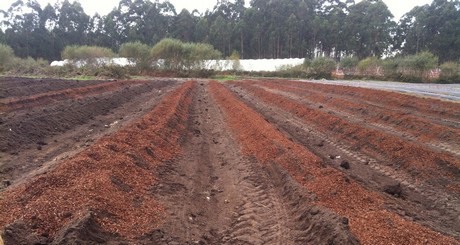
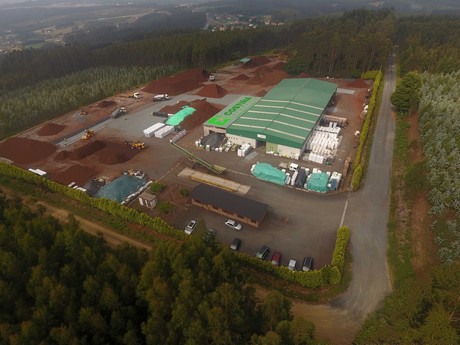
Costiña Orgánica is one of the few European companies with the FSC quality mark for bark. The selected bark, with an exact size of between 8 and 15 mm, without impurities, guarantees the integrity of the substrate's structure for longer. "The substrate ensures that blueberries will grow in a soil with the correct pH value. In some regions, it is impossible to grow directly in the soil, since it is an acidophilic plant and the roots are very thin, so it wouldn't grow, either because the soil is too firm or because of its alkalinity," says Óscar Guido. "Blueberry plants love pine bark, as this ensures a structural stability of the substrate and an optimal oxygen supply."
"We have also developed a mulch that helps control weeds without the use of pesticides. Biological control is the current and future trend. The mulch acts as a thermal insulator (against cold and heat), prevents evaporation loss and maintains acidity levels. These alternatives make it possible to save considerably on labor, which is a major expense in blueberry growing," concludes Óscar Guido.
More information:
Óscar Guido
Costiña Orgánica
Ctra. N634, km 707,5
O Pino, A Coruña. Spain
T: +34981518704
[email protected]
www.costinaorganica.es
Juan Carlos García
Arándanos El Cierrón
Les Vegues
33300 Villaviciosa, Asturias. Spain
T: +34985891560
[email protected]
www.arandanoselcierron.com