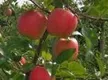
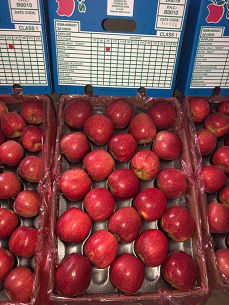
 On the farms Violet and Kransfontein, in the Witteberge mountains of the eastern Free State, apple producer Esias Scheepers has just finished a successful Royal Gala harvest (pictured right: FLASS Royal Beaut).
“By 20 February we have to be done with Royal Gala, otherwise the Cape is on us and prices fall drastically. We start around 15 January and then we have a window of three weeks before the Cape starts. There have been issues with colouring on apples in the Free State this season, with night temperatures staying at 16, 17, 18°C, but we’re in a depression, up against the mountains, where it’s a bit colder,” he says.
Even so, their Royal Gala exports are around 10% down compared to last year due to colour, meaning that they sent 40 to 50% of the harvest to the Far East this year. Larger apples go to the Middle East, some to the island of Mauritius and they sent their first shipment (which hasn’t yet arrived) to Russia this season.
Early Fuji apples
Taiwan has a fondness for Fuji, he notes, and happily they are able to grow the early Fuji strain Beni Shogun. “It only works in the Free State, it doesn’t colour in the Cape. Generally, varieties that colour up 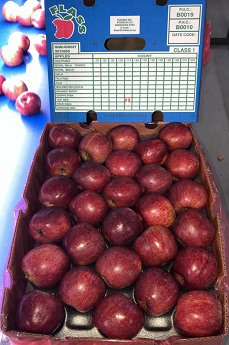 well in the Cape and the Langkloof, colour up even better here.”
Also in their orchards are Fuji Kiku and Fuji Suprema. The latter, he points out, is preferred in the Far East to the Kiku because its colour is more solid, less stripy.
Another unusual variety they are currently planting is the Romeo, marketed by Stargrow, which is a South African Top Red mutation, increasingly planted locally for the African market because it is a full dark red.
It is harvested at the same time as Top Red (pictured right), middle to the end of March.
Current cooler temperatures benefit Pink Lady colour
Apart from Royal Gala and Royal Beaut, another South African variety with even better colour than Royal Gala, they also have Pink Lady and Rosy Glow. “We focus particularly on the newer strains and Rosy Glow performs excellently here.”
He notes that, with unusually high temperatures experienced in the Free State during mid-summer, colour development on the Pink Lady is a concern, but over the past few weeks temperatures have come down, along with rainy weather last week and there’s still enough time for colour to come on par.
The Free State Pink Lady harvest starts in approximately three weeks, and then they’ll open the season’s exports to the EU and the UK, along with smaller volumes of Granny Smith for the EU.
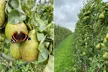
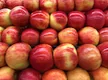
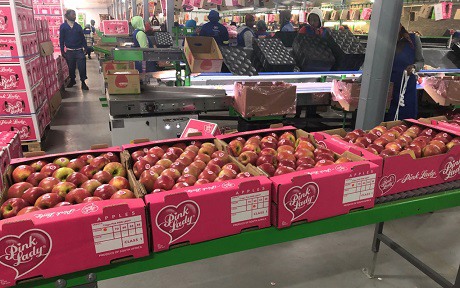 Pink Lady in their packhouse (photos supplied by Esias Scheepers)
“I’m not overly fond of Grannies, they tend to develop a blush, but we use it widely for cross-pollination. When my grandfather and my father started planting apples in this area in 1993 – they were some of the very first to establish apple orchards in the eastern Free State – they also planted Golden Delicious, but it’s not suitable to our area, for the same reason.”
This is a fifth-generation family farm – the apple’s brand name, FLASS, represents the initials of the four siblings – originally focused on livestock and grain. Apples currently make up a third of the turnover, but it’s a figure he’d like to push up to half over the next three years.
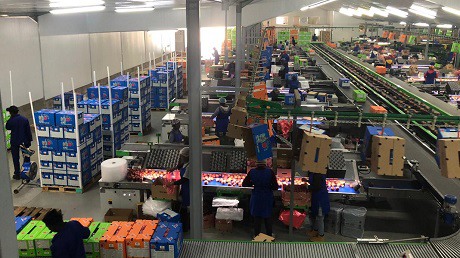
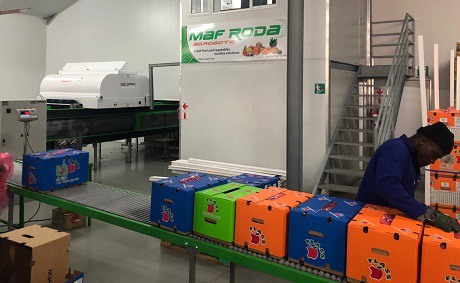
Nine years ago Esias took the helm of the apple division, which stepped up a gear in 2017 with the installation of a four lane Mafroda optic sorter, a piece of equipment of which he’s very fond. In the dust-free, clinical environment of their packhouse they pack a 100 tonnes of apples daily.
Every orchard covered, but only after risk of snow passes
Due to the ever-present threat of hail, every single orchard on their farm is covered by netting. Elsewhere in South Africa apple producers have encountered problems with excessive vegetative growth under netting, which can also hamper bee pollinating activity. Esias says that they have seen that vegetative growth can present a problem on old rootstock, like M7, but that (as trials in the Cape have shown) the dwarfing M9 and semi-dwarfing Geneva 202 rootstocks perform much better.
“We fold up the nets in April, in case of snow. We don’t get snow every year, but it’s a definite possibility in this part of the country. The risk of leaving the nets on during winter is just too large because the weight of snowfall can damage the construction. Just after full bloom we cover the orchards again.”
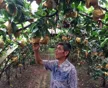
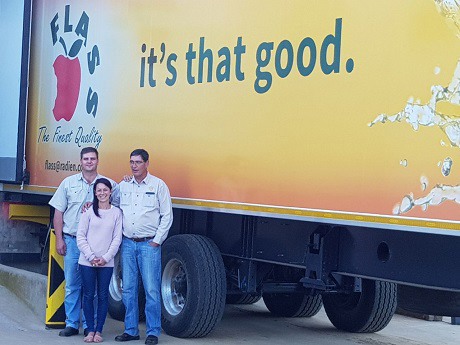 Esias, Adri and Fourie Scheepers of FLASS Apples
For more information:
Esias Scheepers
FLASS Apples
Tel: +27 83 469 4714
Email: [email protected]