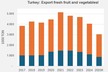
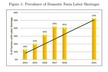
According to the Federal Customs Service of Russia, in 2014 the Russian Federation imported 9,068.2 thousand tonnes of fruits and vegetables, with China accounting for 9.6% of this amount. After the trade restrictions were put in place and the rouble rate fell sharply, the volume of imports of fruit and vegetable products declined. In 2016, the total volume imported dropped by a quarter, down to 6,696.01 tonnes, but the share of Chinese products increased to 11%.
The share of Chinese products was particularly noteworthy in the case of vegetables. In the first half of 2017, it reached almost 20%, and for some products, the figures are even higher.
The potential for China is huge. The country grows up to 60% of the world's volume of vegetables and 30% of fruits. For instance, the Chinese harvest about 60-70 million tonnes of potatoes, which is three times more than Russia's production. At the same time, the number of plants that are cultivated in the country is greater than in many other countries, thanks to the climate and the use of various technologies. China delivers its products to Europe, the United States, Latin America and Russia.
After the embargo was introduced, the Chinese confidently began to increase their presence in the Russian market for many types of products. The most tangible growth was recorded with tomatoes, where the share of Chinese products increased from 11% to 21%. As for courgettes and aubergines, the share increased from 11% to 24%; for carrots and edible roots, it rose from 16% to 26%, and for cabbage it grew from 25% to 39%.
For some specific types of products, China can almost be called a monopolist. The best example is garlic. According to the Federal Customs Service of Russia, China supplies almost 80%. In addition, China accounts for 38% of all imported asparagus and 28% of all imported peaches.
One of the main reasons for the growing popularity of Chinese products is their price. Local producers are ready to offer goods cheaper than their competitors from other countries. Moreover, the Chinese don't hesitate to use all sorts of fertilizers, growth stimulants and other chemicals, so they get not only record harvests, but also products that can be stored for months without any visible damage.
Source: konkurent.ru