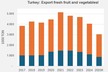
Up to September 2016, the EU's vegetable imports from third countries grew by 12% compared to the same period of 2015, totalling € 1,935 million, and fruit imports grew by 9%, totalling € 9,714 million, according to data from the European Bureau of Statistics processed by FEPEX.
In terms of volume, imports of vegetables from non-EU countries grew by 13% to 1.7 million tonnes and those of fruit grew by 7% to 9.6 million tonnes.
Tomatoes and green beans are the main vegetables bought by the EU from non-EU countries, with 358.6 million Euro for tomatoes, an increase of 12%, and 325.6 million Euro in the case of green beans (+3%).
The most imported fruits from non-EU countries are bananas, with € 2,584 million (+4.5%), table grapes, with € 908.5 million (-4%), grapefruit, with € 908.5 million (-4%) and avocados, with € 767.5 million (+52%). Also noteworthy were the imports of oranges, with € 495 million (+5%), pineapples with € 469 million (-0.2%) and apples, with € 457 million (-7%).
By country, the EU's main supplier of vegetables outside the EU is still Morocco, followed by Egypt, Israel and Turkey, with growth in all four cases. The value of the EU's vegetable purchases grew by 11%, to € 641 million; Egypt grew by 13% to € 159 million; Israel grew by 5% to € 158 million and Turkey by 29%, totalling € 141.3 million.
The main fruit suppliers in the period analysed were South Africa, Costa Rica and Colombia, with 5% growth for the first two countries, which reached € 1,372 million and € 959.5 million, respectively, and 1% growth in the case of Colombia, which reached € 69 million.
For FEPEX, the strong growth in the value of imports from third countries reflects the strong competition faced by EU producers and the ease of market access in the European Union compared to other markets.
Source: fepex.es