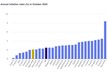
“We see various difficulties in the market,” the Russian starts. “The low oil price, the economic situation and the sanctions are the main causes. The economy is dependent on the oil price in an unhealthy way. Around 70 percent of the export income comes from oil and gas.” The energy sector is also worth half of the government budget.
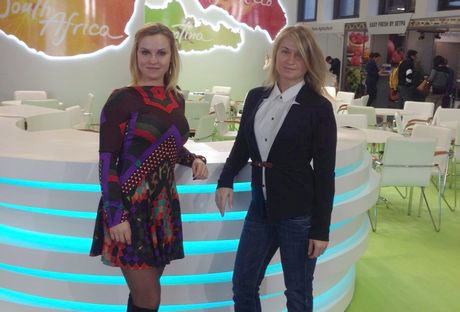
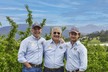
Ekatarina Kosheleva and a colleague at the Fruit Logistica in Berlin.
Boycott positive
In 2014 Europe enforced sanctions against Russia, in response to this Russia closed its borders to European products. “I can’t foresee the future, but I think it makes the sector stronger,” continues Ekatarina. “The situation stimulates development and thanks to good reserves Nevskaya has grown in recent years.”
“The boycott has had a positive impact on the sector,” according to Ekatarina. “It is especially negative for the European producers. We are hearing from Spanish companies that are firing people because they lost the Russian market and have to sell the products for bad prices.”
Income gap
For the Russian importer, with sales in the regions St Petersburg and Moscow, the consequences are limited. The company supplies around 80 percent directly to supermarkets, the other 20 percent is supplied to wholesalers. “We see that the volumes are lower for some products, but nothing has changed in the width of the assortment. Due to the high inflation the consumer is paying more attention to price and cheaper products are doing better. There is a large income gap in Russia, so there is still a small market for the exclusive products.”
With direct import from Morocco, Egypt, South Africa, Argentina, Chile, Peru and India, Nevskaya is avoiding the impact from the boycott. Turkey was also not a large supplier for the Russian business.
Capricious exchange rate
“For us the capricious exchange rate is the biggest problem,” explains Ekatarina. “It means we can’t predict the development of the currency, which is necessary for import. We prepare our sales prices two week beforehand.” A stable exchange rate would fix this problem. “Stability is more important than the height of the exchange rate.”
Nevskaya recently expanded with a business in Israel, which focuses on the export to Russia. The assortment was also extended with frozen products and tea. “We also built a new greenhouse in Krasnodar.”
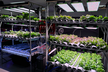
The Russian region plays an important role in Russia’s search for self sufficiency. “The region is developing quickly due to investments by private businesses and the government in greenhouses and agriculture. In the summer months Krasnodar can replace the import, but in the winter months it is impossible. We can’t be 100% self sufficient.”
More information:
 Nevskaya
Ekatarina Kosheleva
[email protected]
www.nevskaya-co.ru