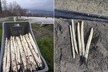
In some countries such as Colombia, Kenya, Malaysia, Thailand and Zambia, green asparagus is harvested throughout the year. In Peru, both white and green asparagus are harvested throughout the year. Ready to harvest spears (shoots) are approximately 20 centimetres in length with tightly closed tips. The young spears are the plant part used for culinary purposes.
Asparagus cultivars can be divided into colors. The two most commonly used asparagus cultivars are green and white. Within the green and white asparagus cultivars there are numerous commercial types. Green and white asparagus differ in color due to cultural practices used during field production. White asparagus is produced by covering the spears with soil and preventing biosynthesis of chlorophyl.
Asparagus is a highly perishable commodity due to the increased metabolic rate following harvest. It is essential to reduce the spears' core temperature to 0-2oC as soon as possible after harvested, preferably by hydrocooling or forced-air cooling and store at 0-2ºC. Failure to promptly reduce spears' core temperature and maintain it at optimal holding conditions will result in rapid deterioration which manifests itself as:
- Spear elongation, in which the spear continues growing and eventually bends upon contact with packaging top.
- Spear Toughening due to tissue lignification, which occurs when temperature increases and ethylene rate rises.
- Tip feathering, which is the opening of the tips, indicating senescence.
Decay is an important cause of asparagus spoilage. Soft rot bacterial decay is the predominant postharvest disease of asparagus and it is caused by the bacteria Erwinia caratovora var. caratovora. The bacteria digest the plant tissue, causing it to soften and eventually rot. While the entire spear is prone to soft rot decay, the tip and the butt are the most susceptible. Fungal decay, caused by molds may also take place, but is less frequent than bacterial decay.
Control of postharvest decay and physiological disorders is attained by accurate post-harvest procedures. These include washing of spears upon arrival at the pack house; and hydro-cooling. The water in the hydro-cooler must include a disinfectant according to the regulations in each country. Sodium hypochlorite (100 ppm) is a well known disinfectant and since its activity is pH dependent,, water pH should be monitored and kept at pH 6-7 during usage. Another disinfectant commonly used is Peroxy Acetic acid (80 – 150 ppm).
Packing of asparagus in StePac's Xtend Modified Atmosphere/Modified Humidity Packaging is advantageous in that the modified atmosphere that develops within the packaging alleviates most of the physiological disorders indicated above including decay development. With Xtend MA/MH packaging the shelf life of green and white asparagus can be extended up to 33 and 45 days, respectively (28 and 40 days in transit at 0-2ºC + 5 days shelf life at 10ºC, respectively). StePac's Xtend MA/MH Packaging for asparagus includes various formats for white and for green Asparagus. Each format is tailor-made to provide the asparagus spears with the optimum conditions for prolonged storage and shipment.
StePac offers Xtend packaging for asparagus in several formats:
1. Bulk: a single liner per box, normally for 5-10 kg.
2. Retail: pre-formed bag for 500 and 1,000 gr (printed or not-printed).
3. Super clear roll stock for flow-pack packaging (printed or not -printed)
For more information:
Andy Swersky
Fresh Produce Packaging
Tel +972 (0)4 9872131 ext 114
Mob: +972 (0)52 6440771
www.stepac.com