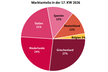
According to data made public at the Europech congress recently held at the Medfel Fair in Perpignan, European apricot production in 2026 is expected to reach 505,320 tons, 6% more than in 2025 and 4% above the 2020-2024 average.
The weather has been less problematic than in the previous year; however, there have been occasional frosts and very rainy conditions during the flowering, which will prevent the production from reaching its full potential.
At this point, only Greece will reach its normal production levels, which are clearly higher than last year.
The stone fruit sector's production potential is in a clear process of adjustment and transformation. Overall, there's a trend towards a long-term reduction in the acreage, especially in peaches and apricots.
On the whole, the sector is seeking to make up for this downward trend with greater productivity, higher quality, and more efficiency. The model that's consolidating is more intensive, more technified, and better adapted to increasingly demanding climatic and commercial conditions.
One of the most important changes is the acceleration of varietal change. Growers setting up new plantations are looking for varieties that are better adapted to current and future conditions, especially climate change. This means varieties that need fewer hours of cold, that are firmer, with a longer shelf-life and better post-harvest performance, and which better meet the market's demands. New products, such as platerinas and other varieties, allowing the commercial calendar to be extended, are also increasingly important.
In general, we are seeing a shift in the production calendar. Very early crops, which are more vulnerable to climatic risks such as frost and are more likely to suffer fruit set problems, are losing ground, and at the same time, there's a tendency to have the campaigns extended to later dates. The goal of this shift is to reduce risks and to better adapt to market needs.
The sector is moving towards greater technification. There's growing investment in protection, anti-hail nets, improved agronomic management, and systems that allow for higher productivity and quality. Still, this modernization is not homogeneous: some farms are investing and modernizing, while others are held back by the ageing of growers, a lack of generational replacement, and economic difficulties.
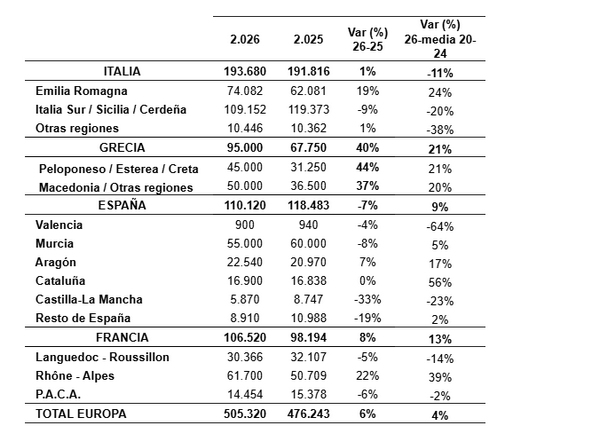 © Afrucat Forecast of 2026 apricot production in Europe. Source: Europech 2026.
Catalonia
In recent years, Catalonia has converted its apricot plantations to more productive varieties while keeping the same number of hectares planted, so production was expected to increase. However, this year's rain and wind have taken a toll on the pollination and fruit set, so figures remain at the same levels as last year.
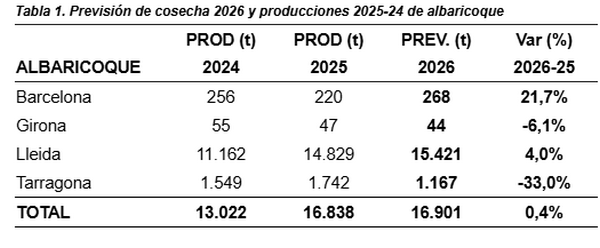 © Afrucat Table 1. Forecast of 2026 production and 2025-24 figures for apricot.
 For more information:
Afrucat
C/ Corregidor Escofet, 64
25005 Lleida, Spain
Tel.: +34 973 22 01 49
www.afrucat.com