Four vessels carrying South African grapes are set to arrive in Europe over the next two weeks, at a time when grapes are already heavily promoted, with prices reaching a low of €1.29 last week.
"You sell significantly more through promotions," says Nico Louw, head of marketing at EXSA. "The uplift can be very strong, sometimes up to three times normal volumes, but the question is whether this is the right strategy for selling table grapes into the European market."
Louw posits that in certain markets, the answer is yes; however, in the larger German market, the prices returned to growers are often insufficient to sustain long-term, viable farming. "This raises a broader concern about whether this represents the right kind of growth for table grapes in Europe, and what alternative market options exist in an increasingly competitive global environment."
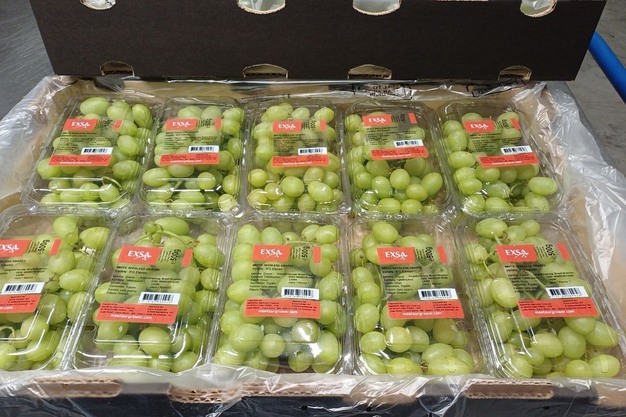 © EXSA
Sugar Crisp™ (IFG11) grapes
In Europe, much of the apparent growth has been driven by promotional activity, largely as a result of oversupply, mixed varieties, and borderline quality. This should not be viewed as true or sustainable growth. "Promotions can work well when they are properly planned in advance and aligned for both parties," he adds. "But they become problematic when they are used purely to gain market share, forcing the rest of the market to follow."
He explains that the percentage of grapes EXSA shipped to the UK five years ago - approximately 40% of the company's total volume - was the same as last year and is likely to remain unchanged this year. The UK shows stable growth, which underscores the matter of what the alternative growth options are.
The Far East loses some of its lustre
In the Far East, the picture is complex. It has not been a stable destination for South African grapes, with volumes declining year on year. "China has been a disaster for South African grapes over the past three years," he says. "The market is simply too volatile, with cherries being our biggest competitor during South Africa's grape supply window. In addition, China is increasingly producing its own grapes almost 52 weeks of the year, which is also having a knock-on effect on other Far Eastern markets."
Vietnam, a market historically willing to pay for premium grapes, and Malaysia have both lost some of their appeal. "We supplied exceptional grapes into Vietnam, but around three years ago, many non-specialist suppliers entered the market with inferior quality, which damaged the overall perception of South African grapes," he explains. Australia has since become South Africa's biggest competitor in Vietnam, benefiting from significantly lower import duties, shorter transit times, and consistently exceptional fruit. "Where we struggle to pack XXL grapes, they farm that size as a standard product."
China and Australia remain the main competitors in the region, with Peru also playing a role last year when fruit rejected from China was redirected into Vietnam.
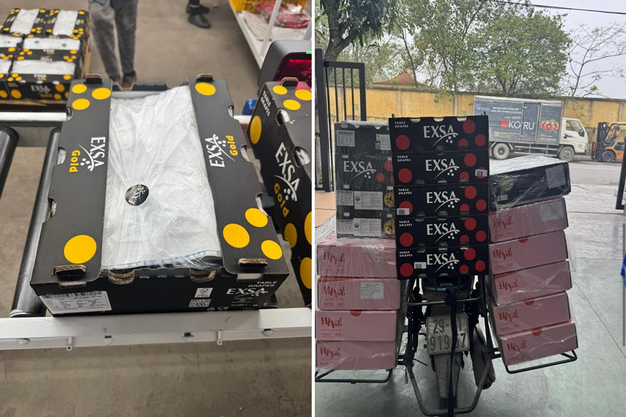 © EXSA
Right: EXSA cartons loaded up to be sold at a Vietnamese open-air market
"Malaysia is still a very good market," he adds, "but India is our biggest competitor on white grapes, putting pressure on prices with older varieties such as Thompson. It is only a matter of time before India becomes one of the major grape competitors South Africa will face."
Meanwhile, the Middle East, previously a relatively minor destination for South African grapes, has been heavily oversupplied this season, primarily with fruit from Limpopo. High rainfall in the region during December has driven volumes into the market, resulting in very low price levels.
Nothing but grapes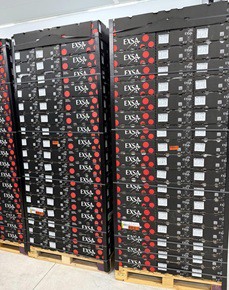 © EXSAEXSA was established almost thirty years ago, following the deregulation of the fruit trade by three grape-growing families: the Viljoens, the Laubschers, and the Jordaans. Today, the second generation has taken over the reins of the business, which remains a 100% table grape specialist.
EXSA is drawing on all its grape-growing and marketing expertise to navigate what has been a particularly challenging season. "We are targeting close to six million cartons this season, although it is a moving target—at times we are closer to just over five million," he says.
The company works directly with retailers in the UK and Europe, supported by offices in both regions that independently explore additional market opportunities. This integrated approach ensures that all fruit coming out of the vineyard finds a home. "Once we complete the South African season, we transition to Egyptian fruit for our Malaysian clients, with EXSA Europe extending the supply window into retail programmes ahead of the European season."
EXSA is also proud to be part of the Woolworths supply chain during the South African season, he says, calling it a partnership that helps growers maintain and invest in the best possible varieties.
 For more information:
Nico Louw
EXSA
Tel: +27 21 914 8280
Email: [email protected]
https://exsa.com/