The first table grape varieties, harvested since 17 December on the farms of JL Vlok Boerdery on the slopes of the Kasteelberg, have been in line with previous seasons. The impact of a very warm November is, however, expected to become more evident in the mid- to later varieties.
"The season started about a week earlier, and I expect it to be a short one," says Johan Vlok, CEO and director of JL Vlok Boerdery. "In this area, I anticipate a slightly lighter crop, with somewhat smaller berry sizes."
Grapes and citrus from the farms of JL Vlok Boerdery are currently delivered to their exporter, Suiderland Plase. The table grapes are primarily destined for the United Kingdom and Europe.
Vlok adds that some later grape varieties may be harvested two to three weeks earlier than usual. Together with ongoing logistics disruptions caused by persistent and often severe winds in Cape Town — which in turn affect surrounding ports — the industry should expect periods of congestion and potential bottlenecks in the grape supply chain.
He recalls a recent vessel whose loading at Cape Town's container terminal took more than fifteen days. "It's difficult to predict what will happen at the retail level," he says. "I expect an on-and-off situation. Wind remains a major problem; if it's too strong, vessels simply can't load."
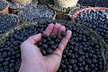
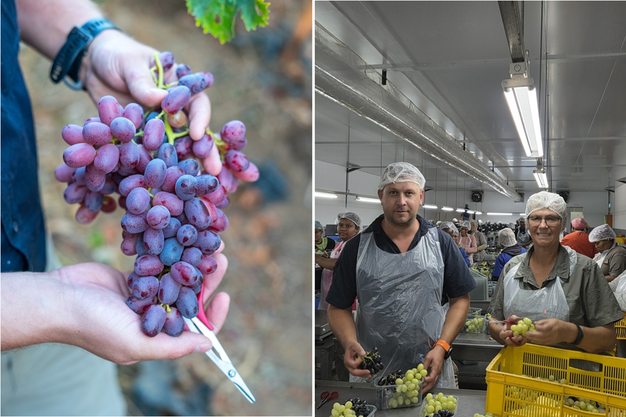 © JL Vlok BoerderyLeft: A bunch of Desire red seedless, a cultivar owned by JL Vlok Boerdery. Right: Johan Vlok, CEO, with Hannerie van Heerden, assistant packhouse manager
Bumper stone fruit catalogue
Stone fruit, which is even more perishable than table grapes, forms a significant part of JL Vlok Boerdery's production. According to Vlok, a wide range of stone fruit cultivars is grown on their farms, from older, established varieties to the latest selections.
"Our microclimate allows us to be two to three weeks earlier than anywhere else in South Africa with stone fruit," he explains. "We started harvesting on 20 September. We effectively open the stone fruit season locally, as well as for early programmes into the UK and Europe, with some volumes also destined for the Middle East."
The early plum season, however, has been under pressure, with market conditions proving more challenging than expected.
When asked whether table grapes or stone fruit are more profitable, Vlok says it depends largely on handling capacity. "With stone fruit, you have one day. If you can't pack it that day, it's gone. Table grapes give you a bit more time, and citrus even more so."
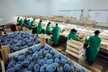
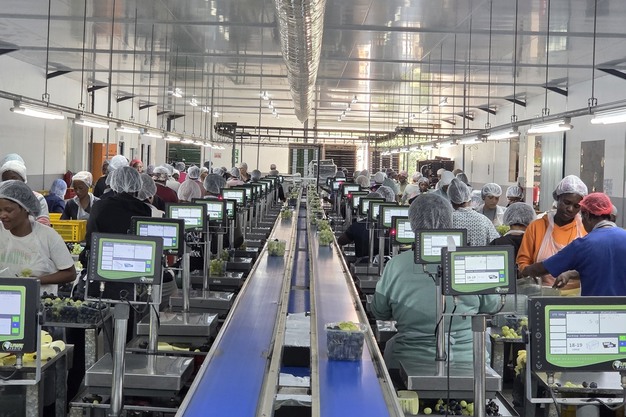 © JL Vlok Boerdery Packing mixed punnets in the Môrester packhouse, Riebeeck Kasteel
Only Red Globe likely to remain among seeded grapes
Seeded grape varieties have been removed on many farms, although the farms of JL Vlok Boerdery have retained limited plantings of Dan Ben Hannah and Alphonse Lavallée.
"The market for seeded grapes has become very small. But because so many producers have taken them out, it has actually become easier to find a market for the remaining volumes," he observes
"Seeded grapes are worth having, but not worth planting," he adds. "Consumers simply don't like seeds anymore. I expect seeded varieties to disappear almost entirely, with the exception of Red Globe."
Returns on seeded grapes are slightly lower than those for seedless varieties, and they require more labour in the vineyard. However, packing costs are lower, as seeded grapes are typically packed in 4.5kg cartons, compared with the more expensive punnet packaging used for seedless grapes.
In addition to fruit production, the farms of JL Vlok Boerdery also own their own cultivar Desire, which is a red seedless grape and is ready to harvest mid to late during the South African season. This cultivar is particularly favourable as it does not require the use of ethephon. The Desire cultivar is not new to commercial production, with several farms already in their second year of harvesting.
For more information:
Johan Vlok
JL Vlok Boerdery
Tel: +27 22 448 1433
Email: [email protected]