The Ecuadorian blueberry sector is growing gradually, with most production focused on the domestic market. "Ecuador produces high-quality blueberries, but it is not a volume-driven country," summarizes Álex Bustos Guerra, general manager of GreenControl- LA.
Data from the Central Bank of Ecuador show that blueberry exports gained prominence in 2022, totaling approximately 200 tons. In 2023, exports fell to 113 tons, but in 2024, exports surged to approximately 758 tons, valued at roughly $4 million. Projections for 2025, based on partial data through October, indicate similar numbers. "Ecuador's blueberry exports are minimal; we are not a major player," Bustos said.
 © GreenControl-LA
Limited volumes affect logistics. "Because of the low volumes, everything has to be shipped by air," he explained. Not much fruit is shipped by sea because there's not enough to fill a container. This impacts prices: "Sending a kilo of blueberries by air to the U.S. costs about $1.80. By sea, it costs around 50 cents, " he added. As a result, the average export price ranges from $ 5.50 to $6.5 per kilo, "a low price compared to Peru."
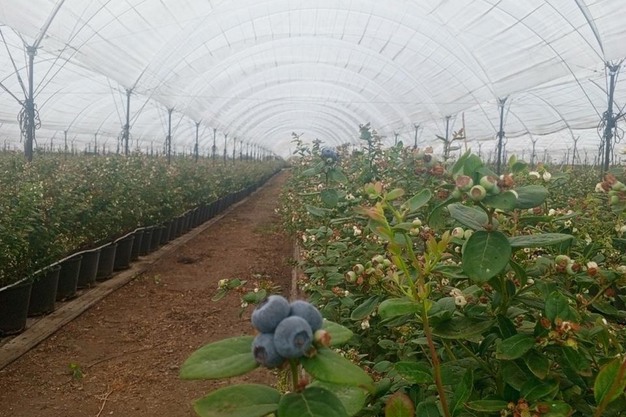
Ecuador has about 300 hectares of blueberries, mainly in the central Sierra at 2,000-3,000 meters above sea level. Most production occurs under macro-tunnels or greenhouses, often using infrastructure from the floral sector. "Everything is hydroponic; we don't plant directly into the soil," Bustos explained. In 2026, the sector is expected to grow by an additional 200 hectares, driven by a few larger producers.
"Producers grow the Biloxi, Emerald, Sequoia, Atlas, Matías, Eureka, Madeira, and Rocío varieties. However, royalty payments and high investment costs - between $150,000 and $180,000 per hectare - limit faster growth," he added.
The local market is crucial for the business's sustainability. Bustos states, "The local market pays between $8 and $12 per kilogram," making local sales more attractive than exports. However, a major challenge is the influx of smuggled Peruvian fruit. He questions, "How can we compete if Peruvian blueberries are imported at 3 dollars per kilogram?"
Despite these obstacles, Ecuadorian blueberries are recognized for their quality. "Our blueberries have better sweetness, better size, and better organoleptic characteristics," he states. With calibers over 16 millimeters and high Brix levels, the product targets specific niches. "It's a niche blueberry, not one for large volumes," Bustos concluded.
 For more information:
Álex Bustos Guerra
GreenControl-LA
Ecuador
Email: [email protected]
www.greencontrol-la.com