The Tropicals Congress took place in Antwerp on Tuesday, 24 and Wednesday, 25 June 2025. Organised by Fruitnet, the event brought together stakeholders from around the world at the Hilton Antwerp to address the ongoing challenges facing exotic fruit. While these challenges are nothing new, it became clear on 24 June that the greatest opportunities and growth potential lie in new markets, new varieties, and evolving consumption patterns. It was reason enough for moderator Chris White to rename the final panel session from "the challenging landscape" to "the great potential."
Click here for the photo report
 © Jannick Flach | FreshPlaza.com
The Tropicals Congress was opened by a familiar face, with Cindy van Rijswick of Rabobank providing an overview of the current state of the exotics market. It was a wake-up call, as she immediately highlighted long-standing issues the sector continues to face. While these problems weren't solved that day, she did point to progress in the right direction. Although the exotic fruit market holds significant potential, securing the right product is becoming increasingly difficult, with growing concerns about availability, quality, and cost.
She also warned of the inconsistency in product quality, which risks driving consumers away. Exotic fruits may be popular, but they're often not the first choice in the shopping basket. Still, there is room for growth. Encouragingly, Cindy noted that European consumers now have more disposable income, with a strong labour market supporting household earnings. However, despite this, consumer confidence hasn't fully returned. People are cautious and very selective about how—and on which fruit—they spend their money, she explained.
There is, in theory, considerable potential for exotics. On a global scale, exotic fruit is playing an increasingly dominant role in trade. Between 2013 and 2023, exotics have dominated the top 10 fruits in terms of rising trade values, particularly durian, avocado, banana, and mango. Avocado stands out as a true success story, surpassing US$20 billion in trade value and continuing to break records. New producing countries are also entering the market, further driving growth. In 2014, only 12 countries exported more than 5,000 tonnes; by 2030, that number is expected to rise to 30. Europe and the US remain the largest importers, while Asia lags behind. However, South American imports are on the rise, albeit from a low base. Current prices for fruits like avocados, mangoes, and pineapples are stable, but for how long?
 © Jannick Flach | FreshPlaza.com
Throughout the two-day event, these challenges were discussed alongside emerging opportunities. One such opportunity is convenience, a market segment with great potential according to Andrew Crawford of PrepWorld and Jai Thakrar of Jalaram Fruit. They noted that consumers are increasingly seeking convenient options, and tropical fruit is well-suited for this trend. Pineapple, watermelon, mango, and pomegranate are leading the way, but there is room for other products. Jai pointed out that while convenience comes at a price, consumers today are often willing to pay a bit more. It also helps introduce them to fruits they might not otherwise know how to prepare or use.
 © Jannick Flach | FreshPlaza.com
One of the biggest ongoing challenges is in the supply chain. Philippe Beaujean of the Port of Antwerp-Bruges spoke about how the port authority is investing in security, including the deployment of drones—dubbed "D-Hive"—that patrol the port grounds to detect suspicious activity. Smuggling remains a major issue in the import of exotic fruits.
Shypple, represented by Jarell Habets and Omar Moghrani, presented their company's response to a changing logistics environment. They have developed a platform that enables real-time container tracking using data. A key point they made was the importance of collaboration within the supply chain to gain optimal shipment visibility. Referring back to Philippe, they stressed the value of port and terminal data, which they view as the most reliable.
Knowledge sharing was also a key theme in the presentation by Marco de Jong of Experience Fruit Quality, who introduced RipeWise, a technology platform designed to optimise fruit ripening, specifically avocados, mangoes, and bananas. The system integrates sensor technology, data analytics, and predictive software to make ripening more efficient, consistent, and sustainable. Marco also emphasised the need to gather as much data as possible for accurate forecasting. However, during a panel discussion led by Steve Alaerts, it became clear that not everyone is eager to share data, fearing it could be misused or used against them. "There are players in the market who only take and never give," it was noted.
 © Jannick Flach | FreshPlaza.com
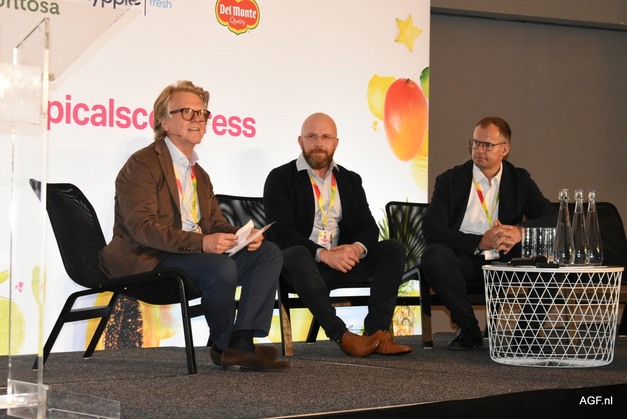
A field tour showcased how to build a strong fruit brand, featuring Perfection Fresh's Calypso mango. Meanwhile, Del Monte, Dole, and Frutas Montosa discussed the future of their key products—pineapple, mango, and avocado, respectively. More detailed insights will follow later, but it was clear that all three companies see a bright future for these fruits. Pineapple, in particular, is now positioned not just as a fruit, but as a premium experience, sustainable and emotionally resonant with consumers. This aspect needs to be highlighted, Del Monte's Gianpaolo Renino remarked. Demand remains strong, though he warned of overreliance on a single supplier—Costa Rica—raising concerns about future availability.
Bruno Gioffre echoed similar concerns in the mango sector. "There are many opportunities in the European mango market," he said, "but these require adaptation." That includes consistent ripeness and quality, investment in sustainability, and responsiveness to consumer preferences. He stressed that collaboration throughout the supply chain is essential and that innovation in varieties and ripening processes will shape the market's future.
 © Jannick Flach | FreshPlaza.com
Arie Havelaar of Sawari Fresh and Angel del Pinto of Anecoop then demonstrated that exotic fruits need not always come from distant origins. Arie explained how Sawari Fresh began cultivating fresh, organic ginger in cold greenhouses in Zeeland and Limburg in early 2021, with local garlic recently added. Initial trials aim to develop processes for growing and drying Dutch garlic for consumer-ready products. Arie highlighted that local cultivation enhances sustainability, freshness, and supply chain control—all aligned with consumer demand and technological progress. This was not just about the product, but the broader innovation. Angel del Pinto then presented similar efforts in Spain, with ongoing papaya projects and new initiatives in pitahaya cultivation.
The final panel discussion, moderated by Chris White, featured Matthew Churchill of Westfalia UK and Jens Gabriel of Greenyard. The focus: how to boost sales in an increasingly complex market. Chris noted, half-jokingly, that the landscape seemed far less daunting than it had just a few months earlier. Despite ongoing hurdles, the day's presentations had revealed a wealth of opportunities. Matthew agreed, adding that market differentiation is key, especially in avocados, where ready-to-eat and premium varieties stand out. Research into new varieties is ongoing and promises new growth opportunities, even if it takes time. The panel concluded with the pressing question of whether exotics have a future amid rising demand for local produce. The answer came in a quote from Hein Deprez: "As local as possible, but as far as necessary." After this, attendees enjoyed refreshments and networking. The congress officially wrapped up the next day with a visit to the Port of Antwerp.
More in-depth articles on the individual presentations will follow next week.
Click here for the photo report
For more information:
Tropicals Congress 2025
www.fruitnet.com/tropicalscongress