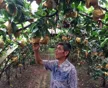
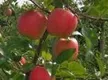
Recently, John Handrahan invested some $150,000 in 6,000 apple trees and their supporting infrastructure. Now, with his 31 rows of first-year apple trees growing on trellises on an eight-acre field, he needs this high-density orchard to prove wrong those critics who suggest the climate in western P.E.I. is not suitable for commercial apple production.
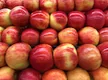
To optimise his chances, he went with 80 per cent Honey Crisp and 10 per cent each of Gala and Ambrosia apple stock. Clearly, his hope for a productive orchard rests largely on the Honey Crisps, but they do require the cross-pollinators so that the springtime bees can really work their magic.
While only about five acres of the field is in production, as the rest of the field is taken up with wet spots, Handrahan, a veteran blueberry grower, sees good potential in his small acreage orchard.
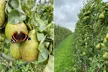
Strands of high tensile wire are stretched from wooden support posts, anchored at the ends of the rows. There are metal posts placed at intervals along the rows, and a vertical metal rod driven beside every tree and secured to the horizontal wires. Trees, planted every two and a half to three and a half feet, are fastened to the rods as they grow. As they fill out they create a wall.
Journalpioneer.com claims that prices for Honey Crisps have remained strong and that growers have received $600 to $700 per bin of Honey Crisps the last couple of years. Thus, Handrahan’s trees should be producing fruit by 2021 and be in full production, with 75 to 100 apples per tree, by 2024-2025. At just $500 a bin, Handrahan should be able to recover his initial investment by year six or seven.