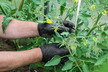
Researchers here have developed a bare-hands technique to easily peel kiwi fruit, persimmons, pears and other fruits.
The one setback to the otherwise appealing process is that it could take days to prepare the fruits.
The blade-less method was devised by the Fruit Tree Research Center of the Shizuoka Prefectural Research Institute of Agriculture and Forestry.
Click here to see how peel fruit by hand
The center says the hand-removal method maintains the shapes and colors of the fruits and keeps the surface smooth and shiny.
The center also says the method can cut processing costs and reduces the amount of edible parts normally removed with the peel.
“The new method is useful in processing fruits for cake toppings and sweets that contain entire fruits,” said Satoru Murakami, 40, a senior researcher at the center. “I expect it will allow for the creation of unprecedentedly impressive fruit-based products.”
Under the method, fruits are first exposed to ethylene, a plant hormone that ripens fruitage, and are then boiled in water at 95 degrees or higher for 30 seconds. After that, they are placed in water with ice.
The processed fruits can then be peeled just by softly rubbing them with the palms.
To develop the parboiling method, Murakami conducted an experiment using the Rainbow Red kiwi fruit three years ago. The results showed that most of the fruits exposed to ethylene for an entire day in a container could be skinned by hand, but untreated ones could not.
Murakami also tested the technique on Fuyugaki persimmons and discovered that they could be easily peeled by hand after exposure to ethylene for 60 hours in a container and then parboiling.
Similar trials using pears, “nashi” Japanese pears, loquats, peaches, avocados and other fruits have proved successful. But some apple species could not be peeled with the method, according to the center.
The center will continue studying the ethylene process on other fruits.
The research has been conducted since 2016 as part of the Ministry of Agriculture, Forestry and Fisheries’ project to develop innovative technologies.
In March this year, the center’s findings were presented at a conference of the Japanese Society for Horticultural Science, and a patent application was filed for the new technique.
Source: http://www.asahi.com