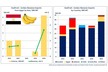
Morocco has become an important destination for surplus bananas from the Canary Islands, especially when prices are low at the source. It serves as an outlet for the product that cannot find a market on the mainland.
Sector data for 2025 show that 87% of the bananas sold—equivalent to 329.1 million kilos—were destined for the mainland market, which remains the primary recipient of this fruit. Out of the total 374.7 million kilos sold that year, 40.3 million were consumed within the Canary Islands' domestic market, while only 5.2 million were exported outside Spain.
Morocco purchased 3.6 million kilos, roughly 70% of these exports, making it the leading foreign destination. It surpassed the rest of Europe, which imported just 1.6 million kilos. In this region, Switzerland was the largest European importer.
Sector sources indicate that Morocco serves as an adjustment market during periods of oversupply. In summer, when production is high and consumption drops, some bananas removed from normal channels are diverted here to help stabilize prices.
This mechanism has become more important in recent years. Notably, in 2025, there were no withdrawals of the product, referred to as "pica," a change from previous years. This suggests that excess stock was primarily managed through exports, particularly to Morocco.
That year's production was the lowest in the past decade, totaling 374.7 million kilos, down from 425 million in 2024. Despite this decline, there were periods of excess supply, which encouraged the use of alternative markets.
The sector stresses that these shipments are driven not by profitability criteria but by the need to sell fruit that cannot be sold under favorable conditions in the usual markets. In this way, Morocco has become a recurring instrument for balancing supply and avoiding a further drop in prices at source.
Source: eldiario.es