On 30 April 2026, WCO members gathered for its seventh Annual General Meeting (AGM). During the AGM, WCO presented consolidated production and export forecasts for the forthcoming Southern Hemisphere citrus season 2026. The preliminary forecast was compiled through the WCO network in Argentina, Australia, Bolivia, Brazil, Chile, Peru, South Africa, and Uruguay. In addition, the Association confirmed its leadership with the two Co-Chairs who will guide its work over the next two years.
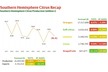
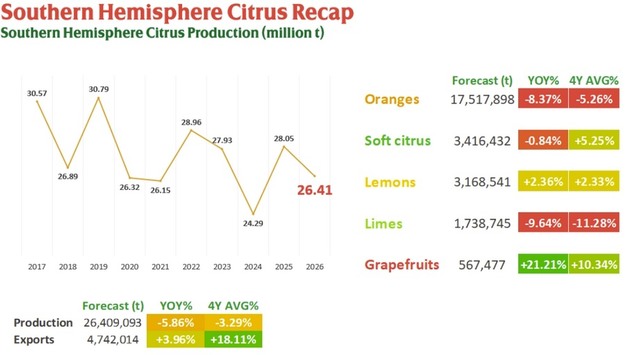
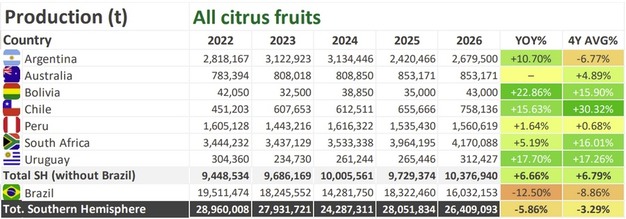
During WCO's AGM, the preliminary forecast for the upcoming Southern Hemisphere citrus season was presented to representatives from the citrus sector in Argentina, Australia, Bolivia, Brazil, Chile, Peru, South Africa, and Uruguay. Citrus production is expected to decrease by 5.86% compared to the previous year, with an estimated output of 26,409,093 tonnes. Exports, however, are forecast to increase by 3.96% compared to 2025, reaching 4,742,014 tonnes. These initial estimates will be revised following the publication of the Fundecitrus forecast for Brazil on 8 May 2026.
 © WCO
© WCO
Orange production is forecast to decrease by 8.37% compared to 2025, totaling 17,517,898 tonnes. Soft citrus production is expected to decline slightly (-0.84%) to 3,416,432 tonnes. Lemon production is projected to increase by 2.36% to 3,168,541 tonnes, while limes are expected to decline by 9.64% to 1,738,745 tonnes. Grapefruit production is forecast to reach 567,477 tonnes, representing an increase of 21.21% compared to 2025.
There is significant concern within the citrus sector regarding the direct or indirect impact of the Middle East crisis, particularly in relation to logistics costs, availability, and access to agricultural inputs such as fertilizers. Consumption trends also remain a concern. Last year's trade boom, particularly from the Southern Hemisphere, did not reflect stronger demand but rather a supply shortage in the Mediterranean basin, which was offset by Southern Hemisphere exports. For the new season, a more cautious approach to supply is recommended in Europe and the Middle East, where consumption drivers will need close monitoring.
 © WCO
© WCO
Following its first leadership transition in 2024, the WCO confirmed its Co-Chairs, Sergio del Castillo (Southern Hemisphere) and Badr Bennis (Northern Hemisphere), who will guide the Association's work over the next two years.
The Co-Chairs highlighted WCO's achievements since its founding, including a record number of members and its role as a key forum for citrus sector stakeholders to exchange data and perspectives. Over the past seven years, WCO has introduced tools such as standardized data reporting formats and interactive databases with updated production and trade forecasts, established working groups to support marketing and promotion of citrus categories, hosted physical and online events, and engaged with media to enhance sector visibility.
 © WCOFor more information:
World Citrus Organisation
Tel: +32 (0) 2 777 15 80
Email: [email protected]
www.worldcitrusorganisation.org