Some of the demands that the European Garlic Contact Group has put down on paper in a document sent to members of the European Parliament include greater safeguards against massive imports from Egypt and China, a halt to the indiscriminate elimination of active defence ingredients, and protection against rising costs such as energy and labour.
"While the internal crisis is a threat to the survival of the sector, the situation is exacerbated by imports from Egypt and China, whose conditions of production and access to the European market are unfair," reads the document.
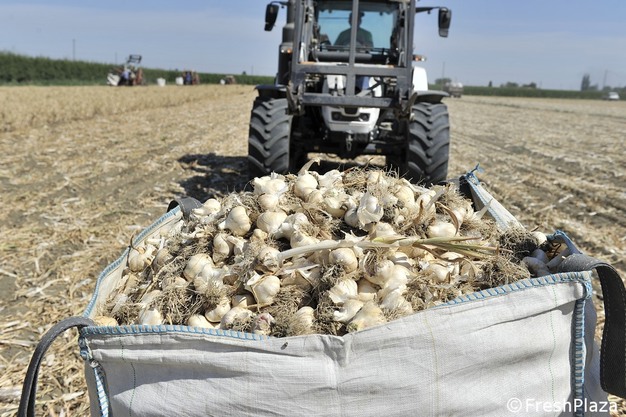 © Cristiano Riciputi | FreshPlaza.com
"Chinese garlic imports have historically been subject to a specific duty of €1,200 per tonne, but this figure has never been adequate and has currently lost a very significant part of its protective power."
"In addition, the duty has been systematically circumvented through triangulation practices, false declarations of origin, split shipments, and under-invoicing."
According to the contact group, another threat to the European product is Egyptian garlic. Over the past two years, garlic imports from Egypt have grown exponentially. "This country benefits from very low energy costs, much looser labour legislation compared to European standards on worker welfare, a generalised use of pesticides not allowed in the European Union, and preferential agreements that, in practice, facilitate access to the European market with a competitive imbalance compared to European producers".
In light of all this, the contact group calls for the activation of safeguard clauses for Egyptian garlic and the urgent updating of tariffs for Chinese garlic, with guarantees of reciprocity in production standards, systematic border controls, and the request for certifications of compliance with European standards and not with the country of cultivation. In addition, a review of the all-European active substance withdrawal policy is needed.