Global pistachio demand is expanding at 6.5% annually, while supply growth remains below 5%, according to industry data. Current production is concentrated in three countries: the United States, accounting for 40% of global output through California, Iran, with 30%, and Turkey. These origins face production limits linked to water scarcity and soil constraints.
Projections from the USDA and the International Nut Council indicate a potential structural shortfall of 250,000 tonnes by 2040. "Pistachios are not a passing trend or a cyclical bet. The fundamentals are very strong: demand has grown steadily for more than two decades, while supply advances more slowly due to technical, climatic, and capital barriers," said Juan Ignacio Ponelli, founder and CEO of AgroFides. He added, "A projected annual structural deficit of 250,000 tonnes by 2040 is enormous. It underpins price firmness."
 © DataLiner
Argentina is expanding production based on counter-seasonal supply and agroclimatic conditions. Planted area has increased by 500% in recent years, reaching between 7,000 and 9,000 hectares, according to INTA. San Juan accounts for approximately 6,500 hectares, representing 90% of national output. Mendoza and La Rioja follow.
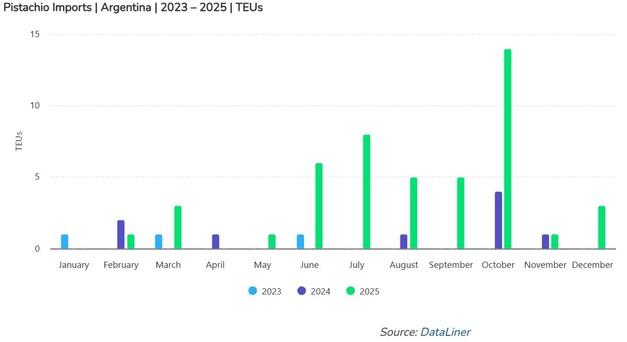
Average yields are 3,500 kilograms per hectare. Production is positioned for export expansion, although domestic demand is also rising. Imports of shelled pistachios have increased by 17,000% over five years, driven by food manufacturers incorporating pistachios into value-added products. Datamar data shows inbound pistachio shipments to Argentina rose 403% compared to 2024 levels.
The sector traces back to 1980, when Marcelo Ighani introduced pistachio seeds. His company, Pisté S.R.L., operates a nursery processing approximately 80,000 seeds annually from California and Arizona, supplying UCB1 hybrid rootstock supporting Kerman and Peters varieties.
Frutos del Sol manages 1,100 hectares and exports 1.6 million kilograms annually. Pistachos de los Andes cultivan 300 hectáreas en San Juan. SolFrut, part of Grupo Phrónesis, has planted 1,100 hectares with production scheduled from 2027. "Our economic and financial analysis showed strong potential. We designed the project with exports as the primary focus," said José Chediack. The company aims to reach 2,000 hectares.
Prodeman has developed 500 hectares in San Juan. AgroFides manages 110 hectares and structures investments starting at US$30,000 per hectare with US$6,000 annual maintenance costs. Farm-gate prices are near US$6 per kilogram, with orchards typically productive after six to seven years and capable of long-term output under managed conditions.
Source: Forbes Argentina / DatamarNews