A freight train carrying bananas from Laos recently arrived in Chongqing, marking the first shipment of imported bananas delivered via sealed rail-to-rail intermodal transport. The consignment comprised five 40-foot containers with a net weight of 85.5 tons. Departing from Vientiane, Laos, the cargo entered China through the Mohan Railway Port in Yunnan Province before continuing by rail to Chongqing. After customs clearance by Chongqing Customs District, the bananas were distributed to fruit wholesale markets in Chongqing and surrounding areas.
According to the importing company, domestic demand for Southeast Asian fruit has increased in recent years. Lao bananas have gained market presence in China due to stable supply conditions, consistent quality, and manageable cost structures, contributing to higher import volumes.
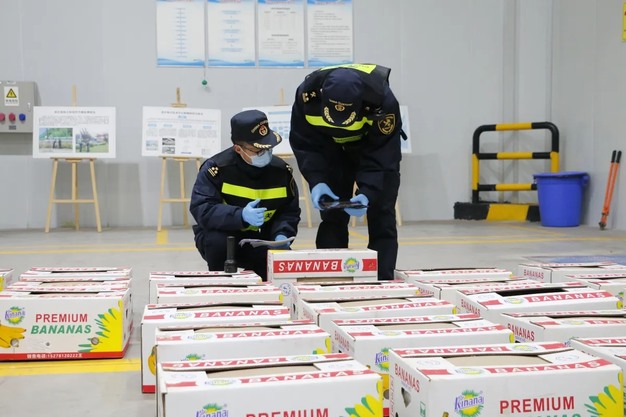 © Chongqing Customs District
The shipment used a rail-to-rail transport model, enabling continuous temperature-controlled handling, end-to-end traceability, and real-time data monitoring. The company reported that total logistics costs, including loading and unloading, declined by about 16 per cent compared with previous transport methods.
To support cross-border fruit trade, Chongqing Customs District has introduced a pilot programme for destination inspection and quarantine under the New International Land-Sea Trade Corridor framework. Coordination has been strengthened with Kunming Customs and Chongqing port logistics authorities, with a joint working mechanism established to provide guidance on policy requirements, overseas supplier verification, and quarantine permit applications.
Zhao Kai, deputy director of the Animal and Plant Quarantine Department at Chongqing Customs District, said the China–Laos Railway is increasingly used for agricultural imports. He noted that as part of the New International Land-Sea Trade Corridor, the railway is becoming a key channel for Southeast Asian agricultural products entering Chongqing.
The customs authority stated that continued cooperation between inspection agencies, logistics operators, and port authorities is intended to support regular rail-based fruit imports while maintaining quarantine and inspection compliance.
Source: Chongqing