Updated mapping from the University of New England (UNE) shows Australia's macadamia plantings have expanded more than 5 per cent in the past year. The mapped footprint now covers 46,487 hectares across major growing regions.
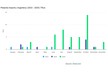
Bundaberg remains the largest region at 19,656 hectares and added 937 hectares over the past year. Tropical Queensland reported the highest rate of expansion, increasing 57 per cent to 915 hectares and becoming the fourth-largest region. Maryborough grew 26 per cent and is now the third-largest production area after Bundaberg and the NSW Northern Rivers.
Australian Macadamia Society (AMS) CEO Clare Hamilton-Bate said the mapping update supports long-term industry planning. "UNE and the Applied Agricultural Remote Sensing Centre (AARSC) team play a crucial role in giving our industry a clear national view of where macadamias are planted and how the landscape is changing," she said. "Their work underpins so much of our planning and forecasting. Having accurate, current mapping helps us understand regional growth, identify future opportunities, and support meaningful conversations with growers, researchers, and government."
 © Australian Macadamia Society
National Agriculture Day was also used to acknowledge growers recognised for orchard performance. CL Macs received Grower of the Year (large farm) for its Benworth orchard at Ainsworth, Gympie, which reported 1.89 t/ha SK in 2024 and a five-year average of 1.49 t/ha SK. The orchard includes 46-year-old trees managed with biological amendments, precision nutrition, and agronomy support.
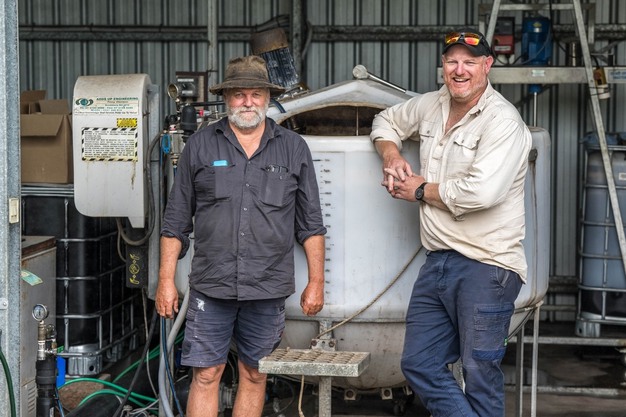
Grower of the Year (small farm) was awarded to Steve and Brooke McLean of Macadamia Allsorts in the NSW Northern Rivers. Their Alstonville orchard produced 2.2 t/ha SK in 2024, with a five-year average of 1.76 t/ha SK. The farm is known for its orchard layout, canopy control, and data-based irrigation and soil monitoring.
Regional winners were also announced for Central Queensland, Gympie, the Glass House Mountains, the NSW Northern Rivers, and the Mid North Coast, based on productivity and kernel recovery data from the 2024 season.
Macadamias are native to rainforests in north-east NSW and south-east Queensland. Australia has more than 800 commercial growers producing across 46,000 hectares and 14 million trees. The 2024 crop totalled 53,950 tonnes in-shell at 3.5 per cent moisture, with about 80 per cent exported to more than 40 countries.
The mapping update forms part of the Australian Tree Crop Map, led by UNE's Applied Agricultural Remote Sensing Centre in collaboration with the AMS. The project uses high-resolution satellite imagery to provide orchard data to support forecasting, regional planning, biosecurity, and environmental assessments. Seventy per cent of macadamia orchards have been mapped using 2024 or 2025 imagery.
 © Australian Macadamia SocietyFor more information:
Australian Macadamia Society
Tel: +61 2 6622 4933
Email: [email protected]
www.australianmacadamias.org