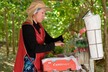
In the realm of cherry cultivation, netting has emerged as a tool for certain Northwest growers seeking to safeguard their crops. Shawn Gay from South Central Washington utilizes both structured and drape netting to shield blush cherries.
The Northwest's interior provides a conducive environment for sweet cherry production, as noted by Matt Whiting, a fruit physiologist at Washington State University. Historically, growers in this region have managed risks like unexpected storms, frost, or heat waves without extensive protection. According to Whiting, "People have just been willing to accept the odd year they lose some of their crops."
Globally, Washington and Oregon trail behind in adopting "protected culture" practices. Instead, regional growers often depend on calcium or sprays like Parka and Vapor Gard to combat environmental challenges.
Meanwhile, economic concerns have made the upfront costs of netting prohibitive for many, especially after periods of underwhelming returns. The extreme 2021 heat wave, however, has prompted some to reconsider, with a few implementing shade netting, rain covers, wind barriers, and cooling systems.
Gay's application of netting, primarily for wind protection, has extended to sunburn mitigation, despite the inability to fully counteract extreme temperatures like those during the 2021 heat dome. Structured nets are favored for new blocks, complemented by trials with Drape Net, which offers wind resistance while allowing for fruit coloring.
Additionally, Gay noted reduced water requirements due to the shade provided by the nets. He continues to expand his netted acreage, employing summer pruning to maintain fruit color.
Other growers, like Todd Wilmoth near Kennewick, utilize rain cloths to prevent cracking in Rainier cherries, acknowledging the trade-offs such as altered fruit coloring. Apple Otte leverages bird nets in Tonasket for secondary shading benefits.
In Sunnyside, John Heffron explored various methods, including overhead cooling, by keeping water volumes low enough to prevent fruit cracking. Although this practice is unconventional, Whiting suggests it, based on research findings indicating effective temperature control.
Source: GoodFruit Grower