Ecuador's banana sector aims to implement a water and carbon footprint measurement tool developed by the FAO's World Banana Forum to obtain an accurate picture of its water consumption and greenhouse gas emissions reduction.
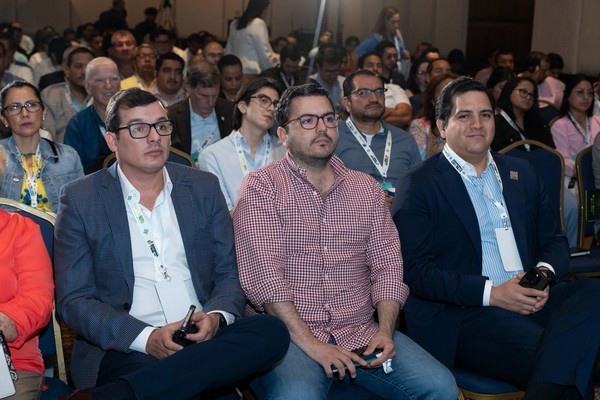
This tool was presented in Ecuador during Banana Time 2025, the flagship convention of Ecuador's banana industry, organized by the Association of Banana Exporters of Ecuador (AEBE) in Guayaquil.
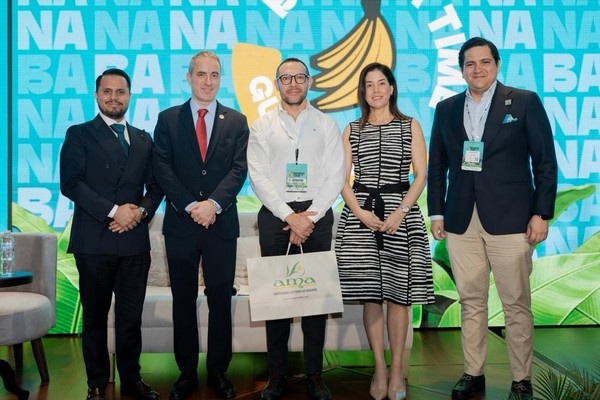 © Association of Banana Exporters of Ecuador
"We are here to help Ecuador have globally standardized tools to obtain the water and carbon footprint that will allow us to inform all buyers, including Europeans, of good practices," said Víctor Prada of the World Banana Forum.
A scientifically verifiable measurement of these values in Ecuador's banana production, which covers nearly 400,000 hectares of plantains and bananas, would also allow access to carbon markets and obtain financing that is currently unavailable.
These funds would be used to address challenges in regulation, security, and pests, said José Antonio Hidalgo, general director of AEBE and coordinator of Ecuador's Banana and Plantain Cluster.
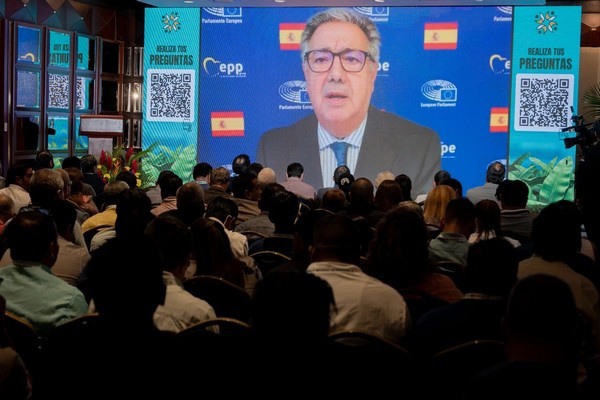 © Association of Banana Exporters of Ecuador
"(Carbon emission reduction) is another intangible asset that we are not exploiting in Ecuador," said Hidalgo, who pointed out the need for regulatory changes that would allow these funds to be obtained with the help of state entities. "We are going to work on a fund to lead the measurement of the water and carbon footprint."
Ecuador expects to end the year with figures similar to its best year on record, amid challenging circumstances at the national level in terms of security and volatility in the international context, with geopolitical and trade tensions affecting prices and logistics chains.
The expectation is to end 2025 with an export volume of between 380 and 390 million 40-pound (18.14-kilogram) boxes to 74 countries, a figure similar to the 386 million boxes shipped abroad in 2022, according to estimates by the Banana Statistical Observatory of AEBE.
 © Association of Banana Exporters of Ecuador
Banana Time 2025' concluded on Friday after the three day event. One day was devoted to the Fusarium R4T pest, which has already affected plantations in countries such as Colombia, Peru, and Venezuela and is suspected of having reached Ecuador. Experts from these countries, as well as from Brazil, presented the latest research on neutralizing this fungus that infects banana plants.
The executive director of Ecuador's Phytosanitary and Zoosanitary Regulation and Control Agency (Agrocalidad), Patricio Almeida, stressed the need to reach international agreements on protocols to combat these problems and the urgency for small producers to get involved in incorporating the protocols against R4T.
The convention concluded by presenting the 'Banana Awards', which recognized companies/actors in the banana sector with best practices in fields such as sustainability and equality, as well as the best exhibitors at a show that brought together producers, exporters, shipping companies, and other actors linked to the banana value chain.
 For more information:
Association of Banana Exporters of Ecuador
[email protected]
https://www.aebe.com