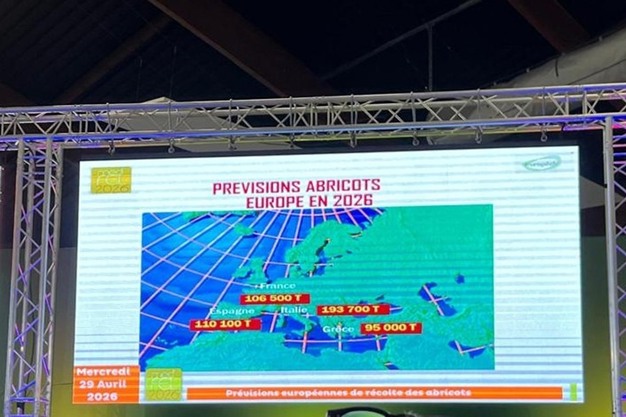
After a rather small harvest in 2025 (476,000 tons compared with 563,000 tons in 2024), European apricot production is set to rise slightly in 2026, with an estimated increase of 6% on last year's figure of 505,000 tons. This is due to generally more favorable weather conditions (no frosts), although rainy spells during the flowering period will limit full production potential. At this stage, only Greece is showing normal potential, significantly higher than in 2025. Italy, Spain, and France remain close to or behind last year. With a forecast of 505,000 tons, the European harvest for 2026 is set for a slight recovery.
 © FreshPlaza
Greece: Production up sharply
With production expected to reach around 95,000 tons in 2026, Greece is on the rebound, with volumes estimated to be around 40% higher than in 2025 (67,750 tons) and almost 20% above the 2020-2025 average. Unlike last year (drought, late frosts, extreme heat, and hail), no major weather problems were reported this season. The weather conditions were conducive to good tree development. Production levels in the Macedonia region were close to normal, with no notable incidents, with the exception of a few early varieties, which showed a drop in production.
In detail:
- Peloponese/Sterea/Crete: 45,000 tons
- Macedonia/Other regions: 50,000 tons
The harvest is expected to start around May 5-10th in Macedonia and from the last week of April in the southern regions.
Structurally, the Greek sector continues to improve yields and fruit quality in most regions. Both the surface area and the number of growers are increasing. However, climate change represents a major challenge, requiring the introduction of better-adapted varieties, particularly in terms of chilling requirements. The sector is also facing a lack of generational turnover and a shortage of skilled labor. On the market, the tightening of regulatory requirements (packaging, labor, environment) is driving production costs up, with no systematic impact on selling prices, undermining the profitability of farms.
Spain: Production virtually the same as in 2025
In Spain, the 2025 campaign was already 12.5% down on 2024, a record year with 118,483 tons. For 2026, weather conditions are generally favorable, although there are contrasts from region to region. The winter allowed a satisfactory accumulation of cold hours, ensuring good flowering and correct initial development. The autumn and winter rains also improved the water status of the orchards. In the spring, however, a number of hazards disrupted the campaign: rain during flowering complicated fruit set, particularly for apricots, localized frosts at the end of March and increased disease pressure due to the damp weather. Despite these factors, the overall situation remains satisfactory, even if uncertainties persist. The calendar is slightly ahead of 2025 by 5 to 7 days, due to higher temperatures in March and April, with variations according to zone and variety. In terms of volumes, the outlook is mixed: stable or slightly up in Murcia and Catalonia, expected decrease in Andalusia, Castilla-La Mancha, and certain areas of Valencia; uncertain situation in Aragon.
Overall, production is expected to be similar to or slightly lower than in 2025. The 2026 harvest is estimated at 110,120 tons, which is 13% more than the 2020-2024 average, but 7% lower than in 2025.
In detail:
- Valencia: 900 tons
- Murcia: 55,000 tons
- Aragon: 22,540 tons
- Catalonia: 16,900 tons
- Castilla-La Mancha: 5,870 tons
- Other regions: 8,910 tons
Italy: Crop virtually unchanged year-on-year
In 2025, Italian apricot production stood at just under 192,000 tons, lower than in 2024 due to unfavorable weather conditions and a slight reduction in acreage. Late frosts affected regions on the Adriatic coast, while spring rains and alternating rainfall penalized early varieties. Emilia-Romagna, in particular, saw a marked drop of 41%. In the south, declines were more limited (-12%), with contrasting situations: a positive harvest in Sicily, but frost damage in Puglia and, to a lesser extent, Basilicata.
For 2026, no significant frosts were observed, although a return to cold between late March and early April had an impact on production. Flowering was generally satisfactory, but frequent rainfall disrupted fruit set locally, resulting in a heterogeneous fruit load. The northern regions should see a recovery from the low volumes of 2025, while a slight drop is expected in the south.
National production is estimated at around 193,680 tons, 1% more than in 2025. This level is still slightly below the recent average, but higher than in years with large deficits, such as 2020-2021.
The reduction in surface area continues, with a 4% drop between 2025 and 2026.
In detail:
- Emilia-Romagna and North: 74,082 tons
- Central: 10,446 tons
- South: 109,152 tons
France: A decent harvest, but below potential
In France, the 2026 campaign is characterized by the absence of frost, but by high humidity, particularly in Languedoc-Roussillon, the region most affected. Heavy rainfall during flowering disrupted fruit set, limiting production potential.
While initial forecasts are set at 106,520 tons (compared with 98,194 tons in 2025), these estimates could be revised downwards due to losses caused by wet conditions. Overall, production is thus expected to be down on last year.
In detail, the volumes estimated at this stage are 30,366 tons in Languedoc-Roussillon, 61,700 tons in Rhône-Alpes, and 14,454 tons in PACA.
Production is expected to peak between weeks 26 and 27 (late June), coinciding with Apricot Fortnight. Volumes will be present on the market, but will not reach the levels of 2025.
After a very poor year in 2024, production in 2025 marked a return to normal. However, the erosion of the orchard and the lower yields of traditional varieties (Bergeron, Bergarouge, Orangered) are limiting overall potential.
The winter of 2025-2026 had initially favored a good vegetative rest, but the mild weather in January and February, followed by heavy rain during flowering in the south, led to physiological setbacks. Conversely, more northerly regions, notably Rhône-Alpes, benefited from more favorable conditions, although the Bergeron variety confirmed its decline.
In the final analysis, even though thinning is not yet complete, the harvest is expected to be smaller than in 2025, with size partially compensating for the low load of many varieties. Earliness is close to that of last year, with the first harvests expected around the 15th of May, for widespread production in early June and a peak between June 20th and July 10th.