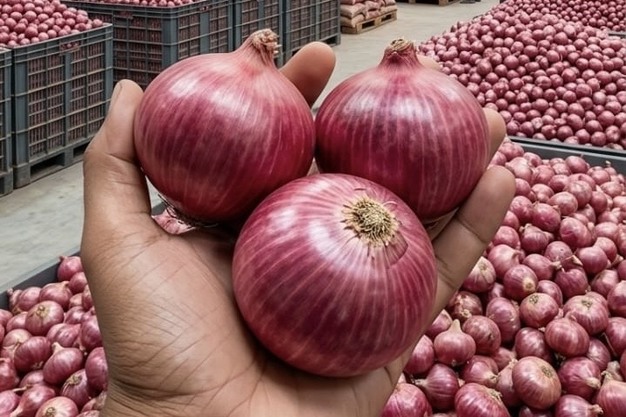
India's Garwa onion season is running well below last year's volumes, says Niteen Rajput of Krushnawal Farmer Producer Company based in Nashik, estimating that the crop has produced around 25% fewer onions compared with 2025. "The shortfall is due to damage from this month's cyclone, unseasonal rains, and high heat, which have not only reduced yields but also affected size and quality across many belts. Onion arrivals in the markets are at least 30 to 40% below last year, and the quality is not good either."
In Nashik, where the pink onion season is a key driver of the summer onion trade, major markets have seen both reduced arrivals and more "second‑quality" stock. "Wet fields and soaked heaps have forced farmers to cover produce under tarpaulin, yet rain‑damaged bulbs still surface later in the chain. These problems are compounded by bacterial issues linked to heat and variable weather, which further reduce size and storability. Lasalgaon market even had to close for a day because the damaged goods were not going out after packing," Niteen adds.
 © Alysha Fernandes | FreshPlaza.com
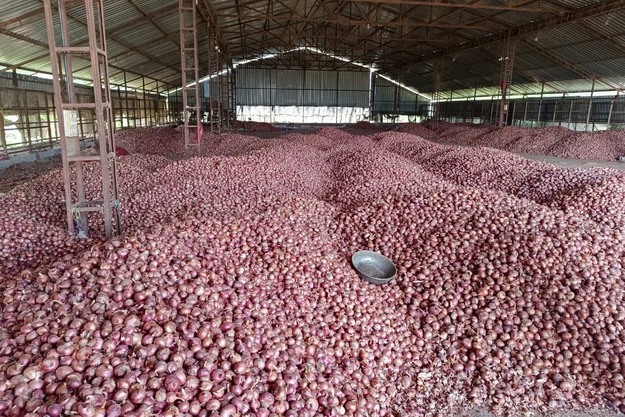
According to him, current weekly flows from Nashik have thinned out considerably, with container‑loadings reportedly 70–80% lower than last year. "The Government and APMC market committees are working together to manage supply, prices, and distribution." Domestically, supply is increasing from alternative belts like Madhya Pradesh and Karnataka, where sambar or rose‑onion still shows relatively better quality, but overall domestic market prices are down, and transport charges are being borne out of traders' and farmers' pockets."
For exports, the picture is even tougher. Niteen notes that the cost of moving a container from Nashik to Dubai has reached around ₹8.5 lakh, while export prices are still hovering near USD 0.30 per kg, and some domestic‑destined onions are clearing at just USD 0.10 per kg, which is erasing margins.
 © Alysha Fernandes | FreshPlaza.com
"Exports are happening like a lottery: if it looks profitable, traders are attempting a shipment; if not, they are holding back. Pink Garwa cargoes headed to the UAE, Sri Lanka, Malaysia, and Singapore are also facing delays and off‑spec arrivals, with extended transit times and vessel issues further denting confidence among buyers," Niteen explains.
As he sums it, "With weather‑linked risks and soil‑fertility pressures building, the 2026 Garwa season is shaping up as a year of constrained volumes, thinner quality, and tighter margins rather than a strong export surge, unless shipping‑lane disruptions ease and policy support stabilizes both domestic and international trade."
For more information:
Niteen Rajput
Krushnawal FPC
Tel: +91 96 89 575 515
Email: [email protected]
www.krushnawalfarmer.in