India continues to register modest volumes in global blueberry trade statistics, but underlying demand indicators point to gradual expansion. Population size, the growth of the urban middle class, and the rollout of modern retail formats are opening space for imported fruit previously positioned as a niche. Blueberries are currently concentrated in higher-income segments and large metropolitan areas, where they are associated with health-oriented diets, convenience, and international food trends. Consumption remains limited, but demand is broadening as exposure increases.
Saudi Arabia has emerged as one of the more active blueberry import markets in the Gulf region. Climatic conditions restrict local production, requiring imports for most of the year. Blueberries are distributed through large supermarket chains, premium retail outlets, and catering channels. Demand is supported by high purchasing power and a well-developed modern retail sector, with consumption concentrated in urban centers and periods when supply from other origins is tight.
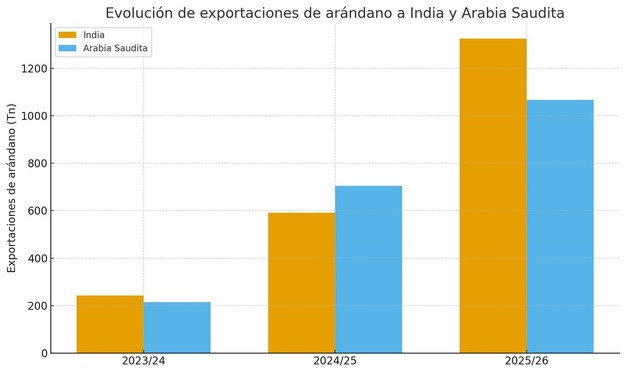 © Blueberries Consulting
Logistical and commercial constraints differ between the two markets. In India, internal distribution remains fragmented, with challenges related to tariffs, infrastructure, and inter-city logistics. Market entry typically requires local partners with the ability to manage multi-city distribution and varied retail channels. Packaging formats and communication strategies also differ, as many consumers are incorporating blueberries into their diets for the first time, requiring product familiarisation at the point of sale.
In Saudi Arabia, the main constraint is temperature management. From port handling through inland distribution, maintaining cold chain integrity is central to preserving firmness and shelf life. Robust packaging, handling protocols, and logistics providers with experience in perishable fruit are required to manage exposure to extreme conditions.
Despite these constraints, both markets allow for segmented blueberry programs. In India, expanding supermarket penetration enables targeted offerings for urban consumers seeking foods positioned around health and global consumption patterns. In Saudi Arabia, programs are built around defined specifications for size, condition, and presentation, particularly for retail chains and food service operators requiring consistent volumes.
Experience gained in India and Saudi Arabia is informing broader strategies for blueberries in other emerging markets across Asia and the Middle East. Market responses to origin, format, and handling requirements are shaping future commercial and logistical approaches, with emphasis on delivering consistent quality at the point of sale.
Source: Blueberries Consulting