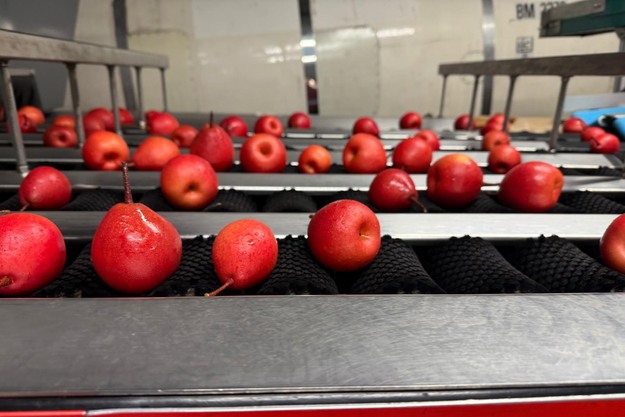
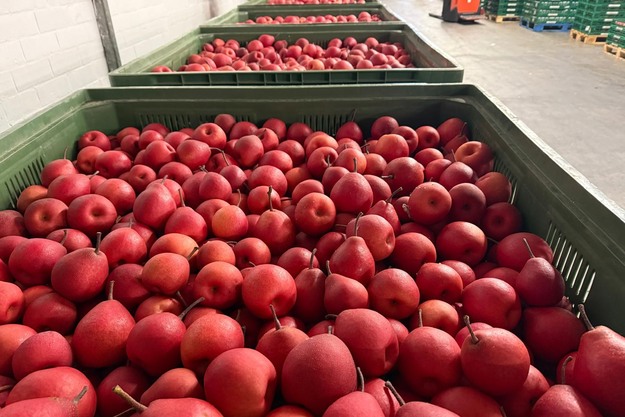
Since last week, sorting and packaging have resumed for the new crop of PIQA® Red, formerly PiqaBoo, at Devos-Wouters. Like last year, December at the cultivation and trading company is once again dedicated to the sale of this red pear. Kris Wouters of Devos-Wouters says this is a deliberate choice because volumes are still relatively limited and consumers are more inclined during the festive season to spend a little extra or choose something special. This makes December an ideal month for marketing the product.
 © Devos-Wouters
Last season was the first full marketing season of PIQA Red for the company, which went off to great satisfaction. This year too, he says, the harvest looks good. "The quality of the pears is particularly good this year. There is hardly any Class II; the product is really beautiful. Volumes have increased, and next year they will increase again as more hectares come into production."
Meanwhile, in addition to regular customers like Delhaize in Belgium and Edeka in Germany, Marks & Spencer from the UK has also decided to work with PIQA Red. "They mainly buy the smaller sizes, so we have a regular partner for all sizes. So we are fully focused on the month of December. The first deliveries have already been sent out, and deliveries to the other partners will start this week. In this respect, December is also an ideal time. After all, the PIQA Red is a bit more expensive, but should perhaps also be seen more as an exotic, with which one presents for the holidays. And this is also how, for example, Delhaize presented it. As part of their end-of-year promotion. That also gives the product a special position on the shelf."
 © Devos-Wouters
Extend selling season
In the longer term, by the way, the plan is to expand the selling season. "This is, of course, linked to the expansion of our production. There are currently about 15 hectares planted, mostly young trees. Each year, the production will grow, so already next season we probably won't be able to limit ourselves to December only, and we will have to look at how we are going to broaden the season. Then we have two options. Either we continue to offer a longer period on the European market, which is certainly possible in terms of storage, as the pears store extremely well and could, in theory, easily be sold until May. Contractually, we are not allowed to sell beyond May because that's when the New Zealand product comes on the market, but technically it would be possible for even longer."
"The other option is that, like New Zealand, we will send some to Asia," Kris explains. "From New Zealand, we have found that the PIQA Red sells very well in Asia. Still,  © Devos-WoutersEurope is our preference, as long as we can realise a good price here. The risk of exporting to Asia has simply become too high. Logistics have become hugely unreliable since COVID. Containers are often longer in transit, unloaded unexpectedly, and placed on other ships, and costs have risen sharply. So if we can sell the product well close to home, we are not going to take unnecessary risks. Only what we will end up doing, the future will have to tell."
Nevertheless, he indicates that the potential in Europe is so great that there are plenty of opportunities. "In Germany, for example, we clearly see that there is Nashi pear in almost all supermarkets there. Usually green, imported from China, but this variety also has genetically Nashi characteristics. Moreover, it is red, which is, of course, visually a lot more attractive. We hope that our European product can eventually replace the imported Chinese Nashi pear. In that case, we would be able to sell our volumes in Europe just fine."
Northern European cultivation
There is also interest from the cultivation side to start working with the PIQA Red. "However, the big difference with, for example, GoodnessMe, for which we have the licence for the whole of Europe, is that we only have the Benelux licence for PIQA Red. So we cannot plant in Germany, Italy, or other regions. There are other license holders for that. The advantage we do have here is that the variety does not grow well in warmer climates. In Italy and France, the pear turns from red to orange at the end of ripening, making it much less attractive. As a result, the crop is really only suitable for northern Europe."
For now, it is mainly Belgian growers who have started working with the variety. "In the Netherlands, there is also interest from growers, but we want to wait for this season first. We have only started again now and want to see how everything goes. Then we can expand, and the Netherlands will probably follow soon. It is important that growers have night frost protection because the pear is sensitive to night frost. Without protection, you get too much class II, and that's not good for anyone. Not for the grower and not for us. That's why we sell trees only to growers who have protection. We don't want to get planted everywhere, to end up with a product that is not good in the market."
 © Devos-Wouters
For more information:
Kris Wouters
Devos-Wouters
+32 16 77 97 58
[email protected]
www.devos-wouters.com