Brazil ranks third globally in fruit production, behind China and India. Over the past ten years, exports increased by 38 per cent in value and 62 per cent in volume. In 2025, fruit exports reached approximately US$1.5 billion, with a trade surplus close to US$400 million.
Sector structuring
According to Eduardo Brandão, executive director of the Brazilian Association of Fruit Producers and Exporters (Abrafrutas), this development is linked to sector organisation starting in 2013 and 2014, when the association was established to support production coordination and international promotion. The segment has since recorded export growth and accounts for about 16 per cent of the workforce in Brazil's agribusiness sector.
Main products
Key export products include mangoes, grapes, lemons, melons, watermelons, and papayas. Mango leads in export value, while lemons and melons lead in volume. Non-traditional fruits are also gaining share, including Hass avocado, which has entered the top ten export products and is supported by demand for fresh products.
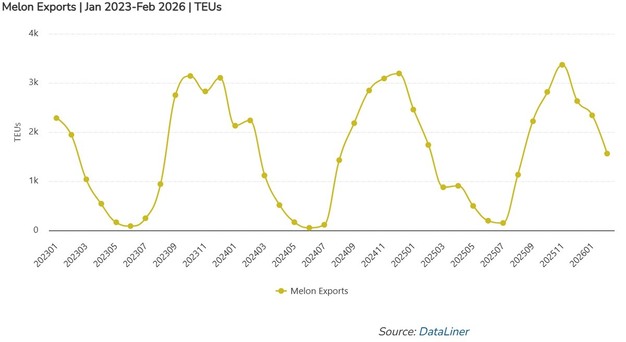 © DataLiner
Strong domestic market
Brazil also maintains a domestic market that requires imports of fruits not widely produced locally, such as pears, peaches, and plums. Despite this, the trade balance remains positive. Production is supported by quality standards and adaptation to international market requirements.
Focus on Asia
Europe accounts for around 60 per cent of exports. The sector is targeting diversification, with a focus on Asia, which is expected to become a larger consumption region for tropical fruit by 2030. Markets such as India and China are gaining importance, with recent access for products including lemons, apples, and avocados. Market development is supported by participation in trade fairs and promotion activities in cooperation with ApexBrasil.
Ready to eat
Around 90 per cent of exports are shipped by sea in refrigerated containers, while higher-value products are transported by air. Supply chain planning focuses on delivering fruit in "ready to eat" condition, aligned with market requirements.
Production capacity
Brazil produces fruit throughout the year due to varying climate and soil conditions. This allows supply during off-season periods in the Northern Hemisphere. Combined with ongoing market expansion and production development, the fruit sector continues to increase its role in exports and regional economies.
Source: DatamarNews / SNA / Abrafrutas