It's a time in Canada when shoppers continue to scan store shelves in search of a maple leaf on their packaging, or are filtering their online order by "Shop Canadian." It's also a sentiment that the Canadian exotic mushroom industry would like to see be applied to them.
 © Holburne Mushroom Farm Limited
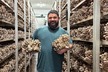
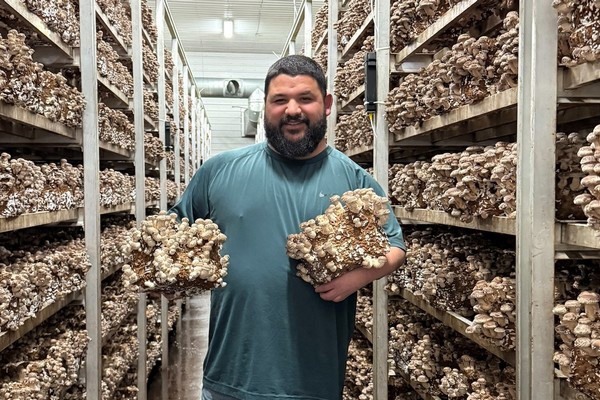
As Steven Rotiroti, co-owner of Holburne Mushroom Farm Limited in Queensville, Ontario, a producer of 50,000 lbs. of fresh exotic mushrooms weekly notes, exotic mushrooms account for slightly under two percent of the mushroom market. However, it has grown over time. When his grandfather switched over to growing Shiitakes from brown and white mushrooms in 2005, he was then only producing 300 lbs./week.
While that growth is seeing some challenges lately–likely due to the state of the economy and consumers increasingly watching their grocery budgets–it's still a time when consumers look to where they are sourcing their food items from.
Producing compost in Canada
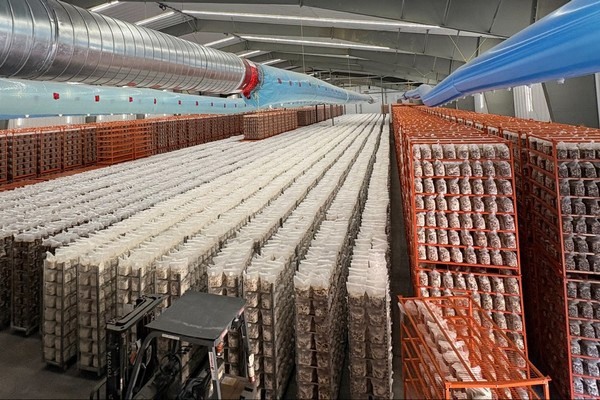
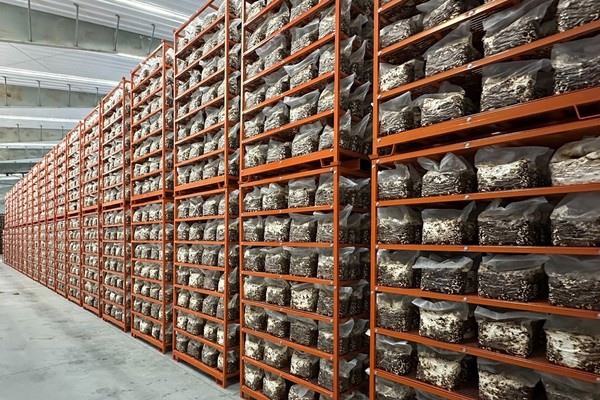
In exotic mushrooms however, it gets tricky. "For us, we take byproducts from other ag industries, such as ground flax, wheat bran and more, we pasteurize it and then inoculate it with some seeds–the mushroom mycelium," says Rotiroti, noting its farm produces about 150 tons of compost weekly. That compost then sits for about 14 weeks to let the mycelium grow, and after that time, it's taken into a fruiting room. Over the course of seven days, mushrooms are grown.
While that product is grown in Canada, there are concerns over foreign compost coming from countries such as China. "About 99 percent of imported compost is from there. So they produce the compost and then wait 14 weeks for the mycelium to finish colonizing the compost. Then, they flash freeze the compost and ship them globally and they land in Canada and go to partner farms where mushrooms are produced from them," he says. "Those farms then market those mushrooms as a product of Canada. Technically they are grown in Canada–however, 95 percent of their 'life' has been in another country and then finished in Canada and it's not right."
 © Holburne Mushroom Farm Limited
He's concerned as well over the volume of compost coming into North America and says it's flooding the market. "They're mass producing it at volumes that our population would never be able to absorb and it's driving prices down. It's making it harder for Canadian producers to compete, and it's bankrupted a few companies in Pennsylvania," as Rotiroti says, noting that Pennsylvania is where the majority of mushrooms sold in North America come from.
The issue dates back to 2015 when Rotiroti says imports from China significantly increased and bankrupted numerous companies producing American-made compost in the U.S. "One of those companies supplied us and when that happened, we decided to produce our own compost," he says.
Growth in the market
That said, as the exotic mushroom market continues to grow in North America, the volume of imported compost is also increasing and the very few Canadian producers of compost are competing directly with them.
It's an issue that Rotiroti isn't keeping to himself and is something he's discussing with both retailers and politicians though not much movement has been made yet on the issue. "It may come down to cost. They're intrigued by it but their interest in it isn't lasting. It may not be a key issue for them because it's not a huge margin item for them. It's not a big enough issue to move the needle," he says.
 © Holburne Mushroom Farm Limited
However it's something he plans to continue to discuss, particularly given his role as vice-president of the association, Mushrooms Canada and his role as a director on the board of the Canadian Federation of Agriculture. He's also planning on discussing the issue at next week's CPMA Convention & Trade Show in Toronto, particularly at his booth, #133.
"We need to strengthen Canada's food security–the pandemic taught us that and it has to go farther than putting a maple leaf on a package," Rotiroti says. "If we can grow mushrooms in Canada, why are we funding companies overseas? It's time to put our money where our mouths are—supporting Canadian family farms and small businesses. In difficult economic times, backing our neighbors isn't optional. It's necessary."
 For more information:
Steven Rotiroti
Holburne Mushroom Farm Limited
Tel: +1 (905) 478-4556
https://www.holburnemushroom.ca/