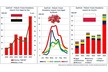
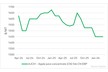
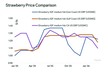
The challenges with logistics due to the conflict in the Middle East are also affecting a country already dealing with many hardships surrounding war, Ukraine. According to Volodymyr Gurzhiy of Ukrainian apple exporter USPA Fruit, the situation is still very hard to predict or work around:
"Ukrainian containers heading to the Middle East are fewer in number but are equally affected by the logistics reshuffle. Some shipments were destined for Oman, Qatar, Kuwait, and Saudi Arabia, and many will likely now be discharged in Jeddah and transported overland. The situation is still evolving quickly, making vessel movements difficult to predict. Some shipping lines were considering calling at Khor Fakkan Port in the UAE, located on the Indian Ocean coast, although it is not a typical port for refrigerated container deliveries compared with Jebel Ali in Dubai."
 © USPA Fruit
For the Ukrainian apple season, there weren't many volumes left to ship to begin with since the start of March, but for the shipments that were still underway at that point, solutions needed to be found, Gurzhiy explains. "Most Ukrainian export volumes for this season have already been shipped, but deliveries from the Northern Hemisphere are still ongoing, while a large share of containers currently heading to the region are already part of the Southern Hemisphere export season. Some cargoes are being diverted or even resold in transit. For example, certain shipments originally destined for Oman have been unloaded and sold in Saudi Arabia with the agreement of the original buyer. This illustrates how exporters are adapting routes almost in real time."
Gurzhiy states that the consequences of this war will be felt all over the global trade, as everything will become more expensive: "The Middle East accounts for a significant share of our business, but it is not our only market, so we monitor developments around the clock. The impact will extend beyond apple exporters. On a broader macroeconomic level, the cost of many goods is likely to rise. Oil and gas prices are increasing, and many production costs are linked to energy, directly or indirectly, including packaging and manufacturing."
"Plastic, widely used in retail packaging, is produced from oil. Fertilisers, packaging materials, and logistics all contribute significantly to the cost of goods on store shelves," Gurzhiy continues. "The energy factor will therefore gradually push prices upward. Part of the price increase will be immediate due to logistics, while other effects will appear slightly later but quickly."
 © USPA Fruit
Gurzhiy can't help but be reminded of what the logistical situation was when the war in Ukraine started, and has hopes that alternative routes will become available: "In many ways, the current situation resembles the first months of the full-scale war in Ukraine. In March 2022, logistics seemed impossible, yet within weeks, alternative routes appeared, via Romania, the port of Constanța, and other directions. If the crisis persists, Jeddah could become one of the main logistics hubs for the region. It is a large port and one of the key gateways on the Red Sea, capable of handling significant volumes of food supplies for the entire Arabian Peninsula."
"The alternative scenario involving Khor Fakkan in the UAE is also being discussed, though its role would likely be more limited. From there, goods would need to be transported by road. The peninsula has a developed road network, but logistics will become longer and more expensive. Trucks may need to travel 1,500 to 2,500 kilometres across the desert in one direction, and then return empty containers back to Jeddah."
"Companies focused on the HoReCa sector, which previously relied heavily on air freight, are among the most affected. They are now forced to reroute supplies through other countries or airports, making logistics even more expensive. The market is therefore under dual pressure: some suppliers have paused shipments, while delivery costs are rising sharply. Until new routes and insurance mechanisms are established, demand in the region will remain partly unmet, and prices will stay under upward pressure. However, as always in global trade, the balance between supply and demand will quickly reshape the market and produce new working logistics solutions," Gurzhiy concludes.
For more information:
Volodymyr Gurzhiy
USPA Food LLC
Tel: +380 50 925 57 32
Email: [email protected]
www.uspafood.com