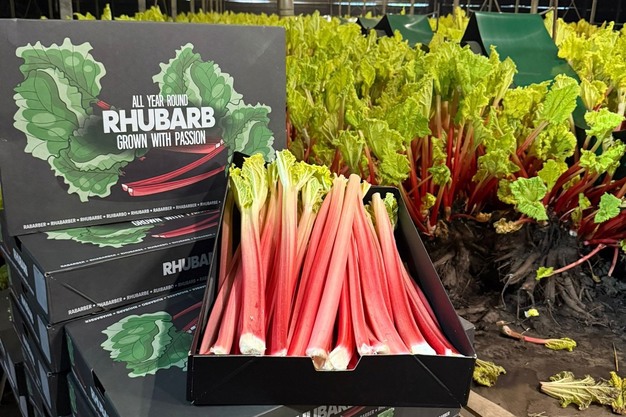
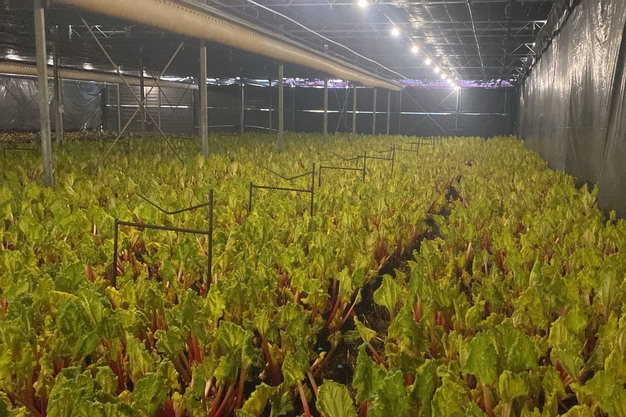
"Actually, there is a fair amount of everything at the moment. We ourselves also cut cauliflower until the holidays, and all of it found its way to consumers. Unfortunately, not always at the price we would have liked. In rhubarb, we are still seeing reasonable prices, but that is really only because the market benefited from the low supply in the previous period, and in fact still does," says Rob de Rond of De Rond Agro.
 © De Rond
However, Rob, who focuses on forced rhubarb from the greenhouse during the winter months, does see that quality is under pressure this year. "Our supermarket programmes have gone well, but we do see a very strong focus on quality and shelf life at retail. It is noticeable that they are much stricter on this than in other years. Every imperfection, every speck, is recorded and fed back. That in itself is not a problem, and fortunately, with some minor exceptions, we did not have quality issues, but I must say the reins have been tightened."
"You see this across all our products," he continues. "That also applies to rhubarb, although overall we have little to complain about. All markets competed quite well, whether in Europe, the U.S., or the UK. They all followed the programmes and agreements nicely. In free trade, there was also good demand, but you do notice that once the buying parties drop out, you really have to search and struggle to still get the product placed. Especially when prices are higher, the market becomes much smaller. That is why it was also positive that there was somewhat less volume available."
Choices per grower
According to Rob, the reason lies in the fact that there were already fewer active rhubarb growers in the autumn. "Everyone made their own choices. For example, some chose to harvest for industry during the summer months."
"We ourselves are more closely tied to the buyers and retailers we supply and want to continue supplying, so we focus more on a long-term perspective. That is easy to say, of course, because we have the security that the product will move at a certain price. Niche products are less suited to free trade if you do not have those agreements. You cannot simply go in every direction with them."
Spring product
Demand towards the end of the year, therefore, remained steady in the rhubarb market, but Rob does not yet dare to predict whether that will continue into the new year. "Right now, there is very little available. In the coming weeks, some growers will gradually start up again. That will not immediately bring large volumes, but production will also restart in England. As a result, some customers will switch to British products, so we will lose some customers."
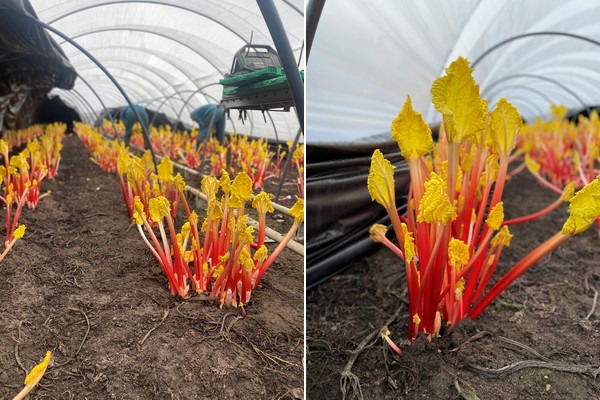
"January is always such a difficult month. Until the trade fair in Berlin, it is always a matter of waiting to see which way the penny drops. During the fair, there are always a few 'black' days, when people are busy with other things. Then, when the sun shows itself and temperatures rise a bit, rhubarb comes back into focus. So it remains to be seen how spring will develop."
Tension
The first weeks of 2026 for De Rond Agro are therefore mainly dominated by harvesting, packing, and preparation. "Our retail and day trade programmes run for 52 weeks a year, but beyond that, we are now preparing for the next season. Talks with buyers. October, November, and December are somewhat of a holding pattern. You wait, and nobody wants to make real decisions, but I hope we will enter that knotty phase in the coming weeks. Still, it feels like people are somewhat hesitant. I also sense that the upcoming aphid issue is very much on the radar of customers and retailers. That will be a real challenge next season."
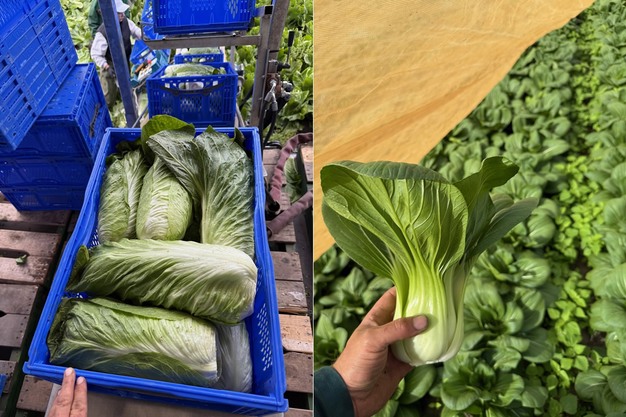
"Some crop protection products are no longer authorised, and alternatives are limited. In recent years, we have carried out trials to see how we can still deliver a good product without them. This will also create tension in the market. These challenges come up in discussions with customers as well. Transparency and realistic expectations are crucial. It is about not promising too much, but showing that we are prepared and actively testing."
 © De Rond Agro
Changing vegetable production
"And if a buyer wants to make a different choice, you have to accept that. It is then up to us to stay focused on our future and our future product. It is important to stay true to yourself," says the entrepreneur, who then reflects on a changing future for vegetable production. "I expect that a lot will change in outdoor vegetables in general. You see more and more inputs disappearing. Robotisation is increasing, whether through spot sprayers, laser weeders, or harvesting robots."
"Within five years, I think vegetable cultivation will look completely different from how it does now. I have also always said that I believe that in 50 years, almost no outdoor vegetables will be grown outside. Instead, they will be grown indoors, close to a distribution centre or cutting plant. The question then, of course, is how you combine volumes within such a relatively small space. I do not have an answer to that yet. Whether that happens within 20, 50, or 70 years remains to be seen, but I think it will happen."
"It is all going to look very different, and then it becomes important to know who your customers are. What do we do well, and what do we want to continue with? It is good to know where you can differentiate yourself, and I think you see that increasingly within our operations. Those contacts and lines of communication, which allow you to anticipate a changing future, are very much top of mind for us."
For more info:
Rob de Rond
De Rond Agro
Gors 127
4741 TC Hoeven
Tel: +31 (0) 165 312314
[email protected]
www.derondagro.nl