Japanese Prime Minister Shigeru Ishiba has responded to a letter from U.S. President Donald Trump threatening higher import duties unless a new trade agreement is reached, reaffirming Japan's commitment to continued negotiations. Speaking on Tuesday, Ishiba said he would work toward an agreement that benefits both nations "while protecting Japan's national interest." He also noted that previous discussions with Trump helped avoid even higher tariffs, initially estimated at around 30–35%.
Trump had announced in April that he would implement reciprocal tariffs ranging from 10% to 50% on dozens of countries, but delayed enforcement for 90 days to allow negotiations. That pause is now set to end definitively on August 1, 2025. In a post on his social media platform Truth Social, Trump wrote, "There has been no change to that date, and there will be no change," stating that tariffs will begin to be paid on August 1, with no extensions granted.
Although the U.S. president initially suggested that the August 1 deadline "was not 100% definitive," he later issued an executive order on Monday, effectively postponing the start date by three weeks. Despite that temporary extension, Trump confirmed on Tuesday that the new tariffs would proceed as planned, citing a lack of progress in trade negotiations with some nations.
 © White House OEC
Click to enlarge
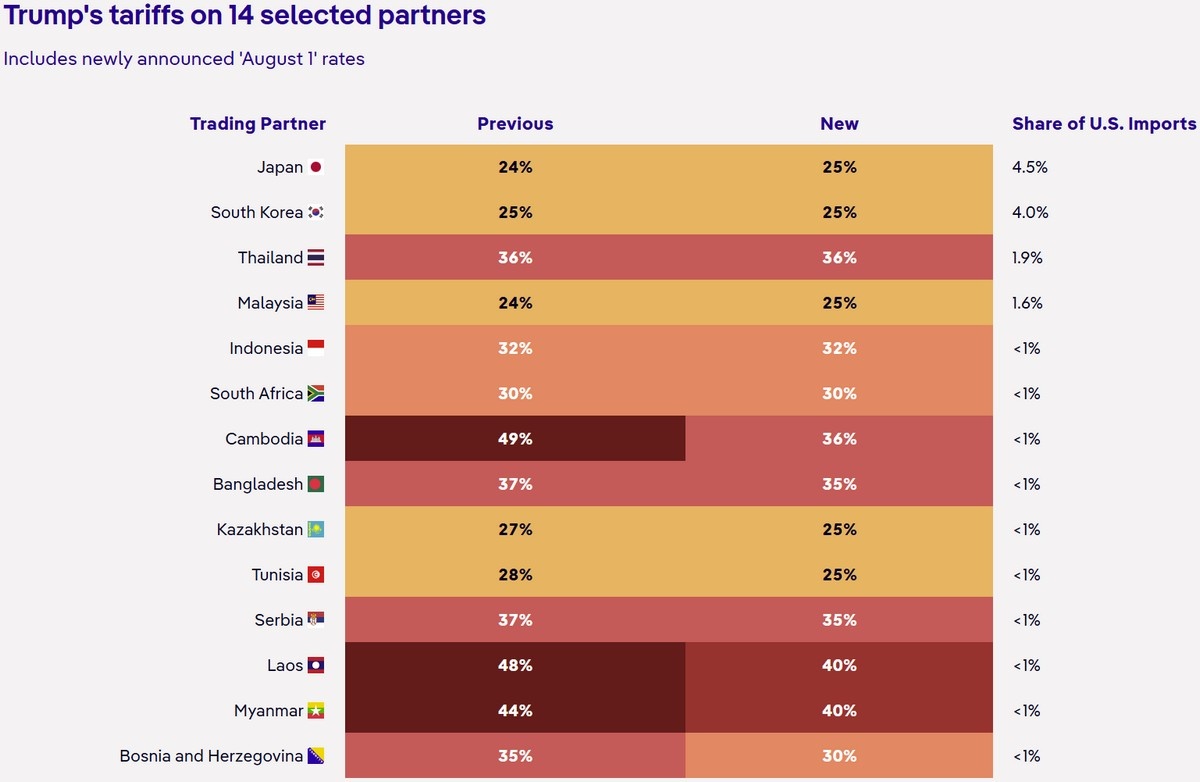
Japan and South Korea are among the countries that received formal letters from Trump, informing them of a forthcoming 25% tariff on imports beginning August 1. Trump's message stated that if these countries were to increase their own tariffs, "whatever the number you choose to raise them by, will be added on to the 25% that we charge." These new tariffs are separate from previously announced duties on specific sectors such as automobiles, steel, and aluminum.
South Korea and other close U.S. allies are not the only ones targeted. Trump also announced tariffs of 25% on imports from Tunisia, Malaysia, and Kazakhstan; 30% on South Africa, Bosnia and Herzegovina; 32% on Indonesia; 35% on Serbia and Bangladesh; and 36% on Cambodia and Thailand. Laos and Myanmar will face the steepest increase, with tariffs set at 40%.
In the European Union, officials are working quickly to avoid similar measures. EU Economy Commissioner Valdis Dombrovskis stated in Brussels that a fast agreement is essential to avoid market uncertainty and disruptions to investment. The EU is reportedly negotiating a baseline 10% tariff with limited exceptions, although a 20% duty could be imposed on EU goods if no deal is reached.
Trump has emphasized that these reciprocal tariffs are meant to create fairer trade relationships. The measures stem from long-standing trade disputes and are aimed at pressuring partner countries to lower their own tariffs on U.S. exports. While the decision has triggered concern among allies and trading partners, former U.S. trade negotiator Wendy Cutler remarked that "while the news is disappointing, it does not mean the game is over," underscoring the potential for continued dialogue.
Source 1: DatamarNews
Source 2: DW