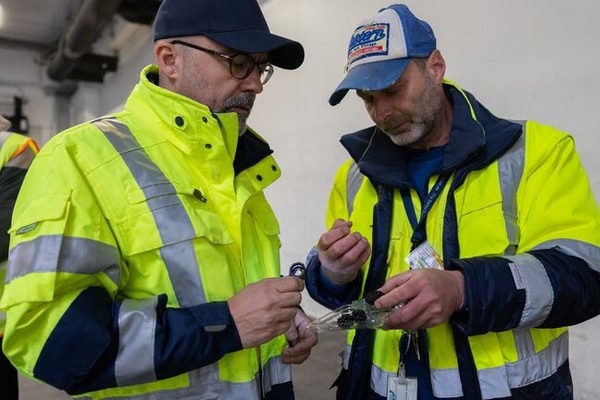
Fruit, vegetables, ornamental plants – everything of this kind that arrives at Frankfurt Airport as an import shipment is checked here: The Hessian Plant Protection Service is responsible for ensuring that neither plant pests nor diseases are brought into Germany and the EU via this route at the "Hessian gateway to the world." State Secretary Daniel Köfer recently visited the Hessian Plant Protection Service at Frankfurt Airport. He praised the responsible work of the specialist authority of the Giessen Regional Council, which rarely stands in the spotlight but plays a key role in protecting agriculture, biodiversity, and the European domestic market: "The Hessian Plant Protection Service plays a central role in ensuring the safety of our domestic agriculture and protecting biodiversity throughout Europe," emphasized Köfer during his visit.
 © HMLU
Phytosanitary safety throughout Europe
"The border inspection post at Frankfurt Airport is the most important of its kind in Germany in terms of the number of consignments to be inspected, far ahead of other locations such as the Port of Hamburg or Leipzig Airport," said Dr. Christian Hillnhütter, head of the Hessian Plant Protection Service. "It is the 'port of first entry' for goods shipments from all over the world, and therefore bears a special responsibility for phytosanitary security throughout Europe."
Imported shipments are inspected, as are passengers and luggage
Last year alone, almost 24,000 imported shipments of fruit, vegetables, and plants were inspected here – always with the aim of preventing the introduction of dangerous quarantine pests. 51 shipments had to be rejected. The main reason was infestation with particularly aggressive or exotic pests, including the fall armyworm, the Asian long-horned beetle, and the Japanese beetle, which can also cause serious damage to native plants.
This is not just about checking commercial shipments. Passengers are also randomly checked for prohibited plant products. This is because live insects can sometimes enter the country unnoticed in luggage and pose a significant risk to domestic crops and ecosystems. In 2024, more than ten tons of fruit, vegetables, cut flowers, and plants were seized during a total of 721 such checks and disposed of properly in accordance with phytosanitary requirements.
In addition, there has been a sharp increase in the number of postal items containing seeds without a phytosanitary certificate that are to be imported into the EU via the International Postal Center (IPZ) in Frankfurt. While more than 7,100 postal items were rejected in 2024, more than 28,100 items have already been rejected in 2025 to prevent the risk of importing unwanted, harmful organisms. In addition to daily checks at the airport, the Plant Protection Service of Hesse also faces enormous tasks in intra-European trade. Numerous new EU regulations have multiplied the number of shipments, goods, and harmful organisms that must be checked within just a few years.
Working in shifts 365 days a year
To be able to check all imports, the employees of the Hesse Plant Protection Service work in shifts – 365 days a year, with a high level of expertise and in accordance with strict international quality standards and norms. They are supported by a highly specialized diagnostic laboratory in Wetzlar. "The employees perform highly complex work in demanding shift work, often far from the public eye, but with an immense impact. I thank them for their daily commitment," emphasized State Secretary Köfer. The authority acts daily between global goods traffic and its regional protection mandate, thus making a decisive contribution to plant health and competitiveness in Hesse.
Source: HMLU