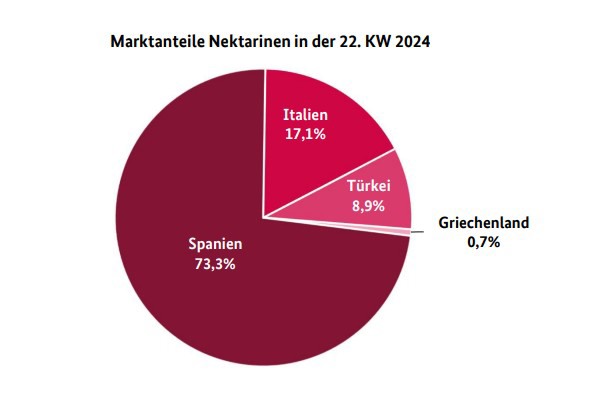
Spanish batches clearly dominated the scene for both yellow-fleshed and white-fleshed fruits. Supplies from Italy and Turkey played at most a supplementary role. Greek offerings were only seen in very small quantities in Frankfurt. The quality was convincing overall, although Italian products showed some issues with split kernels at the start of the season, negatively affecting sales. According to the BLE, availability had expanded compared to the previous week. Demand could not always keep up. As a result, traders were often forced to lower their previous prices.
 © BLE
© BLE
Thus, the popular stone fruits started the marketing year comparatively inexpensively. However, stable quotations were also recorded. In Hamburg, valuations even increased slightly, as demand could only be met with difficulty. Platerinas and especially Paraguayos occupied a wide space in the overall assortment, originating exclusively from Spain and generally generating friendly interest.
Apples
The old crops lost overall significance, with various varieties leaving the marketing, thus continuing the trend of the past weeks. Imports from overseas increased: New Zealand, Chilean, and South African products obviously gained in importance.
Pears
South African batches clearly prevailed: Forelle, Abate Fetel, and Packham's Triumph formed the basis of the range. Chilean Abate Fetel and Forelle followed in importance. Argentine Abate Fetel and Williams Christ complemented the scene.
Grapes
Italian shipments intensified: Black Magic and Victoria gained significantly in importance, and the first Arra 30 arrived. Egyptian imports also became more important. Arrivals from the Mediterranean region increasingly displaced offers from the Southern Hemisphere.
Strawberries
Domestic fruits dominated. Dutch and Greek offerings played a small role, Belgian, Polish, and Spanish ones a minimal role. Generally, supply exceeded demand, as due to low temperatures and many rain showers, storage options were limited.
Apricots
Spanish deliveries predominated. Shipments from Italy and France complemented the scene, with supplies from Turkey and Greece rounding it off. Provision grew and was sufficient to satisfactorily meet demand. Demand was quite friendly.
Cherries
Spanish fruits dominated the scene. Turkish and Greek batches were primarily available, with some quantities from Italy and North Macedonia participating in the marketing. Large calibers above 30 mm were most popular with customers.
Lemons
Spanish Verna prevailed and were mostly unrivaled. In Hamburg, the first South African Eureka arrived, priced at €22 per 15 kg box. South African offers were also available in Frankfurt.
Bananas
The supply was sufficiently in line with the storage options, which had slightly limited in places. Regarding prices, no significant changes were noted.
Cauliflower
Domestic batches dominated by a wide margin ahead of Belgian ones. Polish and Dutch batches supplemented. Although supply was somewhat limited, prices often tended slightly downwards.
Lettuce
In the case of iceberg lettuce, the formerly dominant Spanish offers left the marketing. Domestic products dominated, Dutch ones supplemented the scene. Prices trended downwards more often than upwards. Butterhead lettuces came from Germany and Belgium.
Cucumbers
The assortment of cucumbers consisted of domestic, Belgian, and Dutch items. Generally, business was quite calm. The demand was not particularly strong and could be satisfied without difficulty.
Tomatoes
Dutch and Belgian offers formed the basis of the range. Deliveries from Italy and Spain complemented the scene. Domestic fruits completed the offer. Availability was relatively generous. Therefore, traders could not avoid offering discounts.
Bell peppers
Dutch shipments predominated over Turkish and Belgian ones. German products were only a marginal appearance. Not much was happening: The availability was easily sufficient to satisfy the demand.
Asparagus
Domestic offers clearly dominated the marketing. Supplies from the Netherlands, Poland, Spain, and Italy played at most a supplementary role. The season has already advanced considerably: The supply had already limited. At the same time, a certain saturation among customers could not be denied.
Source: BLE