These are no longer the hectic days of old at Rejo Fresh. "Trade's much quieter than in previous years, so transport, too, is much quieter," begins this Belgian company's Johan Chrétien. Rejo Fresh mainly makes trips to and from the Belgian cooperative REO Veiling.
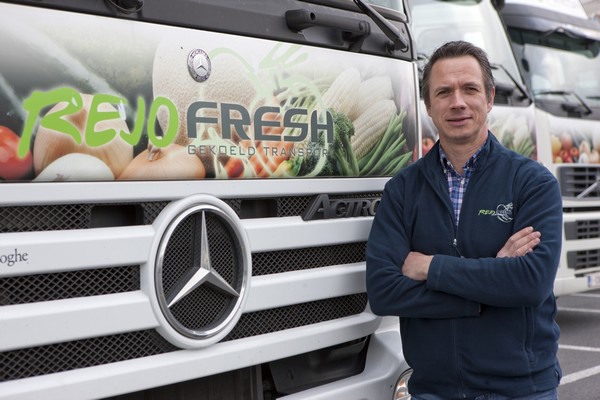
About 40% of Rejo Fresh's business is bringing produce from producers to the cooperative. That has plummeted, explains Johan. "The greenhouse growers are holding off for a while because of the sky-high energy prices. That roughly four-month break means less production, so we, too, will be much quieter until March/April."
"We currently only transport outdoor winter vegetables and make trips from the cooperative to buyers. Yet, here, there's no oversupply either. Plus, vegetables are generally quite pricey, too. So, one doesn't dare speculate on too large a stock. It seems, with these prices, everyone's slightly more careful with purchases," he says.
Nor does Johan see things changing any time soon. "I don't expect any major volume expansions. It's only winter vegetables coming in, which have had an acreage contraction. I, thus, don't expect major supply fluctuations until April. After that, there may well be a volume spike because everything will come onto the market at once. That will undoubtedly put pressure on prices. But we'll have to wait and see. We always respond to customer demand; if that rises, we become busier."
Price adjustments needed to survive
Cost price increases make it tough for Rejo Fresh to deal with these uncertainties and fluctuations. "Our situation's no different than from many other businesses. We're experiencing a 14%+ overall cost price hike. That's what it was in 2022, so I can only expect that in 2023 too. I hope and expect every carrier to implement it - you must if you want to survive," Johan states.
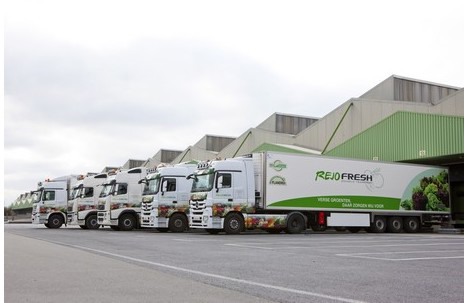
Fuel and staff make up more than half the transport company's costs. "In Belgium, a collective bargaining agreement for at least a ten percent raise has been adopted. For us, with a wage adjustment, that's 11%. That's substantial and compulsory. Personnel accounts for about 33% of our costs."
"That increase, therefore, has a big impact on our company. For fuel, we're looking at a quarter of the total. Those prices fluctuate considerably. Yet, to do business right, you must set the full fuel price, plus a diesel surcharge, at the start of the year. It's a lot to consider in these times," Chrétien explains.
Hydrogen and fuel cells
Looking ahead, Rejo Fresh is taking into account the widespread goal of switching to emission-free transport. "Several of our customers will have switched to CO2-free by 2035. That means they'll no longer welcome trucks that still emit CO2. So we're constantly looking for alternatives. At present, however, I think the best viable option is hydrogen combined with fuel cells."
"The hydrogen supplies a fuel cell which converts that to energy. I think it's the only option to maintain the same range and payload as diesel vehicles. After all, should your payload decrease by 15%, you need 15% more trucks. We don't want that. We're, thus, keeping a close eye on those developments," Johan concludes.
For more information: Johan Chrétien
Rejo Fresh
101 Oostnieuwkerksesteenweg
8800, Roeselare, Belgium
Tel: +32 (0) 512 54 472
Email: [email protected]
Website: www.rejofresh.be