The dry summer and lack of rainfall has had a serious impact on the carrot crop this year. "This year's yield is about 20-25 percent below the average of the past three years. If we compare the volume with last year's record yield, we even suffered losses of up to 35 percent," Carsten Abenhardt of the Datteln (NRW)-based company of the same name tells us.
In the month of August in particular, water shortages caused problems for the carrot producer. "As a result, we were able to harvest mostly small-fallow lots, while the qualities have been quite pleasing so far," Abenhardt said. Due to the warm and dry weather conditions, he said, the storage of the storage carrots was also necessarily delayed by 14 days. "How the volumes will then develop during storage is difficult to predict at present. Given the exponential increase in electricity prices, we are faced with three to four times the storage costs. We are currently negotiating with our food retail customers so that these additional costs are also reasonably reflected in the price level."
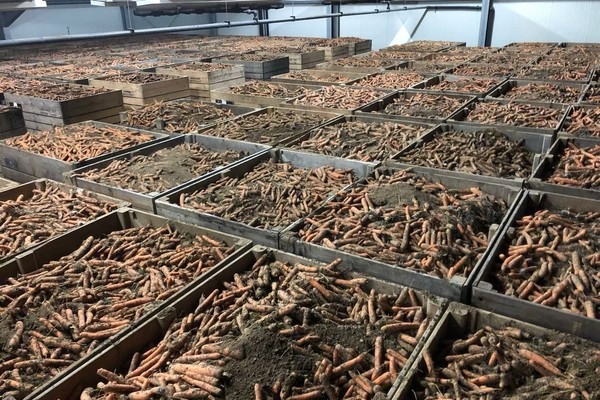 © Abenhardt GmbH & Co. KG
Food carrots during storage
In addition to conventional carrots in different varieties, Abenhardt is also dedicated to the cultivation and distribution of organic carrots. "Compared to the East where the harvest turned out to be partly catastrophic, we still got off lightly in NRW. As far as bunched carrots are concerned, which are usually all under irrigation, we were able to record a normal yield. In the case of autumn carrots, on the other hand, the infrastructure for irrigation is not available across the board. For snack carrots, this year's volumes were quite decent."
Larger marketing window for imported carrots
Due to the lower harvest volumes for autumn carrots, this year the company had to resort relatively early to imported carrots, which are procured on behalf of food retailers and packed at the Datteln site, he said. Abenhardt: "We primarily source our produce from Spain and, additionally from Italy; later in the season, we will then use carrots from southwest France. The key question, however, will be what quantities will be available there, because southern Europe has also had to contend with a severe water shortage in production this year."
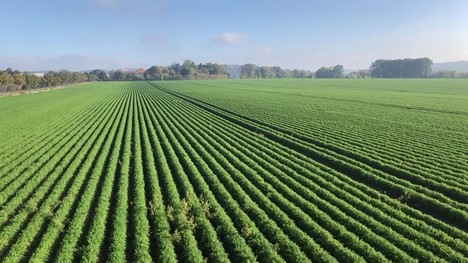
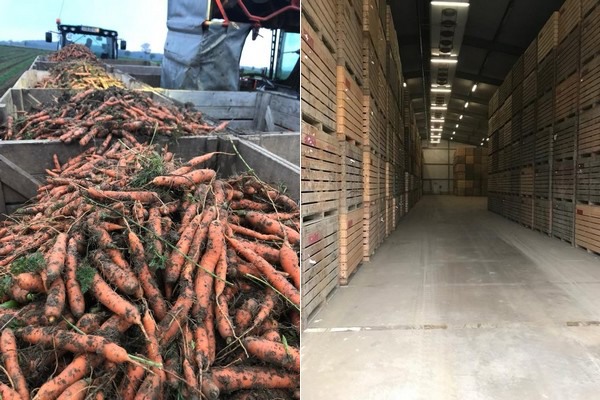
The carrot field
Reluctance to buy 'highly labeled' produce
Despite a difficult campaign, full of challenges, Abenhardt is confident about the future. "We are able to supply both smaller packs, of around 750 grams, to the tried and true large packs of around 2.5 kg for promotions. The product continues to be trendy and we are continuously working on new products and innovations. Bunched and snack carrots have now outgrown their niche and are well established in the market. Multi-coloured carrots are gradually gaining in importance as well."
According to Abenhardt, it remains to be seen how sales in the individual segments will develop this year. "We are seeing consumer reticence in the highly labeled products that are priced high at the full-range retailer. We're already seeing a 30 percent drop in sales in this area: but we'll get through this drop in purchasing power and associated consumer slump, and at the end of the day, there will still be room for sustainably produced and slightly higher-priced foods."
Images: Abenhardt GmbH & Co. KG
For more information:
Carsten Abenhardt
Abenhardt GmbH & Co. KG
Markfelder Straße 15
D - 45711 Datteln
Tel.: +49 (0) 2363 / 3659870
Fax +49 (0) 2363 / 8362
Email: [email protected]
www.abenhardt.de