After extensive modernization and expansion, new packaging technology was put into operation this fall at BayWa Obst's exclusive organic fruit wholesale store in Ravensburg. Around 70% of all organic apples from Lake Constance are sorted and packed here. We spoke on site with the stand manager Hans-Josef Stärk and Carolin Metzger, Head of Communications at BayWa Global Produce.
"The packing station was built in two stages. The first five lines were inaugurated in 2010 with a then new four-lane sorting system that calibrated the fruit according to external criteria and weight," Carolin Metzger tells us.
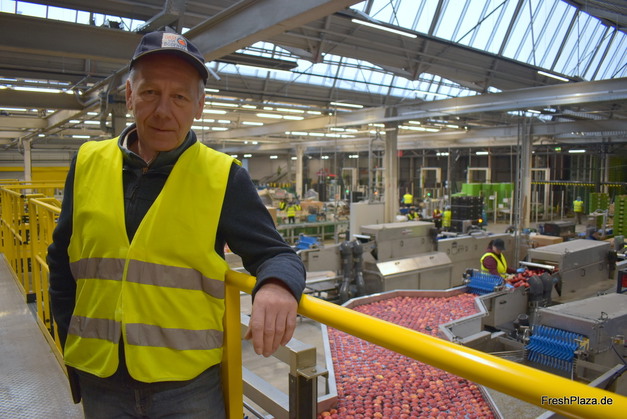
Hans-Josef Stärk
Looking at the "inner aspects" of the apple
"The second section, with two additional lines for plastic-free packaging and a pear sorting plant, has been put into operation in 2022. A completely new sorting system for apples was also installed, which not only classifies the fruit according to external criteria; it also checks the inner aspects, i.e., looks for browning or glassy spots. This allows us to further optimize the merchandise control," says Metzger. "A tree produces fruit of different quality, size, weight, coloring, etc.," he adds. So it's also about defining the best marketing route for each apple."
200 pallets of 500 kg a day
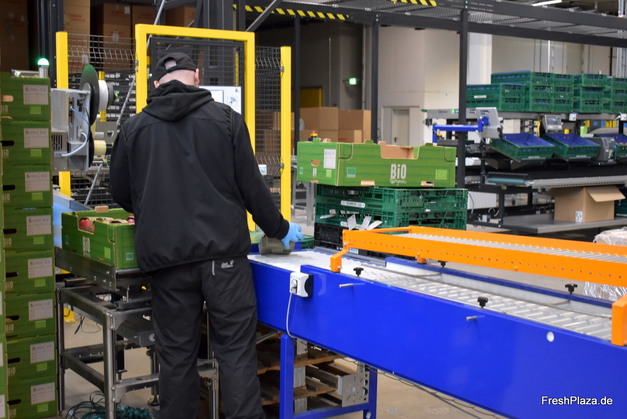
The organic packing station now, after the expansion, has eight production lines, Hans-Josef Stärk tells us. "We have an laying line, two bag and net machines, and four lines for cartons or wing trays. We also added a new four-lane pear sorting line with connected laying belts." Each line can produce between 25 to 30 pallets per day, which equates to a total of 200 pallets of 500 kg each. Some 20 permanent employees and 20-25 seasonal workers are employed at the packing station.
Some organic club varieties
Fifty percent of organically grown varieties are scab resistant. They include Santana, Topaz, Galant as well as marginal varieties such as Natyra®, which have been grown more in recent years. "Snack apples as well as club varieties play a bigger role in the conventional segment than in the organic segment.
Stärk: "Club varieties are not currently grown on a large scale in the organic sector. Even though Kanzi® and the tasty pear Xenia®, for example, have established themselves in the organic segment in recent years with growing acreages, the focus still lies on varieties that offer natural resistance. However, there are some club varieties in the pipeline that may be grown in the coming years." Natyra®, he said, is not a club variety in the common sense, but the name for the SQ159 variety for exclusive marketing in the organic segment.
Snack apples such as the Rockit® variety tend to be less common when it comes to organic production. On the other hand, apples that are 5 mm smaller can be used. "With the Gala variety, we can supply apples of size 55-60 mm, which are then marketed as apples for children."
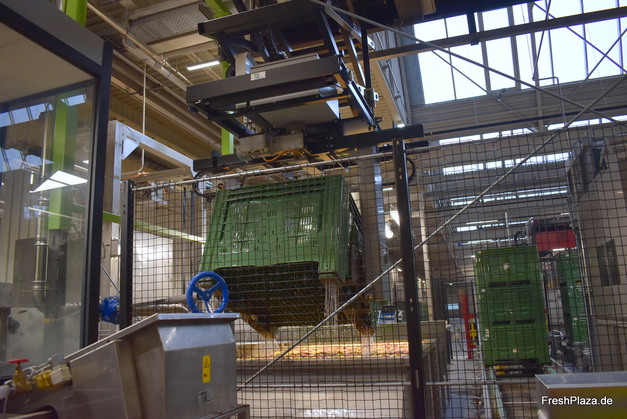 The new machine can sort up to 15 tons of apples per hour by quality, size and color. Stärk: "We have 30 channels here, which are used to filter out about 25 different quality grades from one single crate."
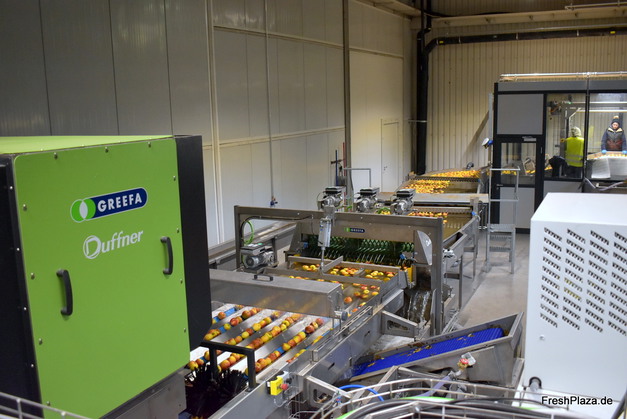
The new sorting system with internal quality sorting.
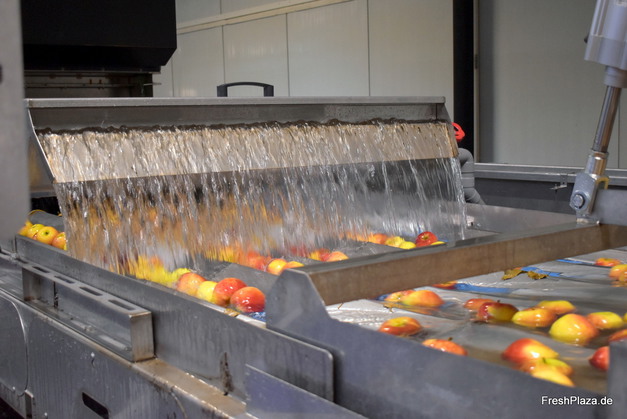
Apples are fed to the sorting unit in six lanes.
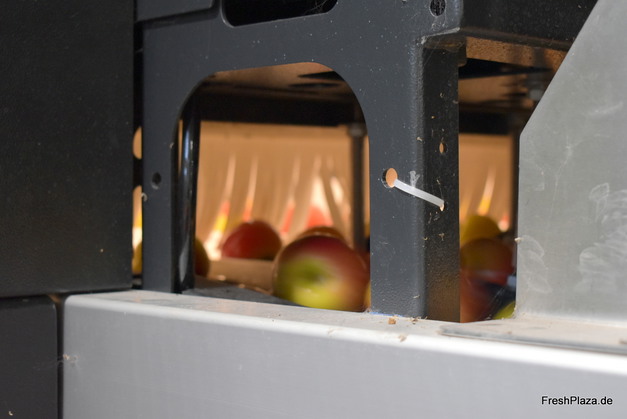
Stärk: "Three photos are taken of each lot, to record their state coming out of the crate. For organic fruit, the apples are first brushed before being visually sorted to remove rain stains, for example. Then they move on to the sorting unit."
Quality sorting via 32 channels
"On six lanes, the apples rotate into the camera tunnel of the sorting unit after being emptied and separated. Each apple is individually weighed and optically measured. The complex camera technology takes about 60 photos of each fruit to determine the external quality. In addition, the apples are virtually x-rayed with infrared cameras and checked for internal defects," Stärk explains.
"Based on the combination of sorting criteria, i.e., size, weight, base color, cover color, skin defects, etc., the apples are divided into a maximum of 25 sorting groups and collected in the defined water channels before being gently filled back into large crates and labeled. We can sort here in steps of up to 2 mm, for example to be able to pack packs with a fixed weight of 600 g as accurately as possible. This is because the more precisely we achieve the defined target weight, the lower the "weight-in", which has a positive effect on the prices paid out to the producers.
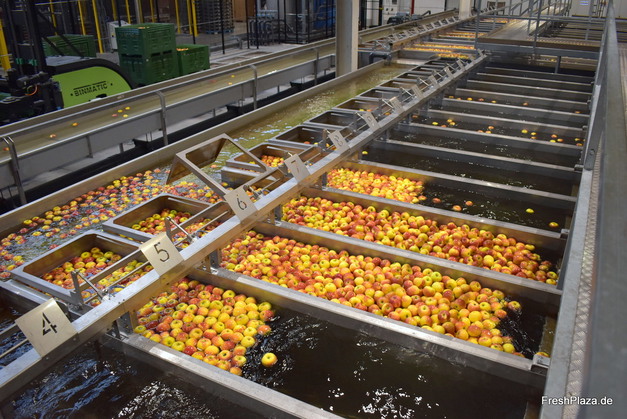
"The plant is state of the art and it operates through low-energy motors. The process water is continuously cleaned via two fully automatic filtration systems, which also saves water. The new water treatment plant includes activated carbon and sand filters as well as a sterilization system with UV light. So in the end, what comes out is drinking water quality, fed back into the production process. From the receipt of the fruit to the dispatch of the goods, the process steps are recorded by scanners to ensure 100 percent traceability. This enables us to trace fruit from the plot to delivery to the retailer and also the reverse route from the customer to the orchard."
Main marketing by Obst vom Bodensee Vertriebsgesellschaft.
The marketing partner for BayWa Obst's organic apples is Obst vom Bodensee Vertriebsgesellschaft, which is 100 percent responsible for marketing the produce to food retailers. Natural food retailers, specialist and wholesale markets or industrial customers are supplied directly by BayWa Obst.
BayWa Obst's product range includes not only apples and pears, but also plums and summer fruit such as cherries and mirabelles, strawberries, currants and gooseberries, and blueberries in organic quality. The latter is more of a subordinate product, although this part has also become increasingly important in recent years.
Stable prices
"Day-to-day business is currently rather quiet, although the promotional business started well and is helping us to get sales going. Being on the market two weeks earlier has given us a good head start," says Stärk. He says prices are comparable to last year's, despite the fact that growers are facing much higher production and operating costs. "Volume has to come into the flow. But it's also important to communicate to consumers that apples are still a good value product."
More information on BayWa Obst
BayWa Obst & Co. is a subsidiary of BayWa Global Produce Ltd. As an industry-specific portfolio manager, BayWa Global Produce bundles global activities from plant genetics to high-quality fruits and vegetables to develop innovative solutions and creative strategies for a "fruitful" future and stable supply chains from origin to consumer. An essential element in the collaboration is an overarching strategy based on the 4 pillars of variety development, sustainable cultivation, new markets and innovation. In doing so, the company builds on the strengths of its subsidiaries T&G Global (New Zealand), TFC Holland (Netherlands), and BayWa Obst (Germany) and, as one of the world's leading suppliers of high-quality fresh produce, has been a solid and reliable partner for its stakeholder for more than 100 years.
For more information: Hans-Josef Stärk
BayWa Obst
Standortverantwortlicher
Tel.: +49 (0)751 808-210
Fax: +49 (0)751 808-216
[email protected]
https://www.baywa-obst.de