Biological control is widely implemented in intensive agriculture under plastic in southeastern Spain. The commitment to sustainable production of thousands of agricultural producers (who grow the fruits and vegetables that reach the tables of all citizens in Europe), as well as the characteristics of this agricultural model, have led to this pest control method being currently used in more than 80% of the wintered area in Almeria and the Costa de Granada (whose total exceeds 32,000 hectares). This percentage rises to 99% in the case of crops such as red bell peppers, according to data from CuteSolar; a success that is expected to be achieved also in the open ground production of fruit trees.
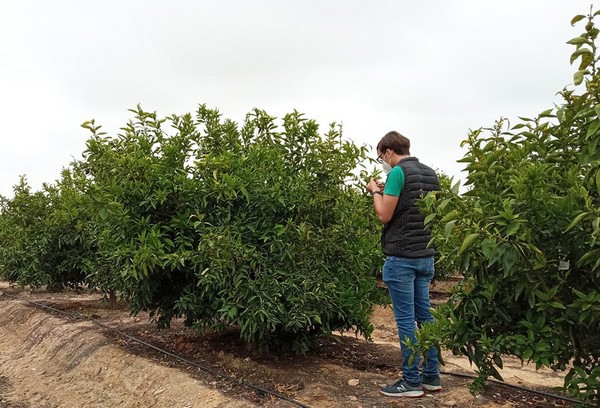
Agrobío technician inspecting the auxiliary fauna in citrus trees
"In 2007, there was a paradigm shift in intensive horticulture under plastic in Almeria," says Mónica González, from Agrobío. The exclusive use of phytosanitary products as the only pest and disease control tool for years led to these building up resistance. In intensive horticulture there are so many production cycles that some insects become resistant very quickly, so the use of higher doses and more active ingredients is needed to control them. "After the detection in 2007 of active materials not allowed in Germany, the future of this agricultural model was jeopardized, so in a matter of 2 years, quick and considerable changes were observed in the pest control model. Biological control thus became the main phytosanitary management tool for these crops
"Already in 2014, after the entry into force of Royal Decree 1311/2012 on the Sustainable Use of Plant Protection Products, Integrated Pest Management (IPM) became mandatory. IPM focuses on setting up pest prevention strategies, whether physical, technological, varietal or cultural, as well as on the follow-up and monitoring of both phytophagous populations and natural enemies, so that intervention thresholds can be established, always prioritizing biological control as the main pest control strategy."
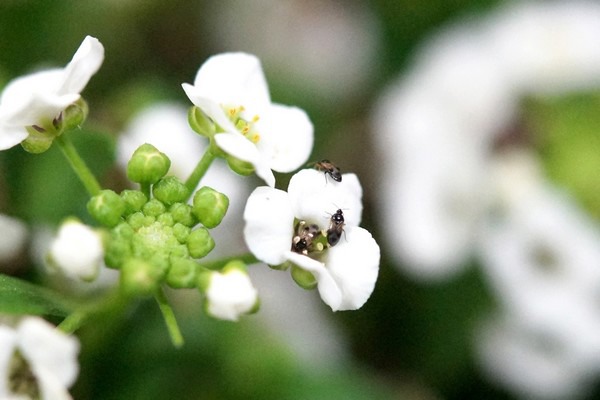
Lobularia maritima.
"However, we have observed that, despite the advances in agricultural chemistry to deal with pests in intensive agriculture, derived from the well-known 'green revolution', we have not been able to reduce crop damage by pests and diseases, which continues to affect around 30% of the production. We have to bear in mind that these intensive cultivation systems are very simplified systems in which only clones of the plant of commercial interest are grown, and where biodiversity is reduced to a minimum. Consequently, the natural regulation offered by the ecosystems' phytophagous insects is limited. In the end, this does not only affect greenhouse agriculture, but also fruit tree cultivation. Therefore, it is necessary to start changing the way we manage plantations and to develop agroecological solutions."
"Organic farming is not the same as agroecology"
"It is necessary to point out that organic farming and agroecology are two different things," says Monica, recalling the words of the recently deceased José Luis Porcuna, a leading pioneer of national and international agroecology. "Organic farming is a certification or quality standard, while agroecological pest management is a strategy that one pursues to bring balance to the ecosystem. In the case of pest management, the goal is to promote natural regulation through functional biodiversity, resorting to ecological infrastructures that provide resources (food, shelter, alternative prey and mating areas) to the auxiliary fauna, motivating it to stay close to the crops."
"Moreover, soil is considered as much more than just the means of support for the plants; soil is a medium that contains many microorganisms antagonistic to those that produce diseases, with which plants establish symbiotic relationships, and thanks to which they develop metabolic defense routes against natural enemies. This is especially important for fruit trees, because, unlike horticultural plants, which are uprooted after their growing cycle, these remain for years in the same soil."
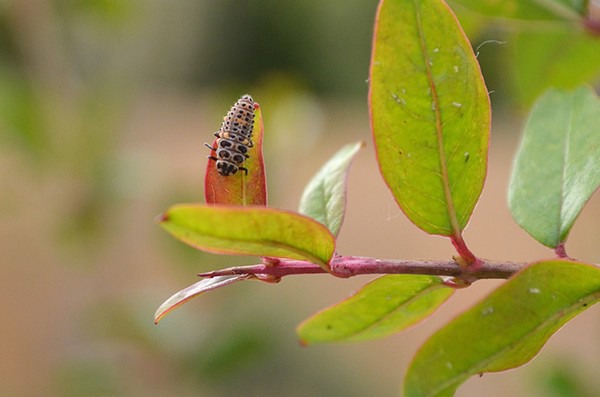
Adalia on pomegranate tree.
Conservative biological control
Agrobío has a wide range of biological control solutions for pests in fruit and vegetable crops, including lacewings, several species of hoverflies, as well as combinations of different parasitoids for aphid control, depending on the crop. "We are developing Cryptolaemus breeding for mealybug or "cotonet" control, and we have developed two breeds of Orius, a predatory bug, adapted to cold conditions and suboptimal diets, which is very interesting for thrips control," says Monica. "To promote biological control in fruit crops and in the open ground, Agrobío has chosen to hire a team of experts in the development of conservative biological control protocols based on the introduction of functional biodiversity."
A correct design of these infrastructures is essential to improve the effectiveness of biological control, taking into account the limited availability of space in the farms. "Therefore, in September 2021, I joined the development team of Agrobío to provide support to these conservative control projects. This happened after 12 years collaborating with Estefanía Rodríguez, researcher at the Ifapa La Mojonera Center, in the research and evaluation of candidate native shrub species, well adapted to the climatic conditions of Andalusia, and studying those that could be interesting for the creation of covers, biodiversity islands and functional hedges, allowing natural enemies to have the right conditions to settle in the crop fields."
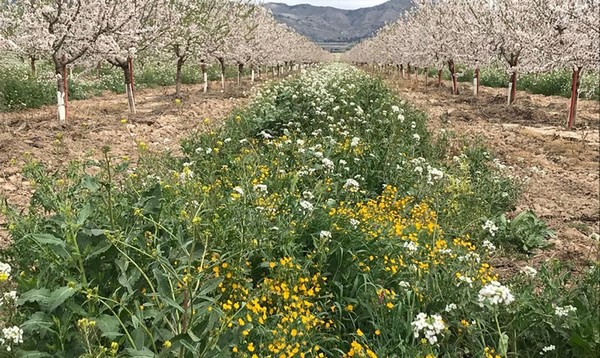
Plant cover
"In an enclosed greenhouse, you release the insects and they stay there, but in open-air fruit tree plantations of several hectares, if they don't find resources that encourage them to stay, they won't."
"Thanks to our knowledge in conservative biological control, Agrobío can offer both training to farmers and advice for the creation of these biodiversity islands. We develop specific projects for each crop and design customized hedges for each plantation based on its characteristics in order to achieve success in the classic biological control strategy."
"There is still a lot left to be done, but just like how 2007 was the time for the development of biological control in intensive agriculture, now is the time for its development in fruit trees. And this agroecological management will play a very important role in pursuing success."
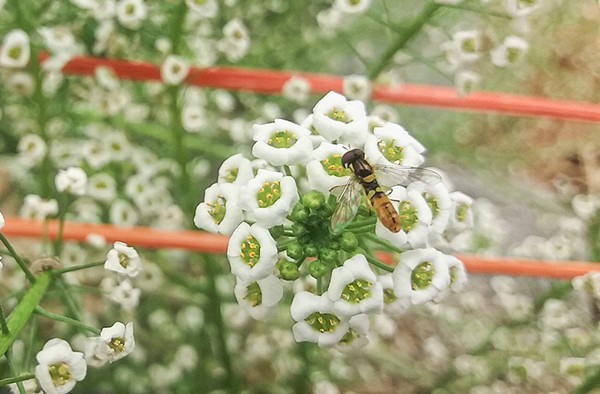
Hoverfly on Alyssum maritimum .
 For more information:
Mónica González
Agrobío
Ctra Nacional 340 Km 419, n.º 81
El Viso (La Mojonera)
04745 Almería, Spain
Tel.: +34 950 558 220
[email protected]
www.agrobio.es