Following steady rains last weekend and more rain to come early next week, there's relief for California organic and conventional stone fruit. "Rain isn't really an issue at this time of year except if it carries hail. Hail is the absolute worst case scenario," says Jon McClarty of HMC Farms.
As he notes, the company is 50-60 percent of the way through the thinning process of the trees ahead of the season. "That's an expensive activity and if you have a block of trees that were thinned and have gotten hit with hail, it's painful because you've already put money into the crop. However, we didn't see any hail in our area and that's basically what we're looking out for."
This comes though amidst the prediction of an earlier start to the California stone fruit season. While 2025 also began early, this year harvest will begin on peaches about six to 10 days ahead of last year. "We will probably start at the end of April or early May–we're in a bit of uncharted territory here," he says, adding that the early start is due to a combination of a warm late winter and an early spring.
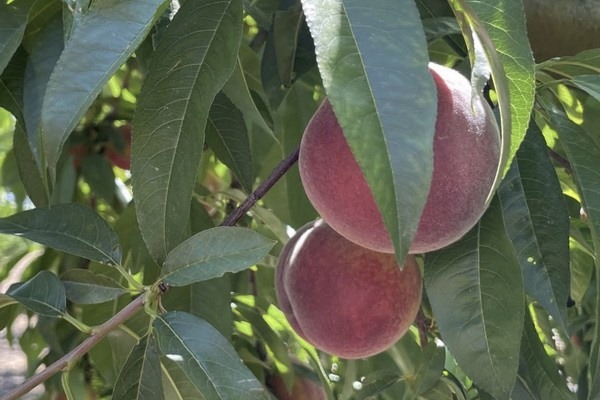 © HMC Farms
Remaining stone fruit varieties
Following the start of peaches, nectarines are expected to begin about seven days later and historically, plums start about 10 days after nectarines. However this year McClarty is waiting and seeing given there are new genetics available this year and between that and the early start, it's also into unprecedented territory.
Over on cherries, the effect of the rains really depended on location. California's cherry-growing regions span a wide stretch of the Central Valley, and the topography varies quite a bit depending on where a grower is located.
"Across the state, rainfall ranged from as little as a tenth of an inch in some areas to around two inches in others, over what was roughly a four- to five-day system," says Joe Cataldo of J&M Farms and Delta Packing Co. "In certain regions, storms came through aggressively—with strong winds and even hail, including larger hail in some pockets—while other areas experienced lighter, intermittent showers or stayed relatively dry. It was a highly variable weather event across the state."
Watching for the rains effects
While any untimely rain during cherry season brings concerns, some of the effects are starting to be seen though so far they appear to be fairly isolated to the hardest-hit areas.
In the northern districts, many orchards were less susceptible simply because of where they were in their maturity stage. However, like with stone fruit, this season has been accelerated due to higher heat accumulation, so some earlier varieties were more exposed than they normally would be at this time. "Even so, the damage we're seeing has been minimal, mostly variety-specific, and not significant enough to materially impact the overall crop."
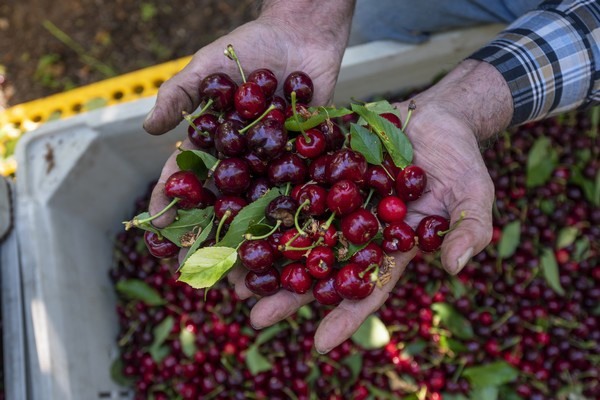 © California Cherries
Meanwhile in the southern districts, rainfall totals were generally lighter, though there has been some minor cracking and splitting though that appears to be limited.
"There are a few isolated cases where certain pollinators—like Brooks and some Royal varieties—may have taken a hit, but broadly speaking, the crop came through in good shape," Cataldo says. "The recent cool weather may have pushed timing back by a few days, but that actually allows the fruit more time to size and mature on the tree."
Rains early next week
As for next week's expected rains, he does note that growers may be close to their limit in terms of how much weather the crop can handle.
"It looks like the northern portion of the state could see the most impact, and that's where the concern starts to increase. A lot of the fruit is now much more susceptible to rain damage, based on its maturity. On top of that, certain cultural practices in the orchard can make the fruit even more vulnerable to issues like cracking if we get additional rain," he says. "So this storm poses more of a real threat and is something we're watching closely. That said, if we can get through this next event without significant damage, we'll be in a good position moving forward."
For more information:
Jon McClarty
HMC Farms
Tel: +1 (559) 897-1025
www.hmcfarms.com
Joe Cataldo
J&M Farms/Delta Packing
https://www.deltapacking.com/