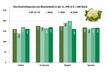
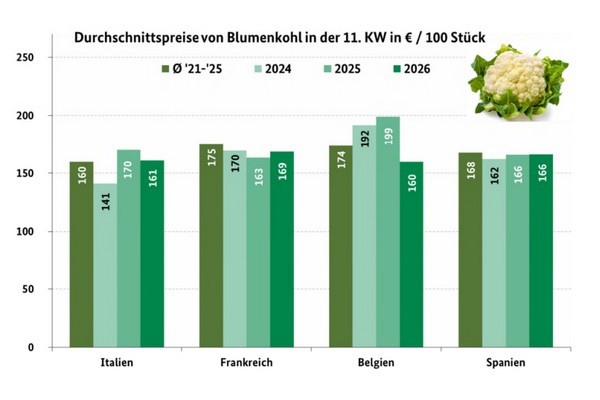
Cauliflower shipments from Italy dominated the market, with French shipments coming in second in terms of volume. In Frankfurt and Munich, Spanish shipments also appeared. Hamburg reported some Belgian products, which, according to the German BLE, were sold at relatively low prices, thereby putting pressure on the competition.
 © BLE
© BLE
In Frankfurt, customers had to dig deeper into their pockets over the course of the week due to strong demand for French and Spanish loads. In Munich, Italian loads showed inconsistent quality, which widened the price range in both directions. Overall, however, traders here were able to raise their asking prices slightly, provided the quality of the produce was satisfactory. In Berlin, too, prices rose slightly to around 10 to 12 EUR per 6-pack despite supply meeting demand.
Click here to go directly to the full market and price report.
Apples
Domestic Jonagold, Boskoop, Braeburn, and Elstar dominated the wide-ranging assortment. Gala, Santana, and Cox Orange had been phased out of the market. Higher purchase prices were passed on to customers in Hamburg, which inevitably led to price increases.
Pears
Italian arrivals still predominated but lost overall significance as South African imports increased and gained market influence. The first Chilean Abate Fetel arrived on Friday, rounding out the market activity. Turkish Santa Maria and Deveci varieties were slowly but surely winding down.
Table Grapes
South African imports dominated the market. Imports from Namibia supplemented the supply with small quantities and were already being phased out of the market in some cases. Shipments from Peru and Chile rounded out the product range. Business remained very quiet.
Oranges
The end of the season is in sight: A certain degree of customer saturation was just as evident as limited availability. Supply was constrained for both oranges and blood oranges, while quality issues intensified.
Small-fruited citrus
Here, too, the season was in its final stretch. Spanish mandarins dominated over Israeli, Turkish, and Moroccan varieties. Demand was limited, as were deliveries. Stocks could generally be avoided, though traders occasionally had to lower their previous asking prices to do so.
Lemons
Spanish Primofiori lemons predominated and were available almost exclusively in some areas. Price increases were possible, though only to a limited extent. The assortment was supplemented by Turkish imports as well as Italian loads with leaves.
Bananas
Business was mixed. In Munich, demand was limited, though this did not fundamentally affect prices. The top grade even saw a slight price increase here. In Hamburg, accommodation options improved; however, an excessive supply in the Hanseatic city prevented prices from rising.
Lettuce
Sales of Spanish iceberg lettuce were unremarkable. Cabbage lettuce came from Belgium, France, and Italy. Domestic supplies supplemented the market; they met quality standards and were therefore sold quickly. This was also observed with mixed lettuce, which came mainly from France and Belgium.
Cucumbers
While Spanish shipments appeared to decline, supplies from the Netherlands, Belgium, and domestic sources increased. Demand rose but was generally met without difficulty. Often, demand did not keep pace with the increased supply, so retailers were frequently forced to lower their previous price targets.
Tomatoes
Spanish, Dutch, and Belgian shipments formed the basis of the assortment, supplemented by Turkish and Italian supplies. Imports from Egypt, Morocco, and Tunisia were also available. Increased transport expenses were passed on to customers. Prices thus rose noticeably, which subsequently slowed sales significantly.
Bell peppers
Spanish loads dominated, but their availability was limited. Dutch and Belgian loads, on the other hand, gained slightly in importance. Supply was limited and was not consistently sufficient to meet demand. Prices rose, in some cases quite significantly.
Source: BLE