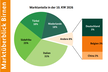
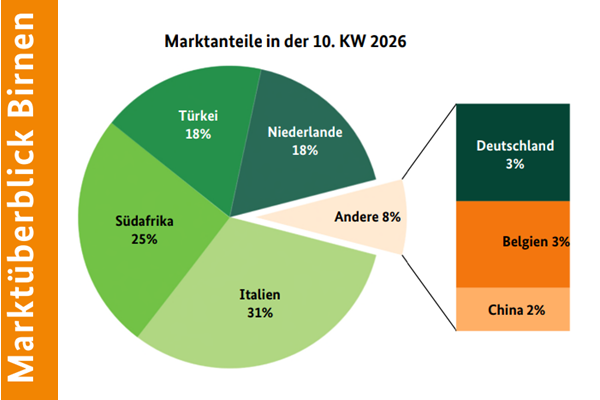
The South African season slowly picked up speed as imports gained noticeable momentum. In addition to Williams Christ, Cheeky and Rosemarie were also increasingly available. The fruit was now being handled in various packaging types, such as 6.3 kg, 12.5 kg, or 10×800 g cartons. The quality was generally impressive, so business proceeded relatively calmly. The intensified South African supplies had an impact on the prices of European and Turkish offers: with greater availability, they often slipped in price. Italian loads still played the leading role in the form of Abate Fetel, Santa Maria, and Williams Christ. Turkey mainly supplied Santa Maria and, to a lesser extent, Deveci. Dutch, Belgian, and domestic loads only played a supplementary role. Nashis from China also only arrived in Berlin and did not go beyond a complementary status.
 © BLE
© BLE
Click here to go directly to the full market and price report.
Apples
Domestic products continued to dominate the scene. Most of the offers delivered came from France and Italy. The range was supplemented by Dutch, Belgian, and Polish shipments. Demand was quite favorable but could be met without difficulty.
Table grapes
South African imports clearly dominated. Deliveries from Namibia and Peru were merely supplementary. The quality was generally good. However, availability was far too high: although demand was certainly there due to the spring-like weather, it could not keep pace with the increased deliveries.
Oranges
The season was entering its final stages: deliveries were limited, the quality was no longer consistently impressive, and a certain degree of customer saturation could no longer be denied. Buyers turned their attention to other types of produce, so that reduced availability was sufficient to meet demand.
Small citrus fruits
The campaign was coming to an end. A few Spanish mandarins were flanked by Israeli, Turkish, and Moroccan imports. In addition, there were a few Egyptian and Italian supplies, but these played only a minor role.
Lemons
Spanish Primofiori dominated and were available in some places on a monopolistic basis. Demand was easily met. Prices generally remained at the previous level. Only Frankfurt reported price increases.
Bananas
In Munich, prices rose as a result of improved storage facilities. In Hamburg, on the other hand, second-grade brands became cheaper. In Frankfurt, third-party brands imported via the Netherlands appeared, which were already overripe.
Cauliflower
The range consisted of Italian, French, and Spanish deliveries. Demand was not particularly strong and had declined in some areas as a result of the spring-like weather. Needs were easily met. Prices tended to fall overall.
Lettuce
Only Spanish iceberg lettuce was available; the few Greek deliveries from the previous week had already disappeared from the market. The quality was not consistently convincing, which is why a fairly wide price range was established in some places. Colorful lettuce came from France and Italy.
Cucumbers
Spanish cucumber varieties still dominated overall, but their availability was limited. In contrast, deliveries from the Netherlands and Belgium apparently increased. German products also played a more important role than recently. The more extensive supply inevitably had an impact on prices.
Tomatoes
The range consisted primarily of Spanish, Dutch, and Belgian supplies. Imports from Turkey, Italy, and Morocco played a minor role. Loads from Egypt and Germany supplemented the range. Exclusive items were in short supply and therefore became pricier. Customers in Frankfurt also had to dig deeper into their pockets for vine tomatoes in general.
Bell peppers
Spanish and Turkish loads dominated the market, with Egyptian, Moroccan, Israeli, and Belgian loads rounding off the range in small quantities. Spanish offers often became more expensive as a result of limited deliveries or increased purchase prices.