With the harvest of the first mini cucumbers in week 9, followed a week later by the first regular cucumbers, the starting signal was given for this year's season in Nuremberg's Knoblauchsland region. "The gloomy winter weather in January and February slowed down crop growth accordingly. However, the weather is currently very nice, so we assume that harvest volumes will be roughly on par with last year's levels for the moment. Meanwhile, entry prices are around 10 percent above last year's levels, although they are now trending downward again in line with rising supply volumes," reports Christian Drechsler, vegetable farmer in Nuremberg and member of Franken-Gemüse eG.
 © Drechsler Gartenbau
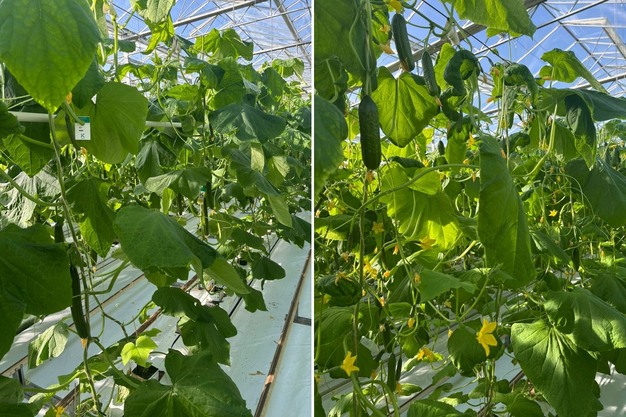
A look inside the cucumber greenhouse. The quality has been consistently good so far.
Drechsler is now the fifth generation to run the family business of the same name, with locations in Nuremberg and Abenberg. For a good quarter of a century, the family of farmers has been dedicated to growing fruit vegetables in greenhouses. Tomatoes account for the largest share of cultivation capacity with around five hectares, followed by cucumbers (2 hectares) and eggplants (1 hectare). "In addition to standard cucumbers, we also produce mini cucumbers. We have expanded our cultivation capacity for the latter from 0.2 to around 0.5 hectares, as experience has shown that it is more difficult to offset the high labor costs in the market price for cucumbers. Here, we are in direct competition with imported goods from low-wage countries." The company is expected to start supplying its first promotions to food retailers in week 12.
 © Drechsler Gartenbau
Cucumbers are grown as a classic high-wire crop in three sets. The last produce is usually harvested in the second half of October. Since last year, insect nets have been used in addition to beneficial insects to eliminate lice and bugs.
Early start to the tomato harvest
In addition to vine and cocktail tomatoes, the tomato department also offers snack and cherry tomatoes. The first tomatoes are typically harvested from week 14 onwards. Drechsler: "In contrast to cucumbers, we deliberately focus on an early start to the season for tomatoes. Due to the early planting dates from mid-December, we usually start 1–2 weeks earlier than most of our colleagues in Knoblauchsland." At the marketing level, the grower expects a normal start to the season for now. "I see the situation with tomatoes as quite relaxed: there are currently no surpluses and prices are stable across the board, and we hope that this will not change in the coming weeks."
In the long term, some interesting trends are emerging in the tomato category, Drechsler continues. "We are noticing that unusual varieties are tending to gain in importance, while the classic vine tomato is losing some ground. We are well equipped for the future with our special crops, such as yellow cherry tomatoes and snack tomatoes in several colors. In the case of the latter product, the traffic light mix of red, yellow, and orange tomatoes in a 300g pack is now a permanent fixture for many food retail customers."
 © Drechsler Gartenbau
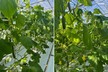
Insight into the tomato greenhouse
Entry into eggplant cultivation
In 2017, the horticultural business acquired a second location in Abenberg. "Here, we primarily tried our luck with pepper cultivation. However, an extremely weak marketing year thwarted our plans, which is why we did not continue with this product line. Instead, we have been growing eggplants for four years now. We deliberately decided to plant later, from week 4 onwards, as it is a light- and heat-loving crop." The regional eggplant has now become well established with consumers and is also valued by retailers. "We can score points here with good quality and stand out from imported goods due to the short transport distances and longer shelf life. Despite the high maintenance required for cultivation, we have found a good market niche here."
 © Drechsler Gartenbau
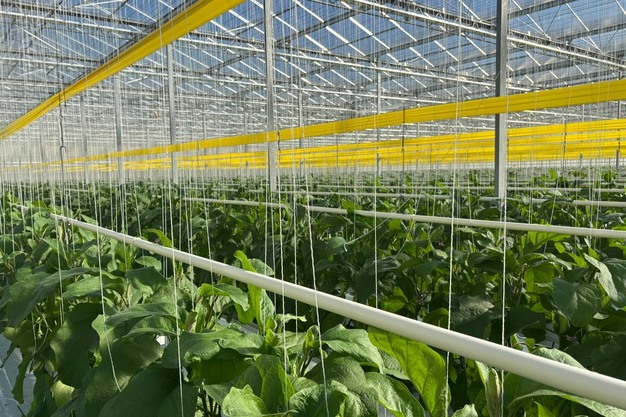
Insight into eggplant cultivation. Here, too, the harvest is about to begin. Harvesting usually continues until the beginning of November.
Ever-present challenges
Although the majority of the yield is delivered to food retailers via Franken-Gemüse eG, the Drechsler company still operates a seasonal stall at the local wholesale market in Nuremberg. "Here we serve a broad spectrum of customers in the catering, specialist retail, and wholesale sectors. Sales have been largely stable in recent years." Overall, he is looking ahead with confidence: "The future will undoubtedly be challenging for us vegetable growers, not least because of rising costs. We will have to adapt to the circumstances," he concludes.
For more information:
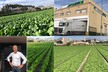
Christian Drechsler © Drechsler Gartenbau
Drechsler Gartenbau
Almoshofer Hauptstraße 111
90427 Nuremberg
Tel: 0911 37474037
[email protected]
www.drechsler-gartenbau.de