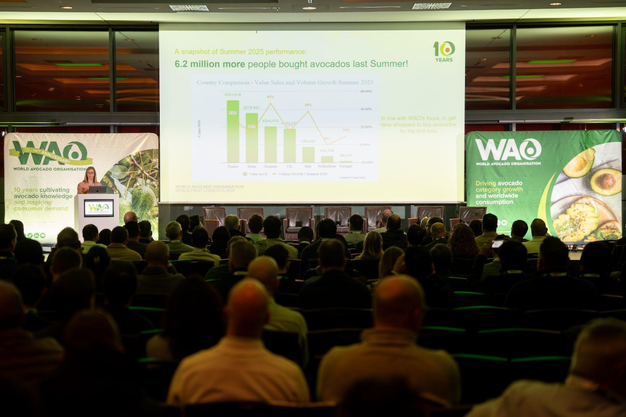
In 2026, the World Avocado Organization (WAO) celebrated its 10th anniversary at Fruit Logistica in Berlin. Within those 10 years, the avocado changed dimension, moving from the status of a fast-growing product to a genuine global specialty. "The evolution of the global market has been remarkable. What started as a rapid expansion has turned into a more structured product category, strategically managed and fully integrated internationally," analyzes Zac Bard, president of WAO. This change of scale is reflected in unprecedented figures and increased professionalism throughout the sector.
 © WAO
© WAO
A decade of spectacular growth in Europe
The increase in global consumption has been particularly visible in Europe. In 2025, in the 27 countries of the European Union, average per capita consumption reached 1.8 kg per year, double the 0.9 kg recorded in 2016. "Last year, Europe and the UK saw total volumes exceed one million tons for the first time, with overall annual growth of 16% and a 22% increase during the summer season. This demonstrates not only wider adoption, but also increased consumer engagement," explains Zac Bard.
Germany is one of the major drivers of this dynamic: +32% in volumes and +24% in value by 2025. This growth is being driven both by the arrival of new consumers and by an increase in the frequency of purchases. Italy and Eastern Europe now account for 33% of EU27+ consumption. While France and Spain are more mature markets, the UK, Germany, Italy, Poland, and the Netherlands continue to show strong potential. "While we believe there is still potential in the more mature markets, there are also significant opportunities in the major emerging markets."
From occasional product to everyday staple
In the space of ten years, avocados have undergone a profound change in status in the minds of European consumers. "A decade ago, it was seen as an occasional or 'trendy' product. Today, it is firmly established as an everyday fruit and an essential ingredient in healthy diets."
A WAO survey of more than 500,000 consumers in 11 European markets identifies three growth drivers: awareness of nutritional benefits, culinary versatility, and improved year-round availability. In France, 77% of households now buy avocados at least once a year. However, households under 35 years of age remain under-represented, revealing further potential for development.
Uses have diversified as well. "Beyond salads, guacamole and avocado toast, consumers are increasingly using avocados as an alternative ingredient," explains Zac Bard. "Thanks to its creamy texture, it replaces mayonnaise, cheese, or cream in classic and modern recipes." Oils, avocado-based mayonnaises, alternatives to dairy products, and snacks are also making headway. "Social networks now list over 40 different ways of enjoying avocados, with new variations appearing all the time."
Sustainability: between perception and reality
"While consumers are paying increasing attention to sustainability, price and quality are still the priorities. However, the sector has made significant progress in reducing its environmental impact," explains the president of WAO.
The avocado's carbon footprint is comparable to that of other fruits and significantly lower than that of meat or cheese. Avocado trees contribute to carbon sequestration and biodiversity. On the sensitive subject of water, Zac Bard adds that "put in context, growing avocados requires less water than many staple foods. Member farms are continually improving their efficiency through precision irrigation and digital monitoring, with reductions of up to 43%."
The diversification of origins - Peru, South Africa, Morocco, Colombia, Kenya, Chile, and Zimbabwe - strengthens resilience and year-round availability. As for sea freight, the majority of which goes to Europe, "it has much lower emissions than air freight."
A structuring role for WAO
Since its creation, WAO has acted as a catalyst for collaboration between producers, exporters, and importers. "We have played a central role in aligning the players of the sector to meet changing consumer expectations and in demystifying unfounded attacks suggesting that avocados are harmful to the environment."
In addition to promotion, the organization encourages the sharing of knowledge, the adoption of technological innovations, and the diversification of emerging origins. "This approach is helping to build a stronger, more coordinated and forward-looking sector."
2030: even more stimulating growth
Looking ahead to 2030, Zac Bard is confident. "We foresee even more stimulating developments over the next five years than over the last ten." The European market could exceed 1.5 million tons. The gap with the United States is set to narrow.
New origins - Guatemala, Ecuador, Tanzania, Rwanda, Portugal, and Angola - will join the market, while Asia will become a major consumer, with India, South Korea, and potentially China and Japan. Eastern Europe and the Middle East will also see sustained growth.
But the priority remains clear. "The future of the sector lies not in growth alone, but in responsible and sustainable growth that generates long-term value for producers, consumers, and communities."