Shine Muscat, once positioned as a premium holiday grape in South Korea, has seen a sharp price decline ahead of the Lunar New Year. The downturn is affecting growers in North Gyeongsang, where the variety expanded rapidly over the past decade.
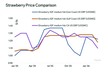
At the Andong Agricultural and Marine Products Wholesale Market, a 2-kilogram box of top-grade Shine Muscat sold for an average of 4,200 won on Feb. 11, equivalent to approximately US$3.15. The highest price recorded was 5,000 won, or about US$3.75, and the lowest was 3,300 won, or roughly US$2.48. A week earlier, the average stood at 4,500 won. On Jan. 10, it was 5,628 won. Compared with previous years, the drop is pronounced. On Feb. 10, 2022, the average auction price reached 29,100 won. On Feb. 8, 2021, it was 23,300 won. Current levels represent a decline of more than 80 per cent compared with those years.
Oversupply is cited as the main driver. Shine Muscat now accounts for about 60 per cent of total grape cultivation area in North Gyeongsang, equivalent to 4,829 hectares. The variety gained popularity for its sweetness compared to conventional grapes, such as Campbell Early, and for being consumed without peeling or seed removal.
However, rapid area expansion and early harvesting practices have affected market perception. Some fruit was reportedly shipped before reaching full sweetness, weakening repeat demand.
"Over the past decade, many farmers rushed into growing Shine Muscat after hearing it was profitable," said Kim In-seok, a Shine Muscat farmer in Gimcheon. "In recent years, some harvested and sold grapes before they were fully sweet in order to ship earlier than others. As disappointment built up, consumers may have turned away from Shine Muscat."
The North Gyeongsang Agricultural Research and Extension Services has urged growers to meet quality benchmarks, requesting shipments only when sugar content reaches at least 18 Brix.
At the provincial level, calls have been made for stricter quality management and diversification. "Farmers who could not even recover production costs are cutting down carefully cultivated trees with chain saws in despair," said Nam Young-sook during a session of the North Gyeongsang Provincial Council. "We must introduce a provincial certification system alongside strict quality control."
"Products that do not meet sugar content standards or exceed weight limits should have their shipments restricted," Nam added. "Only high-quality products that pass the standards should receive the governor's certification mark to restore consumer trust."
Further proposals include diversifying export markets, developing processed products, and supporting growers who switch to varieties such as Red Claret and Glorista to reduce reliance on a single cultivar.
Source: Korea JoongAng Daily