In 2016, at age 24, Yamir Ramos founded Joya Fruits, which aims to export 230 containers of mango in the 2025/2026 season. The company also regularly exports avocados and other products from Peru's agro-export sector. Currently, Ramos manages a team of 11 young professionals, emphasizing quality service: "What the market always defends is quality. It is the only way to sustain and grow in this highly competitive sector."
Joya Fruits, part of the Ramos Group, integrates its production with small and medium growers, emphasizing social sustainability. Ramos states, "We are not only looking for profitability; we want economic growth to translate into rural development, inclusion and good practices."
 © Joya Fruits
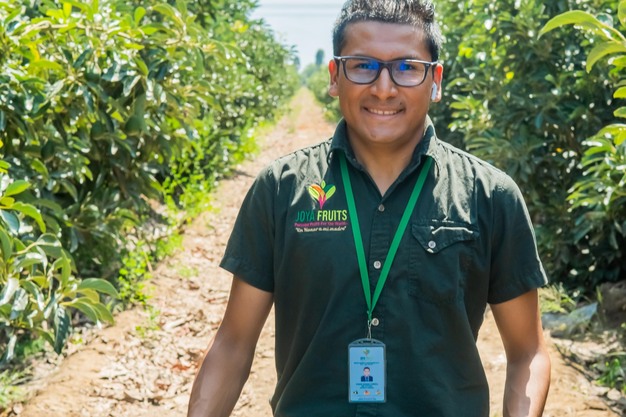
Yamir Ramos, CEO of Joya Fruits.
Avocado: Unlocking the full potential of the crop
Joya Fruits grows Hass avocados and some greenskin volumes on 50 hectares in Chincha, primarily targeting European markets such as the Netherlands and Spain. In 2024, the company exported 82 containers, although small fruit sizes and low prices impacted the results. Ramos notes, "For 2025, we adopted a more cautious approach. We only exported produce from our own farm, totaling 33 containers. The market remained very uncertain in February and March."
Looking ahead to 2026, the businessman anticipates a significant challenge: potential overproduction of avocados in Peru. In response, Joya Fruits has developed a model to repurpose fruit that fails to meet export standards. "Around 25% of the production is not exported. However, we aim to add value to all our fruit: 11% is directed to the frozen market, 9% to avocado oil production, 5% is sold locally, and only 2% is discarded," he states.
Kent mango: Sustained growth in the U.S.
The Kent mango is the company's main product. However, it doesn't produce it on its own farms. Instead, it relies on leased farms and partnerships with small and medium-sized growers. In the 2024-2025 season, Joya Fruits managed 85 hectares and exported 74 containers. "It was a season with several challenges: overproduction, water shortages for the last pre-harvest irrigation, a shortage of cardboard boxes for packing the fruit, and logistical hurdles with container availability and shipping spaces," Ramos stated. This season, the company aims to export more than 200 containers, with 90% to the U.S., 8% to Europe, and 2% to the Middle East.
The marketing window spans from week 46 to week 15. Although a small portion of mangoes arrives in Europe, competing with Brazilian mangoes in December is challenging. "We prefer to focus on where we have an advantage: the United States," he stated.
Product diversification and challenges associated with ginger.
In addition to avocado and mango, Joya Fruits markets approximately 40 containers of other products each year. One of these is ginger, which has faced significant issues. "Ralstonia, a bacterium that severely impacts quality, complicated the season. Additionally, there is intense competition from Brazil and China, offering very low prices," Ramos said. Beyond health and market challenges, he points out a contradiction: "In Europe, small growers sell 'organic' ginger, but many engage in unsustainable farming practices. They clear new forested land each year, degrading the soil. This is hypocritical: they label it organic while damaging the forest." He believes only larger companies practice genuinely sustainable ginger farming, using technical methods that allow for ongoing land reuse without causing degradation.
In addition, Joya Fruits is expanding into new product lines like W. Murcott mandarin, Murcott mandarin, Valencia orange, lime, fresh asparagus, and table grapes, with initial shipments to the Netherlands. "However, fruits such as lime and orange have faced challenges due to fierce price competition, particularly from Colombia," he stated.
International presence
In addition to the United States and Europe, Joya Fruits is exploring markets in Asia, including China, South Korea, Japan, Taiwan, and Singapore. They have begun building relationships there following their participation in international fairs. "We also exported to the United Arab Emirates and Oman in the past, but we reduced these shipments due to payment issues. We prefer to develop long-term relationships with reliable customers and avoid having an overly large customer base," Ramos said.
Joya Fruits has been actively engaged in international trade fairs since 2018. In 2023, the company expanded its presence by establishing its own booth in collaboration with BioXTEND, a company specializing in ethylene absorbent filters, and has already participated in prominent events, including Fruit Logistica (Berlin), Fruit Attraction (Madrid), and Asia Fruit Logistica (Hong Kong). It also has plans to attend the PMA in Florida in 2026.
Consistent quality across different sources
Ramos highlights that one of Joya Fruits' key strengths is maintaining consistent quality, even when sourcing fruit from various farms. "Our quality control team consists of three remarkable women: Shirley, Darian, and Merli. They are highly detail-oriented, and because of them, we ensure a uniform standard from the first to the last container shipped each season," he stated. Their internal quality measures include systematic reporting, which, according to their customers, has become a source of trust. "Naturally, we hold all necessary international certifications," he added.
Business resilience in response to logistics, climate, and political challenges
Ramos states that the logistics situation in Peru is getting better. "The new port of Pisco is already in use, and the port of Chancay, which will be important for Asia, is developing smoothly. Additionally, ports in the north like Paita and Salaverry are expanding, decreasing reliance on Callao," he stated.
The years 2023 and 2024 have been challenging climatically, with cyclones, irregular blooms, and small-sized crops impacting production. Despite the country's political instability, Ramos stays optimistic: "The Peruvian agro-export sector seems to operate on autopilot. It continues to thrive thanks to significant private investments and numerous irrigation and expansion initiatives. In addition, large companies are moving into non-traditional crops such as cherries, pitahaya, and berries, further diversifying the national agricultural sector."
Breaking the middleman chain
Yamir Ramos is especially passionate about combating informality and supporting small producers. "Five to eight years ago, 90% of our purchases involved intermediaries. Now, 80% are made directly with the producers. We have successfully broken that chain," he states with pride.
He criticizes middlemen for controlling supply in remote Peruvian highlands like Ayacucho, Arequipa, and Huancavelica, paying growers low prices and earning high margins without risks. "The producer gets less value for his fruit due to irregular marketing between the producer, intermediaries, and exporter."
Joya Fruits' approach has been to engage with growers, provide them with knowledge about marketing channels, financial planning, and profitability, and encourage them to enhance their practices. "We want them to understand the business and market dynamics. That empowers them," he said.
A hopeful outlook for the coming years
Grupo Ramos is planning a sustainable, equitable growth strategy for the coming years. This includes collaborative marketing projects with growers and existing clients in Europe and North America. These regions have contributed to the company's consistent growth and consolidation in the fresh fruit industry. "We are very grateful to these companies for their support and trust in the industry," Ramos said. He also plans to develop his own fresh packing house in a joint venture with national and international companies.
In 2025, despite a challenging year for traditional export marketing, Ramos expanded into the U.S. market by establishing a subsidiary there, enabling direct sales, securing financial leverage, and simplifying triangular business operations.
For more information:
Yamir Ramos (CEO)
Joya Fruits
C/ Martín de Murúa 150, Of. 506
San Miguel, Lima (Peru)
Tel: +51 991 472 883
Email: [email protected]
www.joyafruits.com