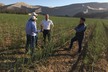
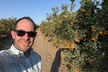
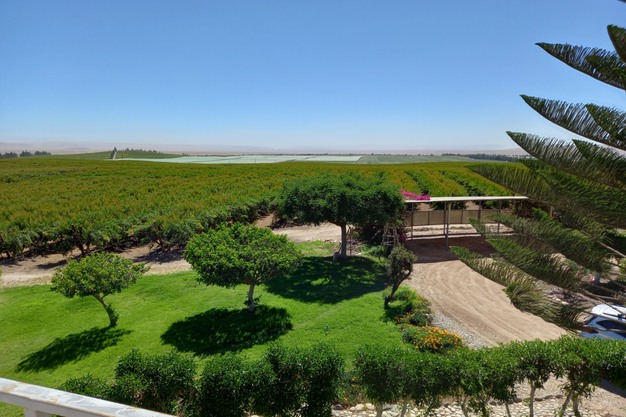
Agrícola Pampa Baja operates in a desert region where water must be sourced from over 100 kilometers away. Despite this challenge, they have developed a highly diverse and competitive agricultural model to access international markets, including Europe, the U.S., and Asia, during key trading periods. Located on 1,300 hectares in Majes, southern Peru, the company has been producing avocados, table grapes, pomegranates, mandarin oranges, and, more recently, blueberries for over 25 years.
Agrícola Pampa Baja operates within an agricultural hub, relying on an irrigation system that draws water from the Condoroma dam. CEO Claudio Albarracín states, "We are the only large commercial-scale company in the area." The irrigation project primarily supplies small-scale growers with plots averaging around five hectares. This setup offers certain advantages, such as access to advanced infrastructure, but also presents challenges, including operating in an environment with limited farming tradition, which makes finding specialized personnel more difficult.
 © FreshPlaza
For over 25 years, Agrícola Pampa Baja has grown avocados, table grapes, pomegranates, and mandarins on its 1,300-hectare property in Majes, southern Peru. In the past three years, they have started cultivating blueberries.
The portfolio features six main fruit and vegetable crops with international reach. The top crop is Hass avocado, followed by table grapes, blueberries, mandarins, pomegranates, and sweet onions.
Avocado: Consistent leadership
Hass avocado is a key product for Pampa Baja, with nearly 1,000 containers annually from Olmos (Lambayeque) and Majes (Arequipa). "Olmos produces early avocados and Majes late ones, helping us avoid the national peak in June-July," stated Fanny Robles, the company's commercial manager. This strategy helps Agricola Pampa Baja secure better prices on the international market.
The climate in Majes supports larger sizes: 12-18 compared to 18-26 in Olmos. "Our yields in Olmos can reach 26 to 29 tons per hectare. We are ahead of many competitors," Robles added.
Pampa Baja primarily exports avocados to Europe, with additional shipments to Asia, the U.S., and Chile, with shipments to Chile increasing due to the logistical benefits of under-48-hour delivery. Robles noted that the U.S. market share remains low due to competition from Mexico and California, while Asian markets, which currently account for 15% of exports, are increasing as ProHass promotes Peruvian avocados in China.
 © Agrícola Pampa Baja SAC
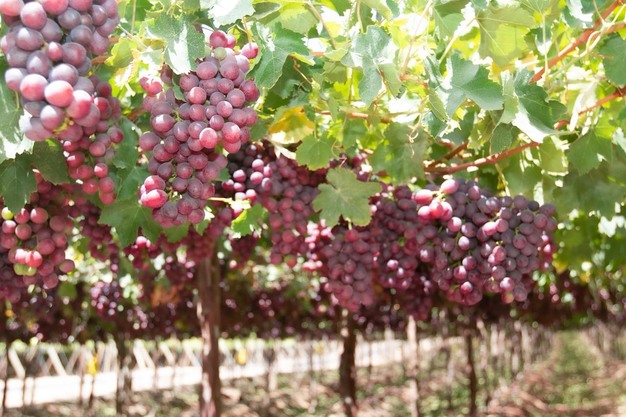
Table grapes of the Timco variety.
Table grapes
Table grapes are another key pillar of production. They are grown exclusively in Majes, with an estimated 830 containers, approximately 1.65 million boxes. All varieties are seedless and licensed, including Allison, Timco, Autumncrisp, Ivory, Sweet Globe, and Melody, among others. Green grapes account for 60% of production, red grapes for 35%, and black grapes for the remaining 5%. "We export 75% to the United States, then Europe, and a little to Asia," Robles comments.
"Asia accounts for just 15% of grape shipments, mainly due to competition from China's local production. Varieties such as Shine Muscat are more affordable and widely available across several Southeast Asian markets, where they are offered at competitive prices. Despite this, some importers particularly favor Peruvian grapes, especially green ones. Our main Asian markets are Japan, Korea, and Taiwan, which require both green and red grapes," the commercial manager explains.
Blueberry: A promising but demanding crop
Blueberries still account for a smaller portion, with an estimated 35 containers. Despite a decline in sales price over the past three years, this berry remains an attractive investment. Pampa Baja grows the Madeira, Manila (Planasa), and Sekoya Pop varieties, with harvests from late May to early December. "The climate in Majes, which is cooler and experiences a wide temperature fluctuation between day and night, benefits the blueberries' bloom, flavor, and crunchiness," stated Albarracín. Nonetheless, expansion plans are under consideration: "Specialized labor is scarce, and the risk of oversupply in the international market is a variable that we are monitoring," he added.
 © Agrícola Pampa Baja SAC
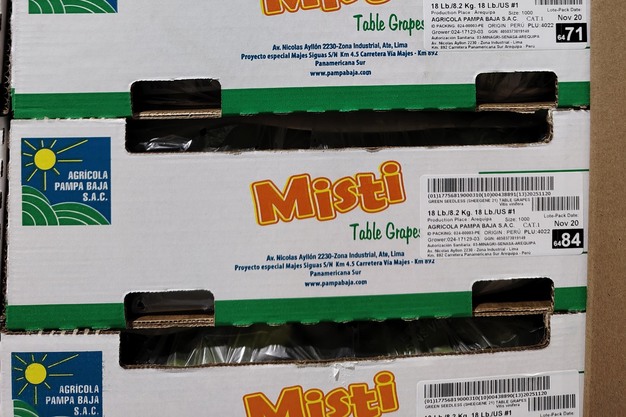
Agrícola Pampa Baja mainly markets its table grapes and other fruits and vegetables abroad under the Misti brand.
Mandarins: Changes and lessons learned
The company has revised its citrus strategy, ceasing cultivation of W. Murcott to focus on the Orri variety. "It is harvested from late August to early October, offering an excellent window for arrivals in European and Canadian markets," Robles stated.
Pomegranate and sweet onion: Products with a window and margin
Pampa Baja's agricultural season begins with the harvest of the Wonderful pomegranate variety from late February to April. The company plans to export around 150 containers of this fruit next season, mainly to Europe, where demand for the early Peruvian harvest has been growing. "At the Fruit Attraction fair, there was significant interest. It's a profitable fruit due to limited supply at present," Robles noted.
The Granex sweet onion is a rotational crop, planted in response to market demand and rotated with other vegetables such as paprika. Its export season is in December, mainly to Spain and the United States.
Technology and packaging at the service of the calendar
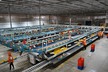
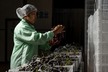
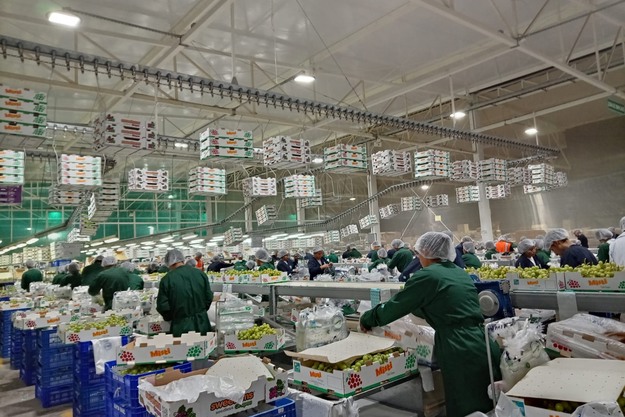
Thanks to effective crop planning, Pampa Baja harvests almost year-round: pomegranates from February to April, mandarins from August to October, blueberries from May to December, avocados from August to October, table grapes from November to January, and onions in December. This steady production enables the packing house to operate smoothly and efficiently. "We pack and ship promptly, which helps preserve freshness and lowers logistical costs," says Albarracín. Additionally, they offer third-party packing services during their off-peak periods.
 © Agrícola Pampa Baja SAC
We pack and ship quickly. That maintains freshness and lowers logistics costs," says Albarracín.
The up to 20 °C temperature difference between day and night in Majes, located 1,200 metres above sea level, directly affects the colour and taste of table grapes, blueberries, pomegranates, and mandarins. For instance, table grapes can reach Brix levels of up to 20º and acidity of 0.65-0.90 g/100 ml, which improves their shelf life. "With these quality traits, our blueberries and grapes can endure more days in transit without losing firmness or flavor," Robles stated.
"In addition, the Majes region faces lower climatic risks because it is less impacted by phenomena like El Niño and heavy rains compared to the northern parts of the country, such as Yaku. Additionally, the phytosanitary risk in Majes is relatively low when compared to more humid northern regions," he added.
Manpower: The key resource for growth.
The primary bottleneck isn't water or land but manpower. "There is no agricultural specialization in Majes. We need to train workers or recruit from the north," Albarracín said. This poses a significant challenge, especially for labor-intensive crops like grapes and blueberries. Currently, the company plans to expand into less labor-intensive crops such as avocados and pomegranates. "We are assessing our available land in Majes and Olmos to explore different growth options," he stated. He also mentioned they were considering a test plot for low-chill cherries, which would harvest between September and October, filling a gap in the international market.
 © Agrícola Pampa Baja SAC
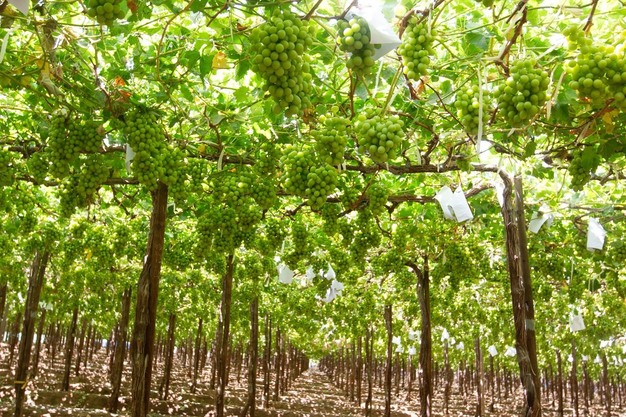
Autumncrisp table grapes.
In addition to fruit production, Pampa Baja has the largest dairy herd in the country, with over 8,000 heads, 4,000 of which are milking cows, producing an average of 45 liters per cow per day. "This stabilizes income and gives us greater resilience and diversification in the face of agricultural volatility," Albarracín emphasizes.
Economic impact and business vision
"Pampa Baja has been around for 25 years. It was founded by Octavio Paredes, whom I regard as a "hero" for transforming a desert into a thriving agricultural area that now creates jobs for thousands of people. Pampa Baja's growth has driven the region's economic and population development, and, thanks to a sustainable business model based on crop diversification, the company can harvest, pack, and export year-round, ensuring sustained employment," Albarracín concluded.

For more information:
Fanny Robles (commercial manager)
Agrícola Pampa Baja SAC
04110 Majes (Arequipa) - Peru
Tel: +51 910 615 673
Email: [email protected]
www.pampabaja.com